
Evolving Social Asymmetry: How Adaptive Networks Save Cooperation
Evolving the Asymmetry of the Prisoner’s Dilemma Game in Adaptive Social Structures
This paper investigates the evolution of cooperation in the Prisoner's Dilemma (PD) within adaptive social structures. It introduces a co-evolutionary model where individuals simultaneously update their strategies and their social ties, demonstrating that netowrk heterogeneity and "symmetry breaking" allow cooperation to survive even in high-connectivity environments.
TL;DR
Why do humans and animals cooperate when being selfish seems more profitable? While static networks struggle to explain cooperation in highly connected societies, this paper reveals that adaptive social ties—the ability to dump "bad" partners and seek "good" ones—naturally create a heterogeneous social structure. This process "breaks the symmetry" of the Prisoner's Dilemma, allowing cooperators to form resilient hubs that successfully wipe out defectors even in dense networks.
The Bottleneck: The Paradox of Connection
In classical Evolutionary Game Theory (EGT), the Prisoner's Dilemma (PD) is the ultimate stress test. Defectors (D) always fare better against Cooperators (C) in a single encounter. While previous research showed that network structure can help (spatial reciprocity), it usually only works if the network is "sparse" (low average connectivity).
In the real world, social networks are messy and often highly connected (high z). In these dense, static environments, defectors can easily infiltrate and exploit any cluster of cooperators. The authors ask: If the structure isn't static, can the evolution of the network itself save cooperation?
The Methodology: Strategy vs. Topology
The authors introduce two critical innovations to the standard PD model:
1. The Distributed Prisoner's Dilemma (DPD) vs. Conventional (CPD)
- CPD: A cooperator pays a fixed cost c for every neighbor. If you have 100 friends, you pay 100*c.
- DPD: A cooperator has a fixed budget c and divides it among all neighbors (c/k).
This distinction is vital. In the DPD, a cooperator with many links (a "hub") doesn't get penalized more for being popular; instead, they become more efficient. This creates Symmetry Breaking: the game's stakes change depending on your position in the social web.
2. Adaptive Rewiring (The "W" Factor)
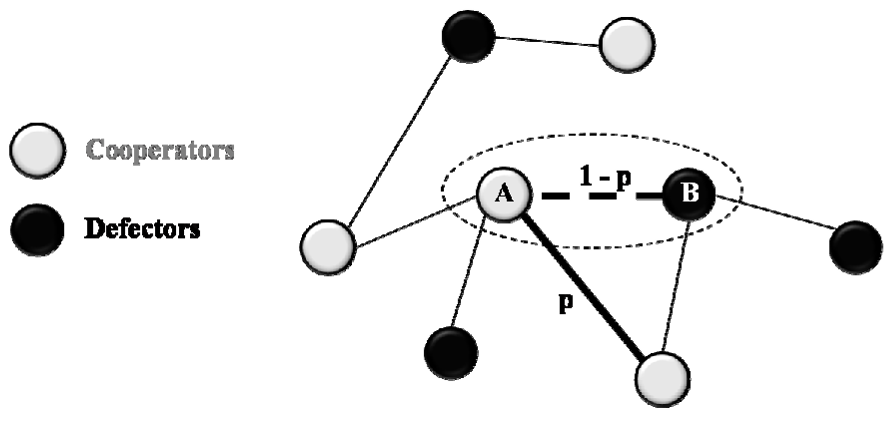
Individuals aren't stuck with their neighbors. If an individual A is linked to a defector B, A is "dissatisfied" and attempts to rewire that link to one of B's neighbors (finding a friend of a friend). The key variable is W, the ratio of the time scale of strategy evolution to structural evolution.
- Low W: People change their minds (strategies) faster than they change their friends.
- High W: People react quickly to bad social ties, rewriting their social circle before defectors can exploit them.
The Results: The "Wave" of Cooperation
The simulations started with Homogeneous Random Graphs (where everyone has the same number of links) and a 50/50 split of Cs and Ds.
The Appearance of W_crit
The researchers found a "tipping point" represented by W_crit. If the speed of network adaptation (W) exceeds this threshold, the population undergoes a phase transition:
- Assortment: Cooperators find each other and stay linked.
- Heterogeneity: The network naturally evolves from a boring homogeneous state into a broad-scale "heterogeneous" network.
- Dominance: Cooperative hubs emerge. These hubs are so stable that they eventually drive defectors to extinction.
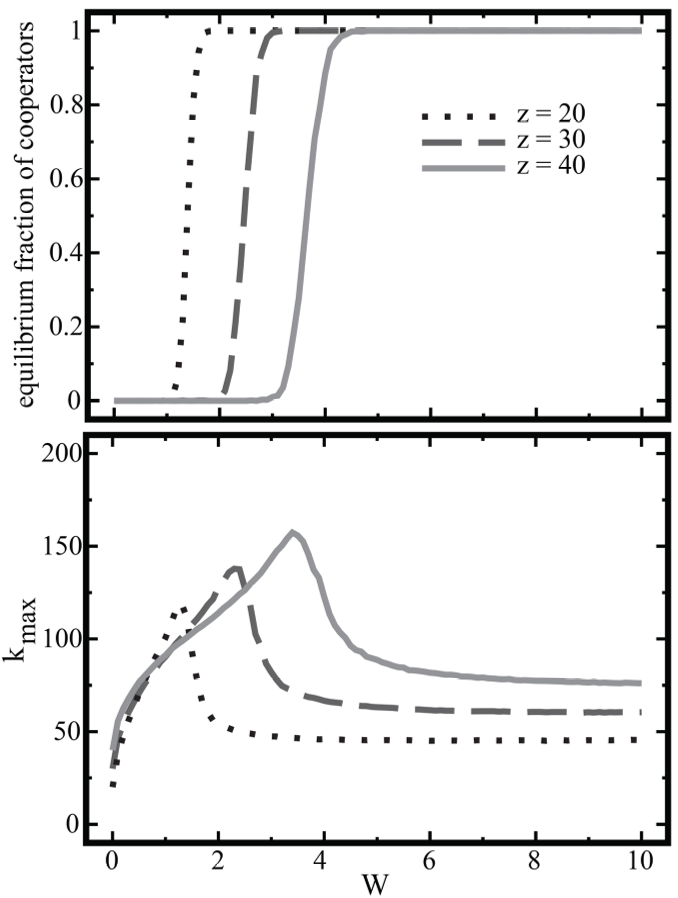
As shown in the figures, as W increases, the Maximum Connectivity (k_max) in the population spikes. The network "invents" its own leaders—cooperative hubs that sustain the entire system.
Deep Insight: Why Scaling Matters
The most profound takeaway is that distributed costs (DPD) benefit the emergence of cooperation more than fixed costs. In DPD, as a cooperative hub grows its connectivity, the cost per game decreases. This makes the "hub" extremely resilient compared to a defector who might have many links but provides no benefit to the network.
The Symmetry Breaking Insight: In a static, equal world (homogeneous), everyone plays the same game. In an adaptive, unequal world (heterogeneous), the "context" of the cooperator changes the math of the game. This diversity of context is precisely what makes cooperation evolutionary viable.
Critical Analysis & Future Outlook
Strengths: The paper provides a bottom-up explanation for why real-world networks are heterogeneous. It's not just "random growth" (like the Barabási-Albert model); it's an evolutionary pressure to foster cooperation.
Limitations:
- The model assumes individuals can perfectly identify the strategy of their neighbors (C or D). In the real world, "noisy" signals or "fake" cooperators would complicate the rewiring process.
- The "connectedness constraint" ensures the graph never splits, which might not hold in all social scenarios where groups can completely ostracize others.
Conclusion: This work moves us toward a more realistic "Social Physics." It suggests that if we want to foster cooperation in a system (be it a decentralized network or a corporate structure), we shouldn't just focus on the "payoffs"—we must focus on the fluidity of the ties. If individuals can quickly disconnect from exploiters, the system will naturally organize itself into a cooperative, stable structure.