
Evolving Cooperation: How Dynamic Social Networks Solve the N-Player Dilemma
Evolving Cooperation in the N-player Prisoner’s Dilemma: A Social Network Model
This paper introduces an endogenous social network model for the N-player Prisoner’s Dilemma (NPD), where agents dynamically form and break links based on cooperation. By incorporating mixed strategies—where the probability of cooperation is a function of social "reliability" (weighted links)—the model achieves stable cooperation even in larger group sizes.
TL;DR
Current models of cooperation often struggle with the "Tragedy of the Commons"—as group sizes grow, selfish defection usually wins. This paper proposes a dynamic social network model where agents earn "reliability" through cooperation and lose all social standing through a single act of defection. By allowing agents to base their decisions on these social ties (Mixed Strategies), the researchers demonstrate that stable cooperation can emerge and persist, forming dense, resilient social cliques even in challenging N-player scenarios.
Problem & Motivation: The Fragility of Large-Scale Cooperation
In a 2-player Prisoner’s Dilemma, reciprocity is simple. However, in an N-player Prisoner’s Dilemma (NPD), the incentive to "free-ride" on the contributions of others becomes overwhelming. As increases, the probability of encountering a defector rises, typically causing cooperation to collapse.
The authors identify a critical gap in existing research: most models use Static Networks (fixed neighbors) or Panmictic Populations (random encounters). They argue that in real-world social systems, networks are Endogenous—we choose our friends, and we stop interacting with those who betray us.
Methodology: Trust as a Dynamic Link
The core innovation lies in the Link Adjustment Mechanism and the Mixed Strategy Decision Rule.
1. The Social link Lifecycle
The model operates on a simple but brutal logic of social capital:
- Mutual Reinforcement: If agents and both cooperate, their link weight increases by 1.
- The "Death Penalty" for Trust: If an agent defects, all links with participants in that specific game are reset to 0.
- Observation: Actions are observable, and links require mutual consent, preventing defectors from forcing interactions upon cooperative "victims."
2. Mixed Strategies and Reliability
Unlike "Pure" agents who are hard-coded to cooperate or defect, "Mixed" agents calculate a probability of cooperation based on the average weight of their links to the current group:
Where:
- controls the sensitivity to trust.
- represents "generosity" (probablity of cooperating with strangers).
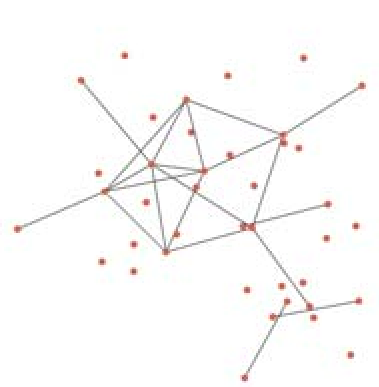 Figure 1: The emergence of cooperative clusters over time. Initially random (a), the system evolves into distinct, highly-connected components (c).
Experiments & Results
The authors conducted Monte Carlo simulations with a population of 1,000 agents.
Cooperation Across Group Sizes
The results (Figure 2) show a clear "Mixed Strategy Advantage." While cooperation in pure-strategy populations collapses rapidly as approaches 10, the mixed-strategy populations maintain significant levels of cooperation.
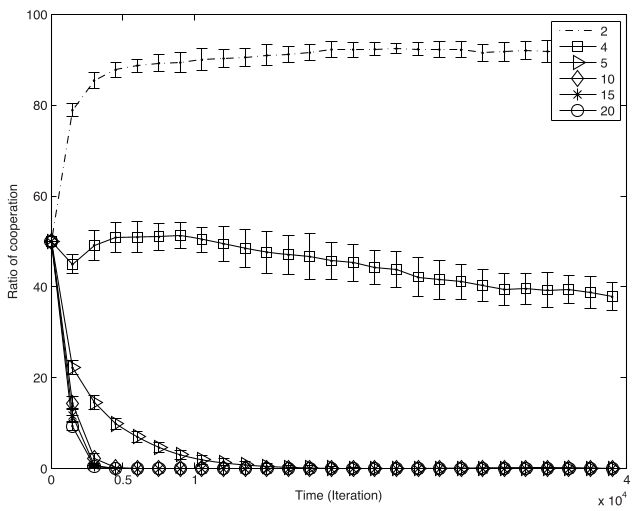 Figure 2: Proportion of cooperation over time. Note that in (b), the mixed strategy significantly buffers the decline of cooperation as N increases.
The Emergent Topology
Why does this work? The analysis of the Clustering Coefficient (Figure 3) provides the answer. Mixed strategy agents form "cliques"—densely connected sub-groups where everyone trusts everyone else. These cliques act as a "shield" against defectors, who find themselves isolated with no social links.
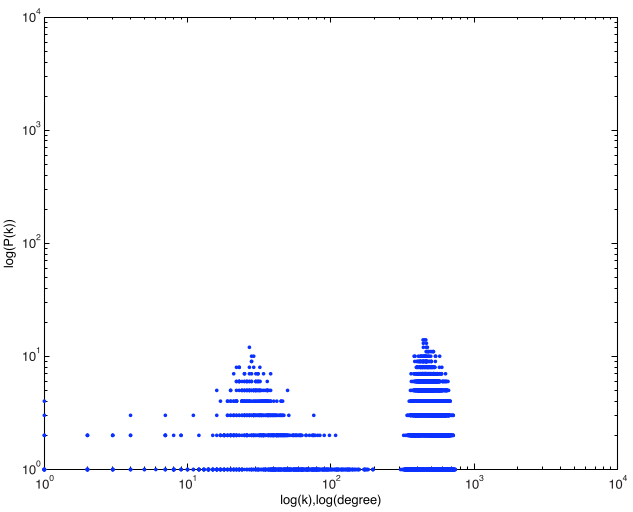 Figure 3: Average clustering coefficient. Higher values in the mixed strategy model (b) indicate the formation of robust social "safety nets."
Critical Analysis & Conclusion
Takeaways
This research highlights that social structure is not just a backdrop for interaction, but a strategy in itself. By making the network dynamic and "punishing" defection through link dissolution, the system naturally filters out bad actors.
Limitations & Future Work
- Perfect Information: The model assumes agents can perfectly observe the actions of others in their group. In real-world P2P networks or large societies, "noise" (perceiving a cooperation as a defection) could destabilize these cliques.
- Fixed Group Size: The study uses a fixed per game. Future work should explore Dynamic Group Formation, where agents can choose not only whom to play with but also the size of the cooperative venture.
In conclusion, this social network model provides a robust framework for understanding how "Reliability" and "Mutual Consent" can prevent the tragedy of the commons in complex multi-agent environments.