
Evolving Ergonomics: How Machine Learning and Evolution Create the Perfect Chair
Evolving Diverse Design Populations Using Fitness Sharing and Random Forest Based Fitness Approximation
This paper introduces a generative design framework that combines Random Forest-based fitness approximation with fitness sharing to evolve diverse, ergonomically viable 3D chair designs. By surrogate modeling complex ergonomic simulations, the method accelerates fitness evaluation by over 60,000x while maintaining a multimodal population of functional designs.
TL;DR
In the world of creative design, "best" is subjective, but "functional" is non-negotiable. This paper presents a system that learns the physics of sitting using Random Forests to act as a high-speed judge for Evolutionary Algorithms. By using Fitness Sharing, the system doesn't just find one perfect chair; it evolves a diverse "population" of functional designs, cutting simulation time from days to seconds.
Context: The Functional Creative Gap
When generating 3D models, we often face a trade-off:
- Aesthetics: Hard to quantify.
- Dynamics/Function: Quantifiable but slow to simulate (Finite Element Analysis, etc.).
If we want to build a "Generative AI" for furniture, we can't just have pretty shapes that collapse when sat upon. We need a way to filter out the "non-viable" designs. The authors target the Chair—a deceptively simple object where ergonomic failure is immediate and painful.
The Problem: The Bottleneck of Simulation
Traditional evolutionary algorithms require thousands of evaluations. Running a full ergonomic simulation (calculating peak pressure, spine curvature, and center of mass) for every single iteration is computationally prohibitive. Furthermore, standard evolution tends to settle on a single "global optimum," resulting in 50 chairs that all look identical. In design, we want a gallery, not a single result.
Methodology: The "Smart" Evolutionary Loop
The authors break the bottleneck using a two-stage process:
1. Learning the Fitness Landscape
Instead of simulating every chair, they used a Random Forest model trained on 12,000 initial simulations.
- Input: 38 parameters (proportions, widths, textures).
- Output: 10 traits (Elbow angle, Foot height, Back pressure, etc.).
- Accuracy: Reached >95% for most traits, allowing the model to act as a "surrogate" that is significantly faster than the physics engine.
2. Guided Mutation & Fitness Sharing
This is the "special sauce" of the paper. To ensure diversity, they used two techniques:
- Guided Mutation: They used the Gini importance from the Random Forest to see which parameters affect which trait. If a chair has "bad foot height," the algorithm knows exactly which knobs to turn.
- Fitness Sharing: Inspired by nature’s niches, this rewards designs for being different from their "cousins," preventing the population from collapsing into one look.
 Fig 1: The ergonomic simulator testing simplified human models against parametric chair designs.
Results: From 45 Hours to 2 Seconds
The performance gains are staggering. A standard evolutionary run that would have taken 45 hours using raw simulation was completed in just 2.5 seconds.
More importantly, the quality of the "Diverse Population" was maintained. Unlike unguided mutation, which struggled to stay within functional bounds, the Guided Mutation + Fitness Sharing (GM & FS) approach explored a wide range of the design space while keeping all chairs ergonomically "legal."
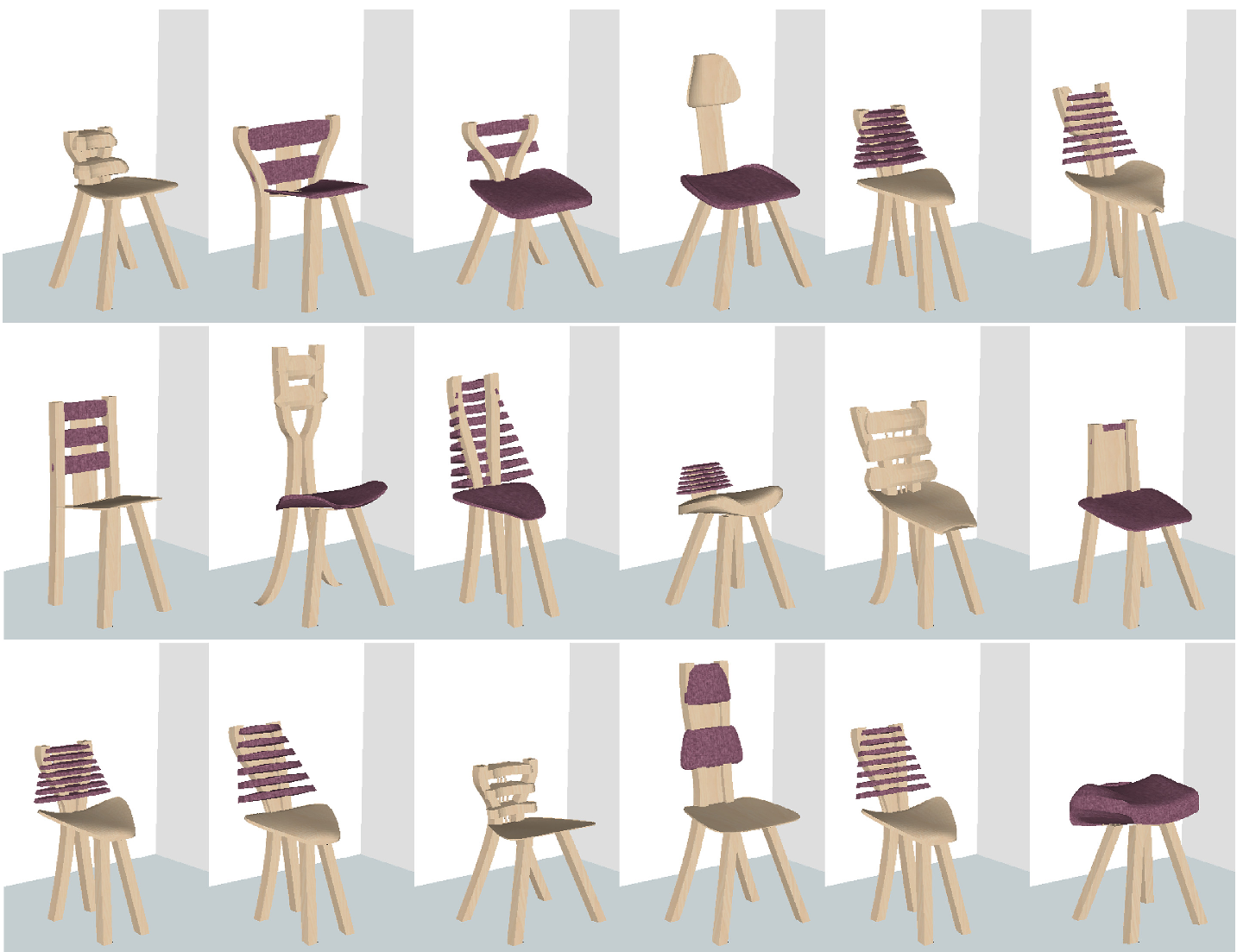 Fig 2: A population of chairs evolved to meet "Dining Chair" criteria—all functional, yet distinct in style.
Critical Insights
- Physical Integrity in Latent Spaces: This work anticipates the current trend in "Physics-Informed" AI. Rather than just learning what a chair looks like, it learns what a chair does.
- Efficiency vs. Accuracy: The authors chose a simplified peak-pressure model over Finite Element Analysis (FEA). While less detailed, the speed allowed for the training of the Random Forest, which is a classic trade-off in technical engineering: approximate and fast is often better than exact and impossible.
- Limitations: The current model ignores leg stability and material strength (focusing only on contact ergonomics). Future iterations would need to integrate structural viability to ensure the chairs don't snap.
Conclusion
By treating "Function" as a learned constraint and "Diversity" as a fitness bonus, the authors have created a blueprint for future creative CAD tools. This method ensures that the AI stays within the realm of the possible while giving the human designer a wide variety of "viable" starting points to refine.