
Evolving Fuzzy Systems: Navigating the Complexity of Fixed-Income Option Pricing
Evolving fuzzy systems for pricing fixed income options
This paper proposes an Evolving Fuzzy Participatory Learning (ePL) model for pricing Brazilian fixed-income IDI options. The approach combines participatory learning (PL) with Takagi-Sugeno (TS) fuzzy systems, enabling the model's structure and parameters to adapt continuously to streaming financial data.
Executive Summary
TL;DR: This research introduces an Evolving Fuzzy Participatory Learning (ePL) model specifically designed to price Brazilian One-Day Interbank Deposit Contract Index (IDI) options. By treating option pricing as a dynamic, online learning problem rather than a static formula calculation, the ePL model captures non-linear market behaviors that traditional models miss.
Academic Positioning: This work bridges the gap between Computational Intelligence (CI) and Quantitative Finance, moving beyond the limitations of the Black-Scholes framework and static Neural Networks by introducing a self-organizing architecture that learns from data streams in real-time.
The Pitfalls: Why Traditional Models Fail in Emerging Markets
The pricing of derivatives is traditionally dominated by the Black-Scholes (BS) framework. However, the Brazilian IDI option is a unique beast. Unlike US or European options, the underlying asset is an index resulting from the accrual of daily interest rates.
Previous attempts at pricing IDI options revealed two fundamental flaws:
- Temporal Independence: Closed-form formulas treat each day as an isolated event, ignoring the historical trend of interest rates.
- Restrictive Assumptions: Markets are rarely Gaussian or linear, yet traditional finance models cling to these simplifying assumptions for mathematical convenience.
The authors argue that an evolving system—one that changes its internal structure as new market information arrives—is the only way to model such high-variance environments.
Methodology: The Core of Evolving Participatory Learning
The ePL model is a Takagi-Sugeno (TS) fuzzy system. Instead of having fixed parameters, it uses a unique unsupervised clustering mechanism called Participatory Learning (PL).
1. Structure Identification (The "Participatory" Part)
The "heart" of the system is the Arousal Index (). Imagine the model is a trader:
- Compatibility (): When new data () is similar to existing knowledge (cluster center ), the model gently updates its belief.
- Arousal (): If the new data is wildly different, the "arousal" increases. Once it crosses a threshold (), the model realizes its current structure is insufficient and spawns a new fuzzy rule.
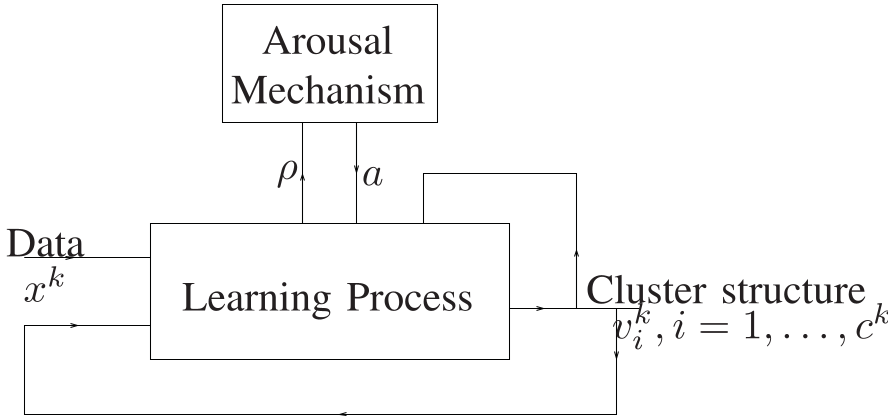 Figure 1: The feedback loop of Participatory Learning showing how compatibility and arousal drive self-organization.
2. Parameter Adaptation
Once the fuzzy rules (antecedents) are defined by the clusters, the model uses Recursive Least Squares (RLS) to fine-tune the linear functions in the "THEN" part of the rules. This ensures that the model is always optimized for the most recent market regime.
Experiments and SOTA Comparison
The study utilized actual daily data from BM&FBOVESPA (Jan 2003 to June 2008). The ePL model was pitted against:
- The Black (1976) model.
- Feedforward Neural Networks (FFNN).
- Recurrent Neural Networks (ERNN/JRNN).
- Other fuzzy models (eTS, xTS).
Performance Metrics
The results were stratified by Moneyness (how close the strike price is to the current index value). The Black model struggled significantly with "Out-of-the-Money" options, where the error skyrocketed.
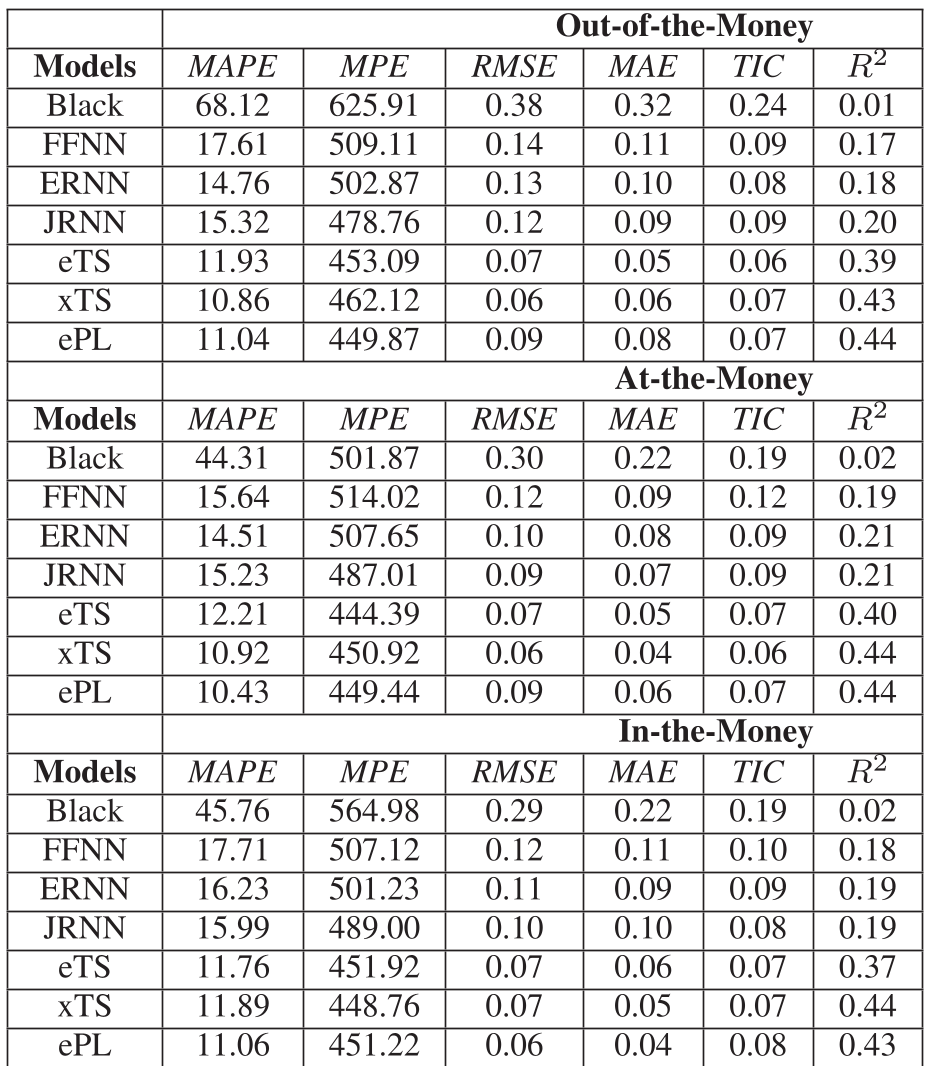 Table 1: Errors by Moneyness. Notice the massive gap between the Black model (MAPE ~47-68%) and the ePL/eTS models (MAPE ~10-12%).
Key Insight: While Neural Networks performed respectably (MAPE ~14-18%), they required complex multi-layer architectures (3 layers, 3-6 neurons). In contrast, the ePL model achieved superior accuracy using only 4 rules, proving that a sparse, expert-like fuzzy structure is more efficient for this task than a dense neural network.
Critical Analysis & Conclusion
Why it Works
The ePL model succeeds because it mimics belief revision. It uses the "Arousal" mechanism to distinguish between market noise and a fundamental shift in interest rate dynamics. The self-organization allows it to maintain high accuracy even during the volatile economic periods captured in the 2003-2008 dataset.
Limitations
- Hyperparameter Sensitivity: The values for must be carefully chosen to balance stability and adaptation.
- Liquidity: The study only focused on call options due to low liquidity in put options, meaning the model's performance on bearish instruments remains untested.
Future Outlook
This work sets a precedent for using evolving intelligence in finance. The next logical step would be integrating Linguistic Fuzzy Systems to incorporate qualitative human expert sentiment (e.g., Central Bank announcements) alongside quantitative interest rate data.