
Evolving Heterogeneous Social Fabrics: Navigating the Edge of Chaos in Optimization
Evolving heterogeneous social fabrics for the solution of real valued optimization problems using cultural algorithms
This paper introduces an evolving heterogeneous social fabric within the Cultural Algorithms (CA) framework to solve real-valued optimization problems. By dynamically selecting and interweaving various network topologies (e.g., Ring, Square, Octagon) based on their performance, the method adapts to varying problem complexities in the "Cones World" environment.
TL;DR
Optimization is not a "one-size-fits-all" game. This paper explores how Cultural Algorithms (CA) can evolve their own social structures—the "Social Fabric"—to solve complex real-valued problems. By moving from static, homogeneous networks to heterogeneous topologies, the authors demonstrate that as a problem becomes more chaotic, a flexible, multi-network approach significantly outperforms rigid structures.
Problem & Motivation: The Limits of Uniformity
In the realm of Cultural Algorithms, the "Belief Space" acts as a repository of cultural knowledge, while the "Population Space" consists of individuals searching for solutions. The Social Fabric is the network through which knowledge flows.
Previously, researchers used fixed topologies—like a Ring (lbest) or a Global (gbest) network. However, the authors observed an "Organizational Mismatch":
- Some topologies are great at exploitation (fine-tuning local solutions).
- Others excel at exploration (finding new peaks in a landscape).
- The Gap: Real-world problems often shift between these states. A static network is like trying to navigate a shifting maze with a rigid map.
Methodology: The Heterogeneous Weaving Process
The core innovation is the transition from CAT 2.0 (Homogeneous) to a version that dynamically selects its topology.
1. The Multi-Tier Selection Engine
Instead of picking one network for the entire run, the system uses a Roulette Wheel selection at the start of each generation. Topologies that helped find better solutions in the past are given a larger "slice" of the wheel.
2. Weighted Majority Win
The paper employs a sophisticated "Conflict Resolution" rule. When an individual receives conflicting advice from its neighbors and the Belief Space, it doesn't just count votes. It uses the Weighted Majority Win scheme, where votes are weighted by the current average fitness of the corresponding Knowledge Source (KS).
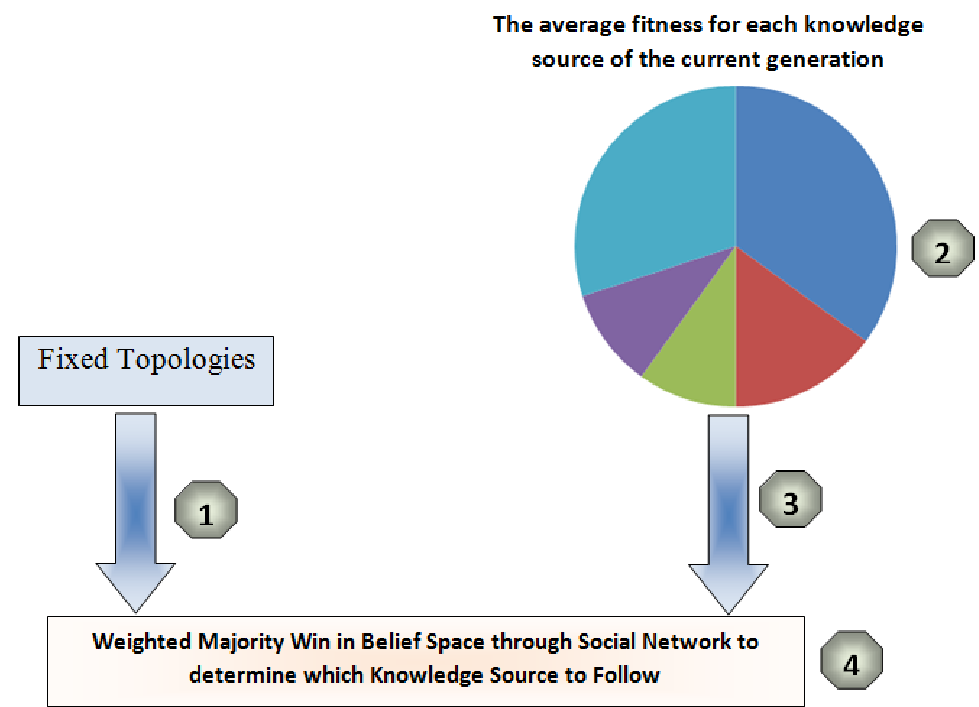 Figure: The process of embedding heterogeneous topologies and resolving conflicts via weighted bidding.
Experiments: Cones World and Langton's Complexity
The authors tested their approach using Langton’s model of complexity, creating three distinct environments:
- Fixed (α = 1.01): Predictable, static peaks.
- Periodic (α = 3.35): Peaks change height and slope.
- Chaotic (α = 3.99): Peaks change position, height, and slope unpredictably.
Key Results
The data suggests a clear trend: Diversity wins when the world is messy.
- Static Success: For simple problems, homogeneous networks were slightly more efficient because the "overhead" of switching topologies wasn't necessary.
- Complexity Dominance: In Chaotic environments, the Heterogeneous approach solved 74% of problems compared to just 66% for traditional global topologies, and did so in nearly half the generations.
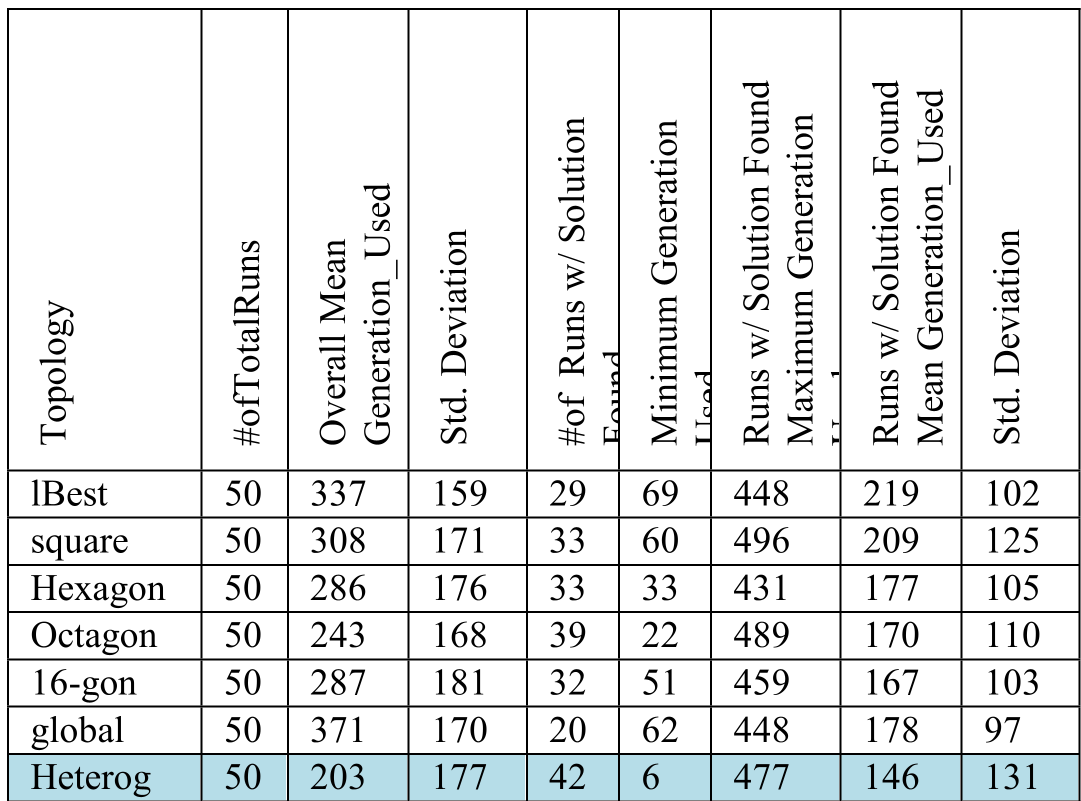 Table II: Performance in Periodic Landscapes. The Heterogeneous topology (bottom row) shows the lowest mean generations and highest success rate.
Critical Analysis & Conclusion
This work provides a deep insight into Artificial Social Intelligence. It proves that the "organizational structure" of a group should be a reflection of the task at hand.
Takeaways:
- Heterogeneity is a Buffer: It acts as a survival mechanism in unpredictable environments.
- Collaboration: By interweaving different networks, the system allows "specialist" topologies to handle specific phases of the optimization process.
Limitations: The computational overhead of maintaining multiple topology wheels and the "roulette spin" might be a factor in extremely large-scale populations, though it is mitigated by the faster convergence rates in complex landscapes.
Future Outlook: Could we use this logic for Neural Architecture Search (NAS)? If we view the layers of a DNN as a social fabric, perhaps evolving their connectivity "on the fly" could lead to more robust AI models.