
Decoding Human Identity via Social Choreography: The Power of Dynamic Multiplex Networks
On the Interplay Between Individuals’ Evolving Interaction Patterns and Traits in Dynamic Multiplex Social Networks
This paper introduces a novel computational framework to study the interplay between individuals' traits and their evolving social interaction patterns in dynamic multiplex networks. Applied to an 18-month longitudinal study (NetSense), it demonstrates that local network dynamics effectively encode human traits like gender and personality, outperforming traditional static analysis.
TL;DR
Researchers have developed a framework that proves your evolving social patterns—how your importance in a network wax and wanes over 18 months—reveal deep-seated traits like gender and personality. By analyzing multiplex data (Phone, SMS, Facebook, and Proximity), the study shows that dynamic analysis is significantly more accurate than looking at a static snapshot of your social life.
The "Static" Blind Spot: Why Time Matters
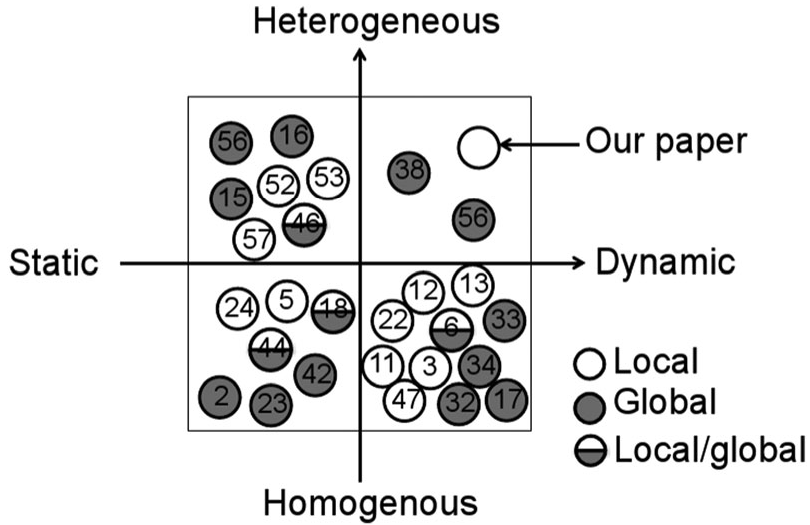
Most social network research treats a network like a photograph—a frozen moment in time. Even when researchers "go dynamic," they often average out the data over months.
The problem? Averaging kills the signal. If Person A starts with zero friends and ends with 20, and Person B starts with 20 and ends with zero, their "average" is the same. Yet, their social trajectory—one rising, one fading—tells a completely different story about their traits. This paper moves from "photographs" to "movies," capturing the local topology shifts that define human behavior.
Methodology: High-Dimensional Social Mapping
The framework utilizes the NetSense dataset, tracking 150 students over 1.5 years across six communication layers (SMS, Calls, Emails, Facebook, and two levels of physical proximity via Bluetooth).
1. Multiplex Construction
Instead of one mega-graph, the authors maintain separate layers. Why? Because you talk to your mother on the phone but likely interact with classmates via Facebook or physical proximity. These layers have "complementary functionalities."
2. Measuring the "Choreography"
For every person in every layer, the framework calculates seven Node Centralities. These aren't just simple "friend counts" (Degree); they include advanced measures like:
- Graphlet Degree Centrality (GDC): Capturing the complex "sub-structure" of your immediate social circle.
- Closeness & Eccentricity: How "central" or "marginal" you are to the whole group.
 The workflow: from raw communication logs to clustered evolving patterns.
3. Clustering the Evolution
By treating a user's centrality over 18 months as a "vector," the authors used k-medoids clustering to find groups of people whose social status moved in sync. They then compared these "network clusters" to "trait clusters" (e.g., groups based on Extraversion or BMI).
Key Insights: What Your Phone Says About You
The results provide a fascinating map of how digital fingerprints link to physical and psychological traits:
- Phone Calls are for Personalities: The "PhoneCall" layer was uniquely effective at capturing Agreeableness, Conscientiousness, and Extraversion. Disagreeable people, for instance, tend to prefer incoming calls over face-to-face meetings.
- Facebook is Gendered: Local network positions on Facebook were high-fidelity predictors of Gender.
- The Efficiency of Dynamic Analysis: The authors compared their dynamic results against a static "snapshot" version. The dynamic analysis yield a 714% improvement in distinguishing meaningful trait correlations compared to a mere 81% for static analysis.
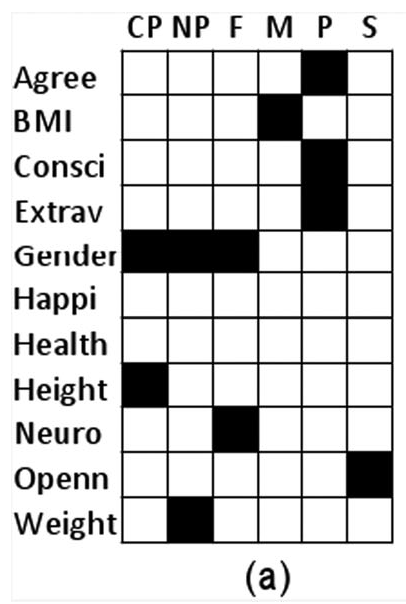 The "Interplay Matrix" showing which network layers (columns) signal which traits (rows).
Critical Analysis & Future Outlook
While the study is robust, it highlights a classic academic challenge: Data Scarcity. Finding a dataset that is simultaneously longitudinal (dynamic), multilayered (multiplex), and tagged with psychological "ground truth" (traits) is extremely rare.
The Takeaway for the Industry: This research suggests that if you want to understand a user—perhaps for personalized services or health interventions—you shouldn't just look at who they are connected to today. You must look at the trajectory of those connections. The "path" of a user's social evolution is a far more descriptive biometric than any single snapshot.
In the long run, this framework paves the way for answering the "chicken or egg" question of sociology: Homophily vs. Influence. Do we make friends because we are similar, or do we become similar because we are friends? By tracking the evolution of both, we might finally find out.