
Evolving Social Insights: Predicting Stakeholder Success via Genetic Programming
Evolving relationships between social networks and stakeholder involvement in software projects
The paper introduces a novel Search-Based Software Engineering (SBSE) method to predict stakeholder involvement in software projects by analyzing social networks. It utilizes Cartesian Genetic Programming (CGP) to correlate a real-world software project (RALIC) against five theoretical model social networks, identifying that successful projects align most closely with a "Rational" connection model.
TL;DR
Why do software projects with hundreds of stakeholders often collapse? It’s rarely the code—it’s the people. This paper proposes a method to "fingerprint" the social health of a project. By using Cartesian Genetic Programming (CGP) to analyze recommendation networks, the researchers discovered that successful projects follow a "Rational" social model where a stakeholder's influence in the network directly predicts their future involvement.
The Human Bottleneck in Software Engineering
Despite decades of process improvement, the "human factor" remains the most volatile element in software development. Most projects identify stakeholders through static checklists, ignoring the dynamic social web. The core motivation of this study is the StakeNet philosophy: if stakeholders recommend each other at the start, can we use those links to predict who will actually show up when the work begins?
Methodology: Five Worlds and a Genetic Search
The researchers didn't just look at a single project; they created five benchmark "Model Worlds" to represent different organizational behaviors:
- Rational: Busy people only recommend others if they are genuinely involved.
- Enthusiastic: Everyone makes recommendations, regardless of actual stakes.
- Incorrect: Recommendations are well-meaning but fundamentally disconnected from reality.
- Perfect: Theoretical data where everyone knows exactly who matters (used as a control).
- Random: Absolute noise.
To bridge these models with a real project (RALIC, a massive university access control system), they used Cartesian Genetic Programming. CGP was tasked with finding a function that takes social metrics—like PageRank and Betweenness Centrality—and outputs an "Involvement Score."
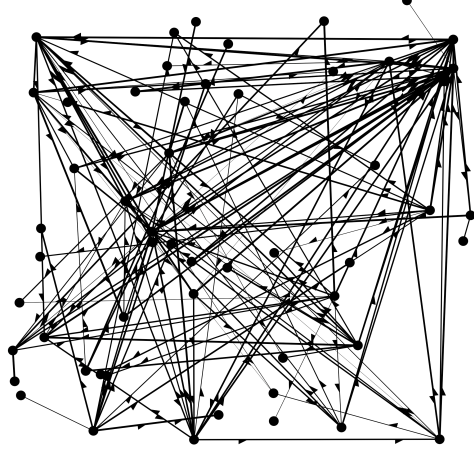 Figure 1: Visualization of different model social networks, contrast the 'Rational' (a) with the 'Perfect' (c) and 'Random' (d) models.
Experimental Insights: The "Rational" Victory
The study found a striking correlation. When CGP was trained on the "Rational" world, its ability to predict involvement in the real-world RALIC project was significantly higher than any other model.
- The Power Law: Involvement follows a power-law distribution—a few "super-stakeholders" do most of the heavy lifting, while many others have light roles.
- Centrality Matters: Metrics like In-degree centrality (how many people recommend you) and PageRank were the most recurring components in the winning evolved equations.
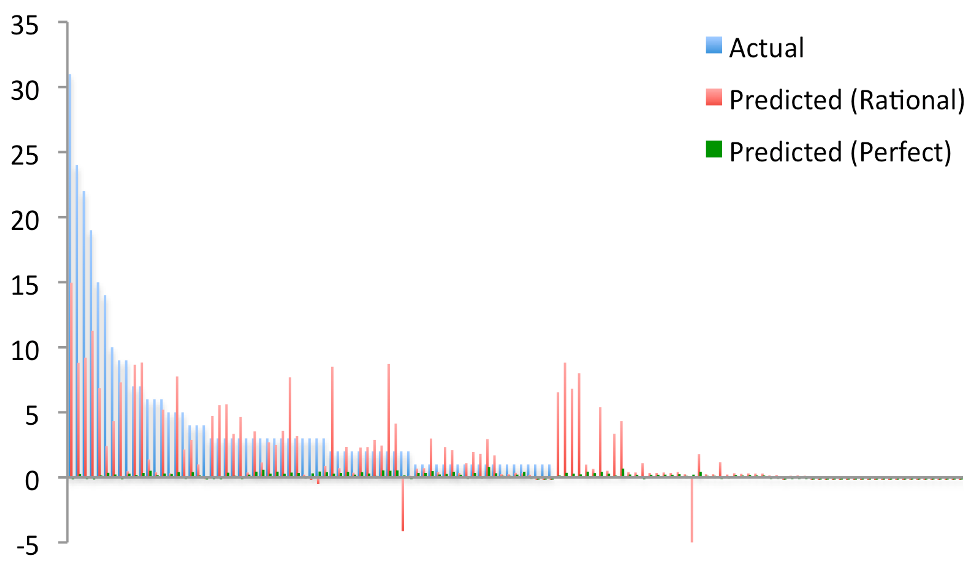 Figure 2: The evolved solution from the Rational world accurately predicts the high-involvement 'peaks' of the RALIC project stakeholders.
Why This Matters for the Industry
This isn't just an academic exercise in evolutionary computation. It provides a blueprint for Predictive Project Management:
- Early Detection: By mapping recommendations in week one, managers can identify if their project looks "Random" or "Incorrect."
- Resource Allocation: If a critical stakeholder is highly recommended but shows low predicted involvement, managers can intervene before the bottleneck occurs.
- Validation of SBSE: It proves that Search-Based Software Engineering can handle "soft" human data just as well as it handles "hard" code testing.
Conclusion & Future Outlook
The paper confirms that in successful large-scale projects, social networks are not chaotic; they are rational. However, the study's reliance on the RALIC project suggests a need for wider validation. Future work could involve evolving models specifically to detect "toxic" project cultures or "silent" silos that lead to failure. For now, the takeaway is clear: In the social graph of a project, the links are just as important as the nodes.