
Evolving Viral Marketing: Beyond the "Hub" Heuristic with Genetic Algorithms
Evolving viral marketing strategies
This paper introduces the Local Viral Marketing Problem (LVMP) and proposes an evolutionary approach to optimize consumer seeding strategies across various social network topologies. By utilizing a genetic algorithm-based tool called BehaviorSearch, the authors identifying near-optimal seeding budgets and weighting functions, achieving a 2.5% NPV improvement on empirical Twitter data compared to standard degree-based heuristics.
TL;DR
Viral marketing often relies on "seeding" influential users to jumpstart product adoption. While simple heuristics like "target the most popular people" work on paper, they often fail in the messy reality of social media. This paper introduces an evolutionary computing approach to discover "Local Viral Marketing" strategies. The key discovery? In real networks like Twitter, the best seeds aren't just the popular "hubs"—they are the "brokers" who bridge different social circles.
The "Local" Challenge: Why Global Knowledge is a Myth
In academic theory, researchers often assume we can see the entire "Social Graph." In reality, marketing managers deal with fragmented data and privacy walls. The authors pivot from the Global Viral Marketing Problem (GVMP)—which is NP-Hard and computationally expensive—to the Local Viral Marketing Problem (LVMP).
The LVMP asks: If you can only see a user's local stats (how many friends they have, how much their friends know each other), can you still design a seeding strategy that maximizes the Net Present Value (NPV) of a campaign?
Methodology: Evolution in the Agent-Based Loop
The researchers used BehaviorSearch, a tool that applies Genetic Algorithms (GA) to agent-based models.
1. The Strategy Space
The GA explores a 12-dimensional parameter space, evolving weights for:
- Degree: Raw popularity.
- Two-step Reach: Friends of friends.
- Clustering Coefficient (CC): Do your friends all know each other? (Lower CC means you bridge different groups).
- Average Path Length (APL): How "central" are you to the whole network?
2. The Model Architecture
The adoption follows a Bass-like model where users adopt based on two factors:
- Innovation (p): Seeing an ad or finding it themselves.
- Imitation (q): Peer pressure from friends.
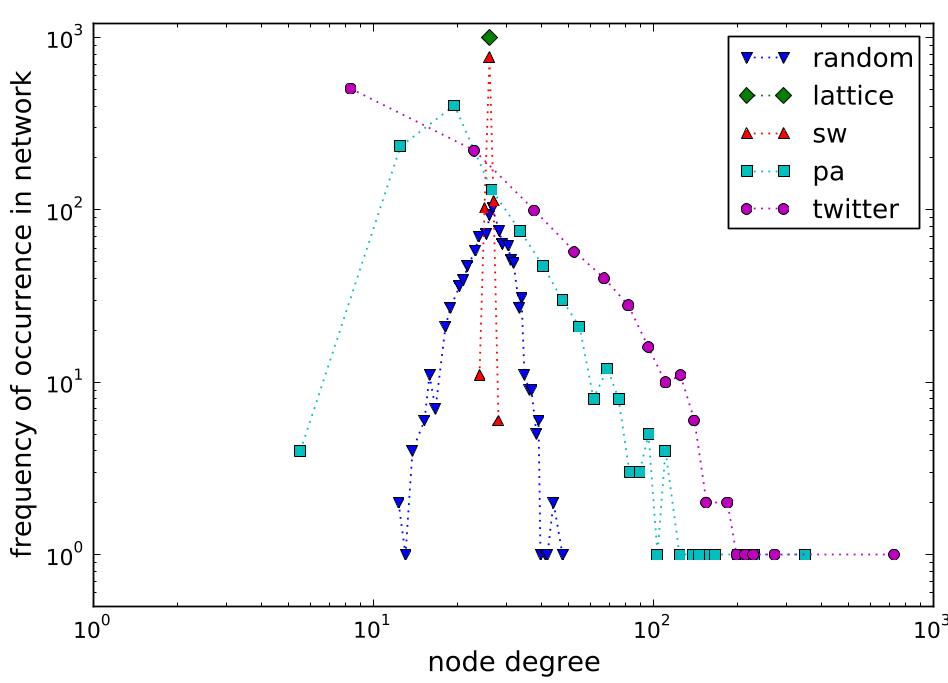 Above: A visualization of the empirical Twitter network used in the study.
Experiments: Theory vs. Reality
The study compared four theoretical networks (like Random and Small-World) against a real-world Twitter dataset.
The Budget-Inequality Link
A fascinating insight emerged: the more "unequal" a network's connections are (high Gini coefficient), the fewer people you need to seed to get a massive result. If a few people hold all the influence, your marketing budget can be much smaller.
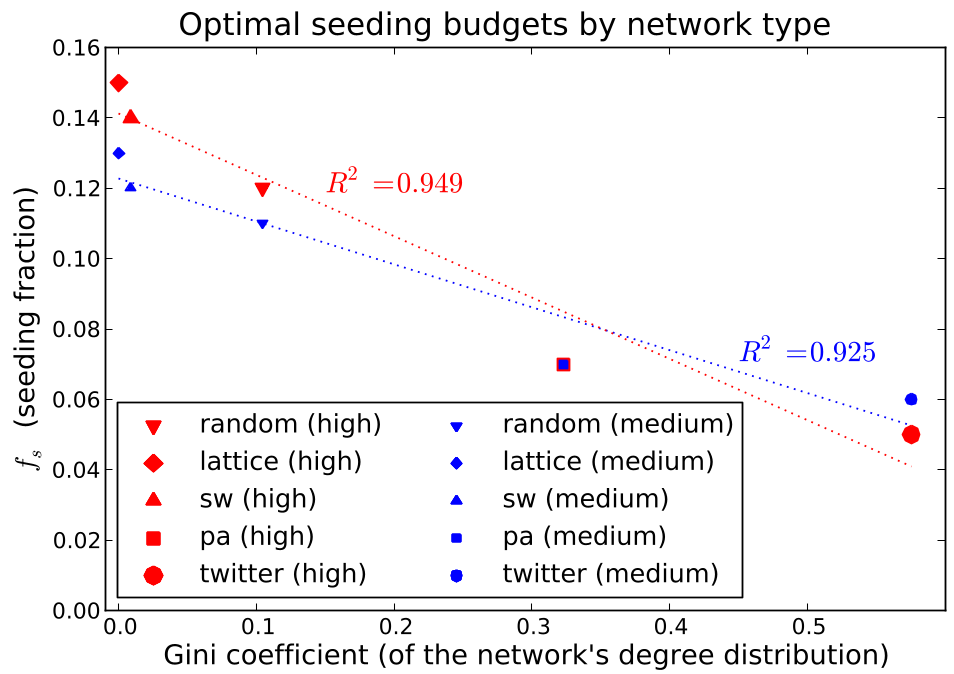 Figure: The GA's progress across different topologies. Notice how skewed networks (Twitter, PA) reach higher NPV faster.
Deep Insight: The Brokerage Strategy
The most significant finding was the "failure" of theoretical models. In the four artificial networks, ranking by Degree (simple popularity) was the best it could get.
However, on the Twitter network, the GA found a strategy that beat the "Degree" baseline by 2.5%. This strategy prioritized nodes with High Degree AND Low Clustering.
Why? In real social media, the massive hubs are often clustered together. If you seed five "Super-Hubs" who are all friends with each other, you are wasting your budget—their influence overlaps. The GA learned to find "Brokers": people who are influential but connected to disparate, un-tapped social pockets.
Critical Analysis & Takeaways
- The "Real World" Matters: The fact that the specialized strategy only worked on the Twitter network suggests that our standard Small-World and Preferential Attachment models are still missing something fundamental about human social structure.
- Robustness: The strategies remained effective regardless of whether the product was "medium" or "highly" viral, suggesting marketing managers can rely on these rules of thumb across different product categories.
- Limitations: The study assumes 1,000 nodes. Scaling these GA searches to millions of nodes remains a computational hurdle.
Conclusion
Don't just buy the biggest "Influencer" on the market. Evolution suggests that for true viral growth, you should look for the well-connected individuals who bridge the gaps between communities—the silent brokers of the social web.