
CSP-CS: Revolutionizing the Closest String Problem with Constraint Satisfaction
Exact Closest String as a Constraint Satisfaction Problem
This paper presents the first evaluation of Constraint Satisfaction Problems (CSP) as a computational framework for solving the NP-complete Closest String (CS) problem. By utilizing the Minion solver and a novel Position Weight Matrix (PWM) heuristic, the authors achieve several orders of magnitude speedup in finding exact and all closest strings, particularly for biological sequences.
TL;DR
Finding a "consensus" string that minimizes the maximum Hamming distance to a set of sequences is a cornerstone of bioinformatics, yet its NP-complete nature often forces researchers to settle for approximations. This paper introduces the first Constraint Satisfaction Problem (CSP) approach to the Closest String (CS) problem. By leveraging a Position Weight Matrix (PWM) heuristic and distributed "cloud" computing, the authors achieve massive speedups and provide the first-ever analysis of finding all possible closest strings.
The Bottleneck: Beyond Approximation
The Closest String problem is vital for identifying DNA motifs and consensus patterns. While polynomial-time approximation schemes (PTAS) exist, they cannot guarantee the minimal distance () or identify the full set of strings that satisfy that distance.
Previous exact methods, such as Integer Programming (IP), focus heavily on optimization. However, they struggle with "all-solutions" tasks and lack a structured framework for exhaustive backtrack search. The authors identified that existing tools lacked the "physical intuition" of symbol frequency—leading to unnecessary exploration of the exponential search space.
Methodology: Mining Frequency as a Heuristic
The authors reformulate CS into a CSP framework using the Minion solver. The model defines:
- Search Variables: The characters of the candidate closest string.
- Distance Constraints: Variables calculating the Hamming distance between the candidate and each input string.
- Objective: Minimizing the maximum distance variable.
The PWM Insight
The breakthrough comes from the Position Weight Matrix (PWM). Instead of a blind search, the algorithm calculates the frequency of each symbol (A, C, G, T) at every position across the input strings. It then prioritizes values in the search tree based on these frequencies.
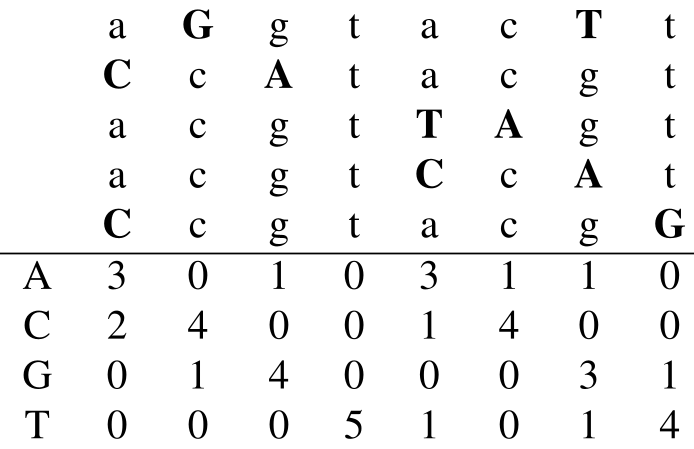 Figure 1: A Position Weight Matrix (PWM) example for biological sequences, used to direct the search toward high-probability candidates.
Experimental Performance
Testing on hundreds of instances with varying string lengths, the PWM heuristic consistently outperformed standard CSP heuristics (like Smallest Domain First).
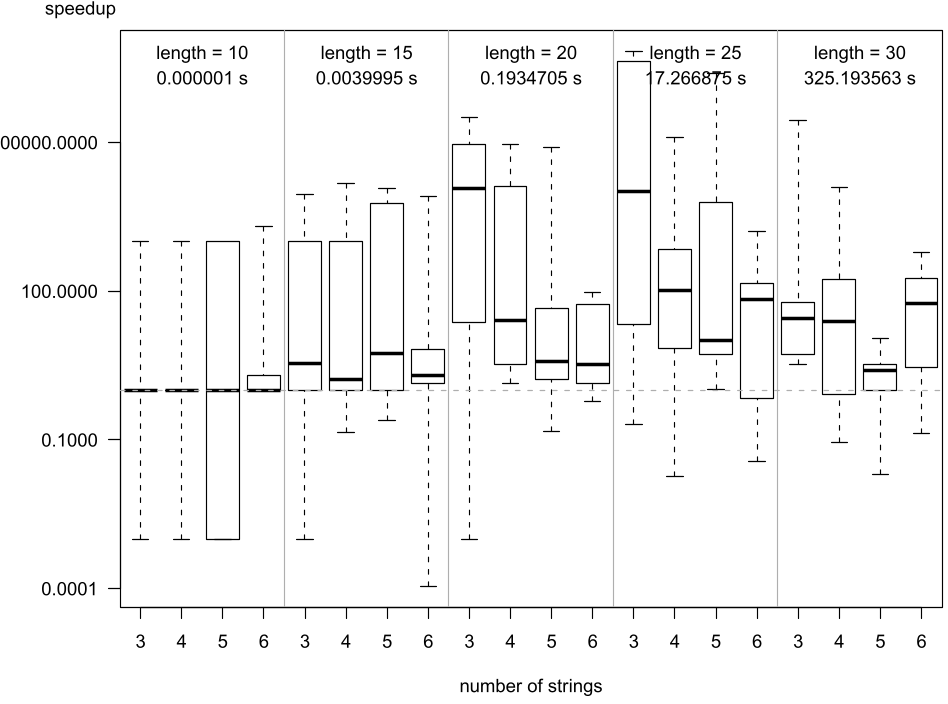 Figure 2: Logarithmic scale comparison showing PWM-based speedups of several orders of magnitude as string length increases.
Key Findings:
- Scalability: The speedup magnitude grows with string length, suggesting CSP is better suited for the "exponential explosion" of longer DNA sequences.
- Certificates of Optimality: While CSP is lightning-fast at finding a solution, the authors admit that proving no better solution exists (optimality certification) remains difficult, prompting their move toward distributed and hybrid strategies.
Scaling Up: Distributed & Hybrid Strategies
To tackle "web-scale" problems, the authors propose a Hybrid Distributed Algorithm.
- Top-Down & Bottom-Up: Using a cloud cluster, they simultaneously search for an upper bound (optimization) and rule out lower distances (certification) in parallel.
- AI-Numeric Fusion: If the gap between the upper and lower bound narrows but persists, the problem is handed over to Integer Programming or Linear Time Search.
This collaborative approach ensures that the system utilizes the pruning power of CSP for the "messy" global search and the numeric efficiency of IP for fine-tuned optimization.
Finding "All Closest Strings"
Perhaps the most unique contribution is the study of All Closest Strings. In biological contexts, multiple consensus sequences might be equally valid. The authors found that by restricting the alphabet to symbols actually present at a specific position (informed by Lemma 2 in the paper), they could find nearly all valid solutions while reducing nodes visited by .
Critical Analysis & Future Outlook
The paper successfully proves that CSP is not just a theoretical alternative but a pragmatic powerhouse for bioinformatics.
Limitations: The primary bottleneck remains the "Certificate of Optimality." While finding a solution is fast, proving it's the best one still consumes the bulk of CPU time.
Future Work: The integration of Global Constraints and Symmetry Breaking could further refine the search. As genomic data continues to explode, the transition from local clusters to fault-tolerant cloud computing (like the Condor framework used here) represents the likely future of exact sequence analysis.