
Beyond Trajectories: How Place Semantics Revolutionize Friend Recommendations in LBSNs
Examining place categories for link prediction in Location Based Social Networks
This paper introduces a semantic-aware approach to link prediction in Location-Based Social Networks (LBSNs) by analyzing place categories. By proposing two new feature groups, CPCPS and CCCSP, and applying Bayesian Network classification, the authors achieve performance improvements (up to 0.978 AUC) across various user subsets by leveraging the granular habits of check-in behavior.
TL;DR
Is a user you meet at a "Dive Bar" more likely to become your friend than someone you cross paths with at a "Gas Station"? This paper argues that the category of a location is a critical missing link in social network analysis. By moving beyond simple check-in counts to category-specific semantic features (CPCPS and CCCSP), the researchers achieved State-of-the-Art (SOTA) performance in link prediction on the Gowalla dataset, proving that what a place is matters as much as where it is.
The "Scalar Loss" Problem
In the realm of Location-Based Social Networks (LBSNs) like Foursquare or Gowalla, link prediction—predicting if two users will become friends—has traditionally relied on topological features (Common Friends) or basic spatial overlap (Common Check-ins).
The authors identify a major flaw in previous SOTA methods: Unification Bias. When we aggregate all check-ins into a single "Common Place Count," we lose the semantic nuance. Some categories are social "honey pots" (e.g., bars, churches), while others are purely functional (e.g., terminals). Treating them as equal weight in a classifier dilutes the predictive signal.
Methodology: The Math of Semantic Similarity
The core contribution lies in two new feature formulations designed to capture user similarity through the lens of 283 place categories.
1. CPCPS (Common Place Check-in Count Product Sum)
This feature emphasizes frequency at the exact same physical locations within a category.
 Intuition: If two users both visit the same specific Italian restaurant frequently, the product of their check-in counts will be high, signaling a strong potential bond.
2. CCCSP (Common Category Check-in Count Sum Product)
This measures "Lifestyle Similarity." Even if two users don't go to the same specific building, do they frequent the same types of places?
 Intuition: If User A loves "Antique Hotels" and User B also frequents "Antique Hotels" (even if different ones), they share a demographic or psychographic profile that suggests high link probability.
Experimental Results & Insights
The study evaluated these features using a Bayesian Network on four distinct subsets of users from the Gowalla dataset:
- FOF (Friend of Friends): Purely topological candidates.
- PF (Place Friends): Users sharing locations.
- BG (Both Group): High-confidence candidates.
- WG (Whole Group): The general population.
Performance Gains
The integration of category features (FNFS - Filtered New Feature Set) consistently outperformed the Best Performing Feature Set (BPFS) from prior literature.
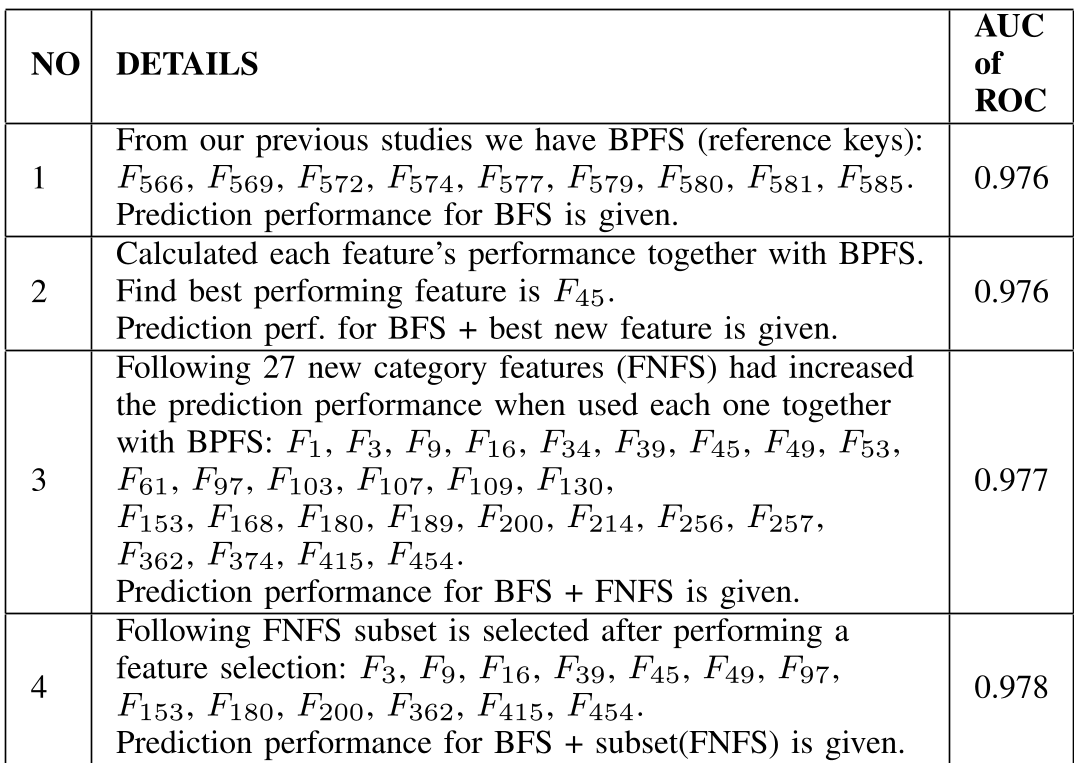 As shown above, for the Place Friends (PF) group, adding category features F3, F9, etc., pushed the AUC to a remarkable 0.978.
Key Category Discoveries:
- "Gas & Automotive": Surprisingly predictive for general users.
- "Dive Bars" and "Churches": Highly predictive for users who already share mutual friends (FOF), acting as catalysts for converting "friends of friends" into direct links.
- "Cineplex" and "Convention Centers": Strong indicators for users who have both spatial and social overlaps.
Critical Analysis & Future Outlook
While the paper successfully proves that semantic information provides an "Information Gain Enhancement," there are limitations:
- Sparsity: With 283 categories and millions of pairs, many category-feature vectors will be sparse.
- Temporal Dynamics: The study uses static check-in counts but doesn't fully account for when the check-ins happened (simultaneity).
Future Work: The logical next step is to combine these semantic categories with Temporal Graph Networks. Knowing that two people were at the same "Concert Hall" at the same time is even more powerful than knowing they both like concerts.
Conclusion
This research underscores that in the digital-physical world, context is king. By breaking down "location" into "semantics," we can predict human relationships with much higher fidelity. For LBSN developers, the message is clear: Stop just tracking where your users go; start understanding what those places say about who they are.