
Beyond Particles: Modeling Opinion Spreading through the Lens of Cognition and Interaction
Exchange, adopt, evolve: Modeling the spreading of opinions through cognition and interaction in a social network
This paper introduces an agent-based model for opinion dynamics called the "Belief Acquisition Framework," which treats opinion formation as a cognitive learning process. By integrating ID3 decision tree learning with social network interactions, the authors demonstrate how agents can evolve from biased local beliefs to a unified, accurate consensus.
TL;DR
Most social models treat opinions like viruses—simple states that "infect" neighbors. This paper breaks that mold by treating agents as learners. By combining decision tree induction with social network theory, the authors show that when agents are motivated by accuracy (epistemic rationality), social networks naturally gravitate toward the truth, with central nodes leading the charge.
The Problem: The "Black Box" of Opinions
For decades, researchers modeled society using metaphors from physics. In these "Statistical Mechanics" models, an opinion is just a number. If your neighbor has a 0.8 and you have a 0.2, you might meet in the middle at 0.5.
The issue? Humans don't just average numbers. We have experiences (data) and we build mental models (beliefs). Prior work failed to explain:
- Origin: Where does the initial attitude come from?
- Cognition: How does new evidence change a belief structure?
- Independency: Why do we treat different opinions as independent when they often share the same underlying logic?
Methodology: The "White Box" Framework
The authors propose a Belief Acquisition Framework composed of three stages:
- Initialization: Agents receive a small, biased sample of "world data" (e.g., wine attributes and quality). They use the ID3 algorithm to build a personal decision tree (their belief).
- Interaction: Agents pick neighbors to exchange both data points and their entire decision tree.
- Evolution: Agents compare their old tree against the neighbor's tree using their local data. Following the principle of epistemic rationality, they adopt whichever model is more "accurate."
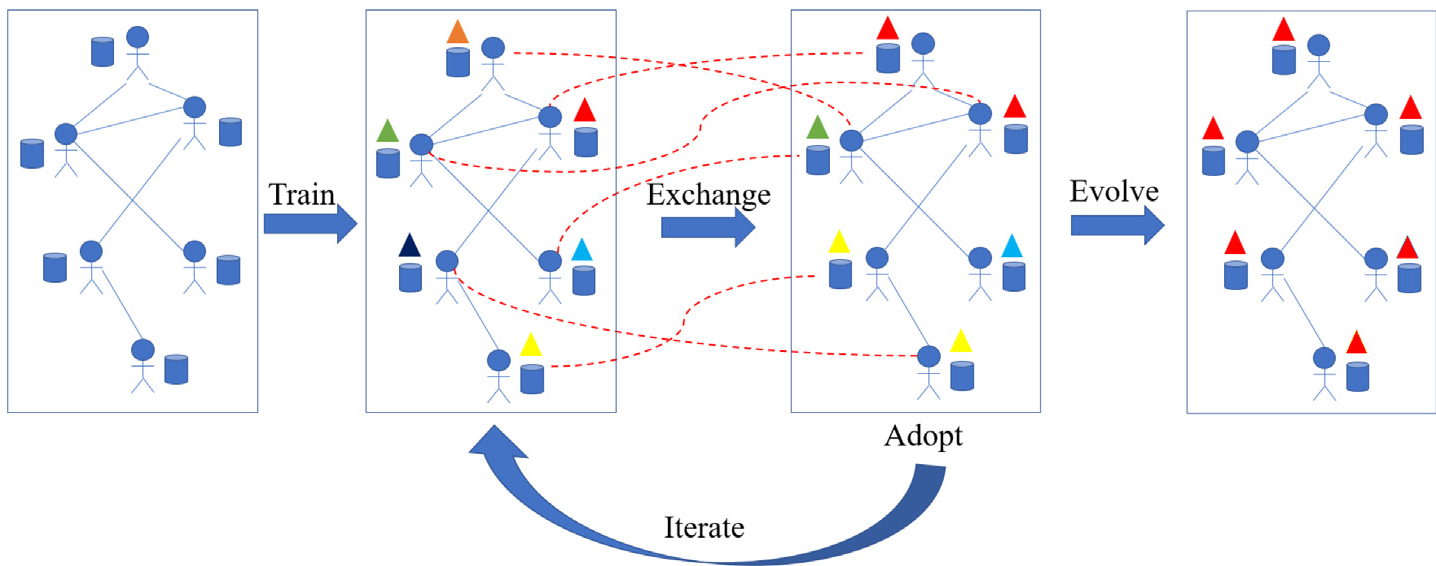 Fig 1: The lifecycle of belief—from local data mining to global consensus.
The Positional Advantage: Does Centrality Matter?
One of the paper's most compelling findings is the "Micro-perspective" analysis. By testing the model on the Medici family marriage network and global trade data, the authors found a striking correlation between a node’s position (Centrality) and its "Learning Ability."
Key Findings:
- Closeness & Betweenness: Nodes that bridge different communities or are "close" to everyone else reach high-accuracy beliefs much faster.
- The Medici Effect: In the Florentine network, the Medici family’s dominance isn't just about power; the model suggests they had the best structural position to acquire the most "accurate" social beliefs.
- Network Radius: On a macro level, the "radius" of a network is the primary bottleneck. Sparser networks (like path graphs) take significantly longer to reach a consensus than "star" or "complete" networks.
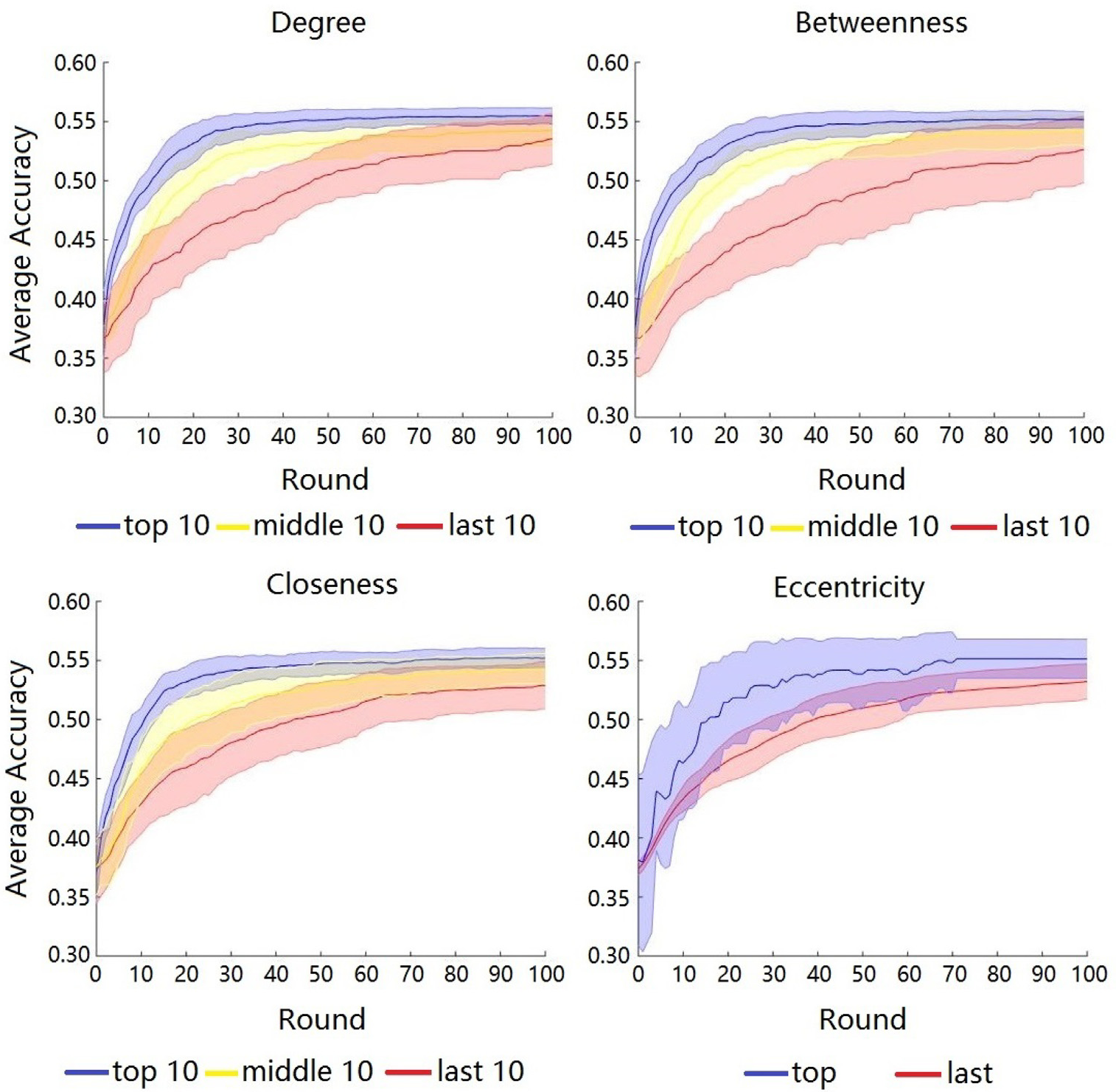 Fig 2: Comparison of how different centrality measures (Degree, Closeness, Betweenness) correlate with the accuracy of an agent's belief over time.
Strategic Intervention: Introducing the "Experts"
Can we speed up the truth? The authors introduced Expert Agents—nodes with massive, unbiased datasets.
- Results: Adding even a single expert can "infect" a network with accuracy.
- Optimization: Using a "Discounted Degree" (DD) algorithm to pick where to place these experts is far more effective than random placement, mirroring strategies used in Influence Maximization (IM).
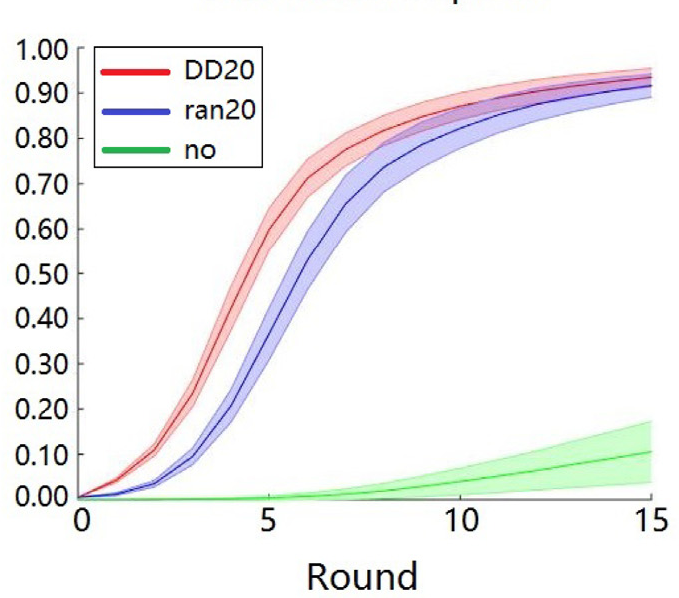 Fig 3: The rapid "cascade of accuracy" when expert agents are strategically placed in a Facebook social graph.
Critical Insight & Conclusion
This paper is a significant "theoretical repair" for opinion dynamics. It proves that Consensus is not just about agreement—it’s about collective learning.
Limitations: The model currently guarantees consensus, which we know doesn't always happen in the real world (e.g., political polarization). The authors suggest that adding "Trust" or "Authority" weights to the interaction rules could allow the model to simulate the "Echo Chambers" seen in modern social media.
Final Takeaway: In a world of "epistemic rationality," the social network acts as a distributed computer that processes local experiences into global truth. Your "truth" is only as good as your neighbors—and your position relative to them.