
[arXiv 2024] Exclusive Self Attention: Breakthrough via Orthogonal Context Modeling
Exclusive Self Attention
This paper introduces Exclusive Self Attention (XSA), a novel modification to the standard Transformer architecture that explicitly removes the "attention similarity bias" by orthogonalizing the attention output relative to the self-value vector. Evaluated on language modeling tasks up to 2.7B parameters, XSA consistently outperforms standard Self Attention (SA) with minimal computational overhead.
TL;DR
Apple researchers have identified a fundamental inefficiency in standard Transformers called Attention Similarity Bias, where the attention mechanism redundantly processes information already present in the current token. Exclusive Self Attention (XSA) solves this with a simple two-line code change that orthogonalizes the output, forcing the model to focus purely on the surrounding context. The result: better performance, better scaling, and superior long-context handling with almost zero cost.
Deep Dive into the Motivation: The Similarity Bias
In a standard Transformer, the Self Attention (SA) layer aggregates context, and the Feed-Forward Network (FFN) performs point-wise updates. However, the author discovers that the output of SA () often has a surprisingly high cosine similarity with the token's own value vector ().
This "Attention Similarity Bias" implies that the SA layer is wasting its parameters to replicate the current token's features—a task already handled by the residual connection and the FFN. This redundant competition diminishes the model's ability to learn complex contextual dependencies.
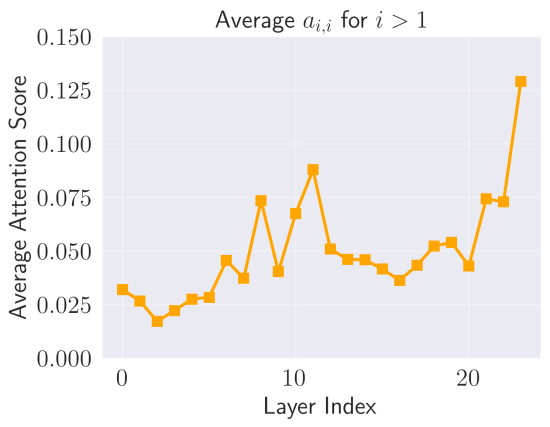 Figure 1: Evidence of bias. Note the high cosine similarity (right) between the aggregated output and the self-value vector, which increases in deeper layers.
Methodology: The Power of Exclusion
The fix is elegantly simple. Instead of allowing to contain components of , XSA subtracts the projection of onto the direction of .
The XSA Transformation:
By removing these "self-aligned" components, the attention layer is forced to be exclusive. It can only pass information that is fundamentally different from the current state. This forces a cleaner "division of labor":
- SA Layer: Strictly for contextual relationships.
- FFN Layer: Strictly for point-wise feature refinement.
 XSA can be implemented with a simple subtraction after the standard attention operation.
Experiments & Results
The author tested XSA on the FineWeb-100BT dataset using models up to 2.7B parameters.
1. Scaling and Downstream Performance
XSA consistently maintained a lower transition and validation loss compared to the standard Transformer. On downstream tasks (ARC-E, HellaSwag, PIQA, etc.), the performance gap increased as the model grew, suggesting that XSA scales better than standard SA.
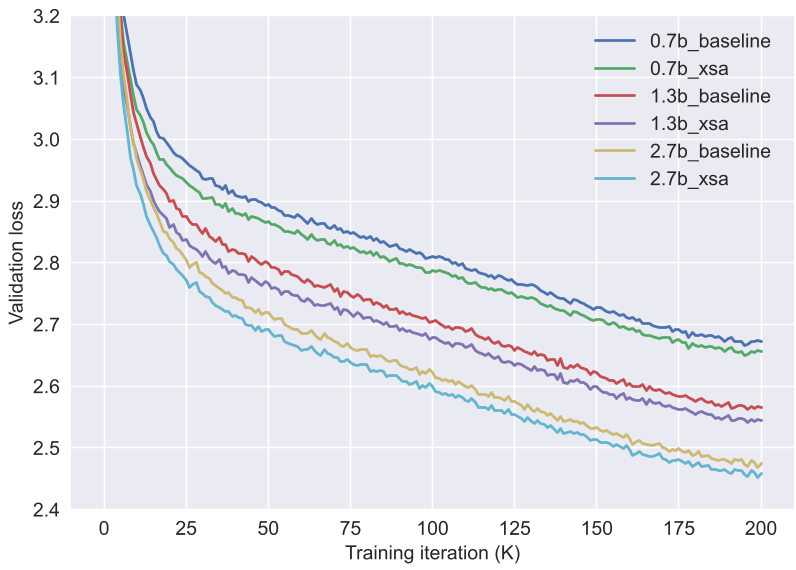 Figure 2: XSA (green) consistently outperforms the Baseline (red) across all model sizes (0.7B to 2.7B).
2. The Long-Context Advantage
Perhaps the most exciting finding is that XSA provides larger gains as the sequence length increases. When the context grows from 512 to 16k tokens, the "tension" on the attention mechanism to find relevant information increases. XSA’s exclusion policy makes it more efficient at filtering through this noise.
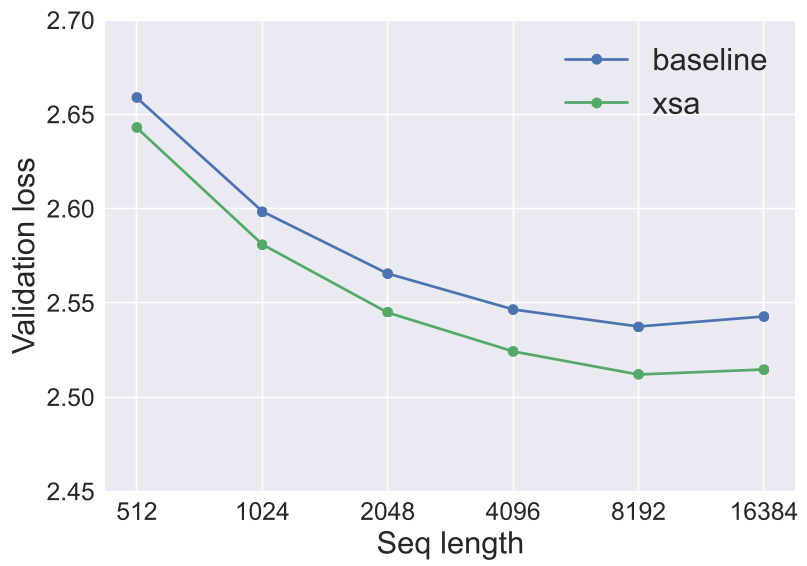 Figure 3: The performance gain of XSA compared to the baseline grows significantly as sequence length scales.
3. Computation Overhead
Despite the extra projection step, XSA introduces minimal overhead. Benchmarks on B200 GPUs show that throughput and memory usage remain nearly identical to the standard architecture, making it a "free lunch" for large-scale training.
Critical Analysis & Conclusion
Takeaway
XSA is a rare example of a structural simplification that leads to better empirical results. By recognizing that the attention mechanism was "lazy" (relying on self-similarity), the author found a way to unlock higher modeling efficiency.
Limitations & Future Work
- Scale: While 2.7B is a respectable size, the performance at the 70B+ scale remains to be seen.
- Optimizers: The interaction between XSA and non-standard optimizers (like Muon) is an open question.
- Modality: The paper focuses on LLMs; however, the similarity bias might be even more prevalent in Vision Transformers (ViT) due to spatial correlations between adjacent patches.
In conclusion, XSA is a highly practical refinement to the Transformer block that should be considered for next-generation foundation models, especially those targeting long-context applications.