
Hypergraph Modeling: A New Frontier for Exhaustive User Behavior Analysis
Towards an Exhaustive Framework for Online Social Networks User Behaviour Modelling
This paper proposes a comprehensive, component-based framework for modeling Online Social Network (OSN) user behavior by integrating structural, semantic, and activity-related data. The core innovation is the use of hypergraphs to represent complex multi-user interactions and the development of the "Julia-based" library for scalable behavioral profiling.
TL;DR
This paper introduces a modular framework designed to solve the "fragmentation" of user profiling in Online Social Networks (OSNs). By shifting from simple graphs to hypergraphs, the author provides a way to unify structural, semantic, and activity-driven data into a single, time-aware model, challenging the traditional 90-9-1 rule of user participation.
Problem & Motivation: Beyond the "Follower" Count
Most current research treats user profiling as a static snapshot—looking at how many followers a person has or what their bio says. However, true behavior is fluid and multi-dimensional. If three people comment on the same thread, a traditional graph records three separate edges; this loses the context of the shared interaction.
The author identifies three major gaps in the field:
- Lack of Dynamicity: Profiles don't evolve as user interests change over time.
- Data Fragmentation: It is difficult to combine insights from Twitter, Instagram, and Yelp into a unified model.
- Representation Limits: Simple binary relationships (Friend A follows Friend B) cannot capture the complexity of group dynamics.
Methodology: The Power of the Hypergraph
The cornerstone of this research is the User Behaviour Modeller, which leverages Hypergraphs.
Why Hypergraphs?
In a standard graph, an edge connects exactly two nodes. In a hypergraph, a "hyperedge" can encompass any number of nodes.
- Physical Intuition: Think of a hyperedge as a "virtual room." Everyone who participates in a specific hashtag, comments on a specific photo, or visits a specific restaurant belongs to that same hyperedge. This captures the co-occurrence of behavior much more effectively than a series of binary links.
The Modular Framework
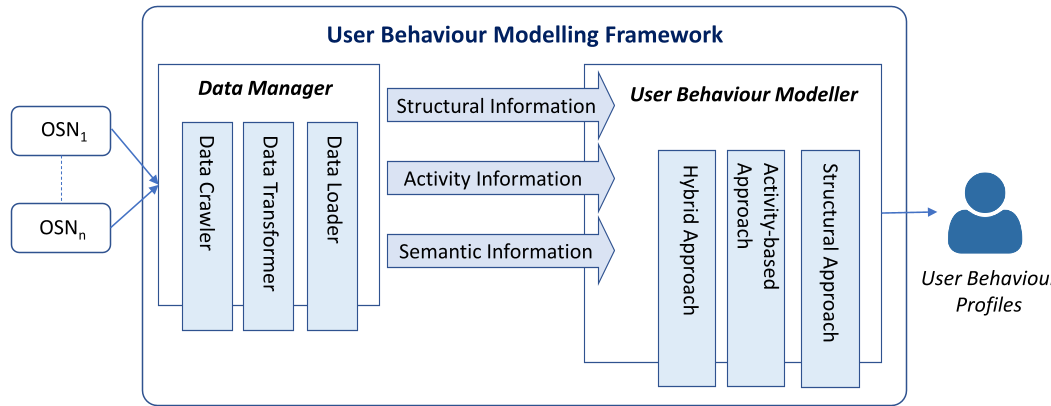
The proposed system is divided into three key components:
- Data Manager: Handles the "messy" work of social media crawling, dealing with API rate limits and data storage (MongoDB).
- Behaviour Modeller: The engine where structural (network), semantic (text/sentiment), and activity (frequency) data converge.
- Julia-based Library: Choosing Julia over Python or R emphasizes the need for high-performance scientific computing when processing datasets as large as the 9GB Yelp challenge.
Experiments & Results: Debunking the 90-9-1 Rule
The author conducted extensive experiments on Twitter datasets (over 1 million users) to validate the model.
Key Findings:
- Static vs. Dynamic: Static profile data (total likes, etc.) is good for identifying "influencers" but fails to distinguish between active users and passive lurkers.
- The Lurker Reality: While the famous "90-9-1 rule" suggests 90% of users are lurkers, the author’s data-driven approach found that only 75% (3 out of 4) are truly passive. This suggests that users are becoming more engaged than previously thought.
- Behavioral Stability: By analyzing the temporal axis, the research found that users rarely migrate between activity levels; a lurker tends to stay a lurker.

Critical Analysis & Conclusion
Takeaway
This work shifts the focus from "who a user is" to "how a user acts within a collective." By providing an open-source library and a modular framework, the author enables the community to move away from proprietary, "black-box" profiling and toward transparent, multi-faceted behavior modeling.
Limitations & Future Work
While the hypergraph model is mathematically robust, the computational cost of hyperedge expansion can be significant. The next phase of this research involves a "Hybrid Approach," combining hypergraphs with Machine Learning to predict things like bot/spam detection and personalized recommendations more accurately.
The project’s future roadmap includes integrating semantic analysis (sentiment and topics) to see if what people say is as predictive as how often they say it.