
ExHero: Why Your Pipeline History is Hiding Critical Timing Errors
ExHero: Execution History-Aware Error-Rate Estimation in Pipelined Designs
ExHero is an automated framework designed to estimate timing error rates in pipelined microarchitectures by considering deep execution history. Applied to a floating-point unit (FPU), it demonstrates that the order and type of instructions within a window equal to the pipeline depth are critical for accurate reliability assessment.
TL;DR
As silicon scales into the nanometer regime, hardware variability makes timing errors inevitable. While researchers have long tried to predict these errors, ExHero reveals a massive blind spot: existing models ignore the "instruction history" stored in the pipeline. By considering all in-flight instructions, ExHero finds that we have been underestimating error rates by as much as 46.5%.
The "Local Memory" Problem in Pipelines
In a standard synchronous pipeline, the delay of any given logic path isn't just a function of the current instruction's operands. Because stages share control logic and hardware nodes, the physical state of the circuit (voltage levels, switching activity) is determined by the sequence of instructions that came before it.
Prior SOTA models (like CLIM or b-HIVE) assumed that a "look-back" of one instruction was enough. However, in a 6-stage or 9-stage pipeline, an instruction enters the pipe while several others are still churning through later stages. ExHero's core insight is that the error behavior of the current instruction is a joint function of the entire in-flight window.
Methodology: Bridging the Gap between Gate-Level and Architectural Trace
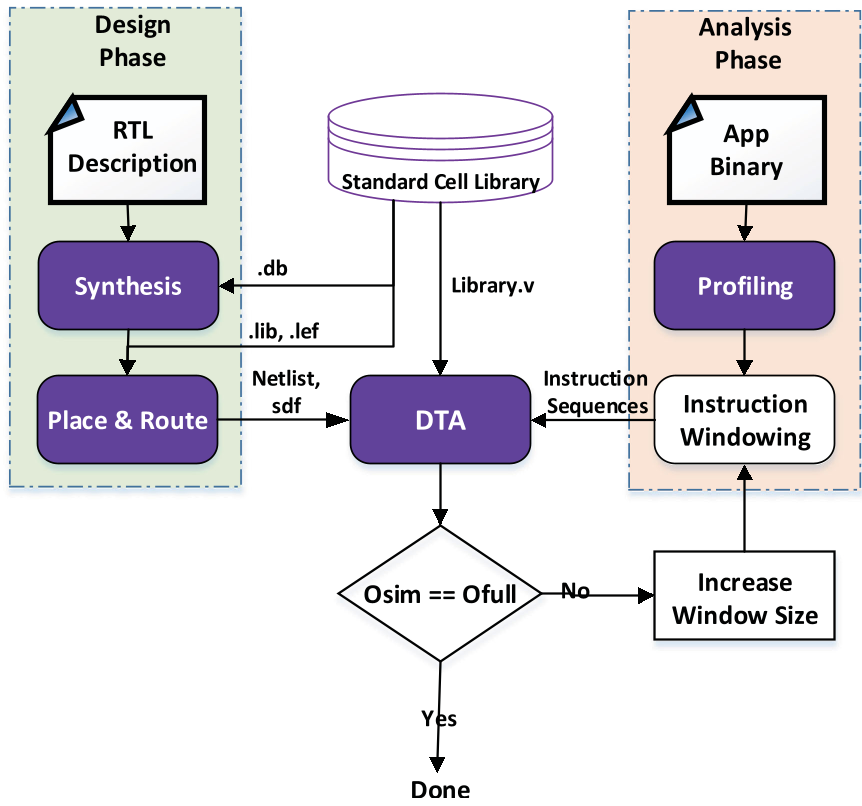
ExHero bridges the gap between high-level application traces and low-level gate reality through a two-phase workflow:
- Design Phase: Standard Synthesis and P&R to generate a gate-level netlist and Standard Delay Format (SDF) files.
- Analysis Phase: This is where the magic happens. ExHero extracts million-instruction traces from real benchmarks (NAS suite) and performs Dynamic Timing Analysis (DTA).
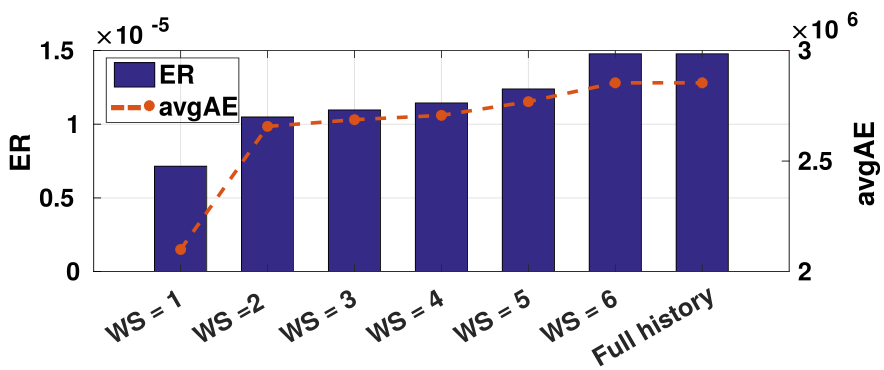
The framework defines a Window Size (WS). It scales WS from 1 (the current instruction only) up to K (the full pipeline depth). It proves that unless WS equals the pipeline depth, your error simulation will likely fail to match the "Full History" reality.
Verification: The Smoking Gun
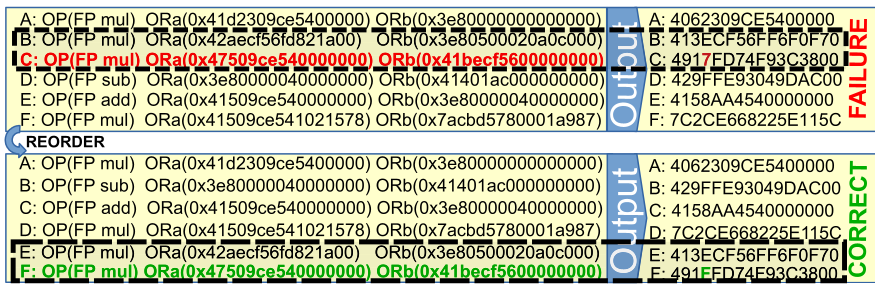
One of the most compelling pieces of evidence provided by the authors is a comparison of two identical instructions (Instruction C) placed in different sequences.
Even with the same operands and the same immediate predecessor (Instruction B), Instruction C might fail in one sequence but succeed in another simply because the third instruction back (Instruction A) was different. This confirms that the internal state of the pipeline has a "memory" longer than what current models anticipate.
Experimental Results: The High Cost of Being "History-Blind"
Testing on a pipelined Floating-Point Unit (FPU), the authors observed drastic differences across benchmarks:
- Baseline Inaccuracy: Previous history-aware frameworks (using WS=2) underestimated the Absolute Error by 32.1%.
- Deep Dependencies: For the
epbenchmark, no errors were detected at WS=1 or WS=2. It was only when the window was expanded to WS=9 (matching the multiplication pipeline depth) that the actual errors manifested.
Deep Insight: Beyond Just Benchmarks
The value of ExHero isn't just in the tool itself, but in the shift of perspective it demands. As we push for Voltage Scaling to save energy, we usually rely on error models to tell us when we've gone too far. If those models are off by 46%, our "reliable" systems are actually ticking time bombs of silent data corruption.
Limitations & Future Work
While ExHero is a breakthrough in accuracy, it relies on gate-level simulation which is computationally expensive for full CPU cores. The next frontier will be "abstracting" these deep pipeline dependencies into faster, machine-learning-based models that don't require full-gate simulation but retain the history-aware precision discovered here.
Conclusion
ExHero proves that in the world of high-performance pipelined design, context is everything. If you aren't looking at the full history of the pipeline, you aren't seeing the full picture of the errors.