
ENCFB: Solving the Full Coverage Challenge in Social Networks via Finite Buffer Network Coding
An expanded network coding with finite buffer size information dissemination approach in social networks
This paper introduces the Expanded Network Coding with Finite Buffer size (ENCFB) approach for efficient information dissemination in social networks. By integrating network coding at small cell base station (SCBS) helpers, it addresses the "full coverage" problem to ensure all communal destinations receive source data reliably under hardware constraints.
TL;DR
Information dissemination in social networks usually relies on helpers (relays) to reach all members (Full Coverage). However, when these helpers have limited memory, traditional methods fail. This paper proposes ENCFB (Expanded Network Coding with Finite Buffer size), a method that performs real-time data combination to ensure high reliability even with tiny buffers, reducing the number of required relays by nearly half.
The "Finite Buffer" Bottleneck
In applications like emergency evacuation notifications, the goal is "Full Coverage"—every single actor in the community must receive the data. We typically use User Equipment (UE) or Small Cell Base Stations (SCBS) as helpers.
The problem? Helpers are not supercomputers. They have finite buffers.
- Uncoded approach: Relays just pass data. If the buffer is full, new data is lost.
- Standard Network Coding: Relays combine packets. But if the buffer reaches limit , they stop receiving, leading to "sink" nodes that contribute nothing to the network's information diversity.
Methodology: The ENCFB Intuition
The authors suggest that we shouldn't stop receiving data just because the buffer is "full." Instead, the ENCFB approach Performs a combination of the latest received data item with an arbitrary item already in the buffer.
Mathematically, this is equivalent to setting the reception probability to 1 and performing network coding dynamically. This ensures that the information contained within the relay's buffer is always a fresh linear combination of the global data set, maximizing the probability that a destination can decode the original items.
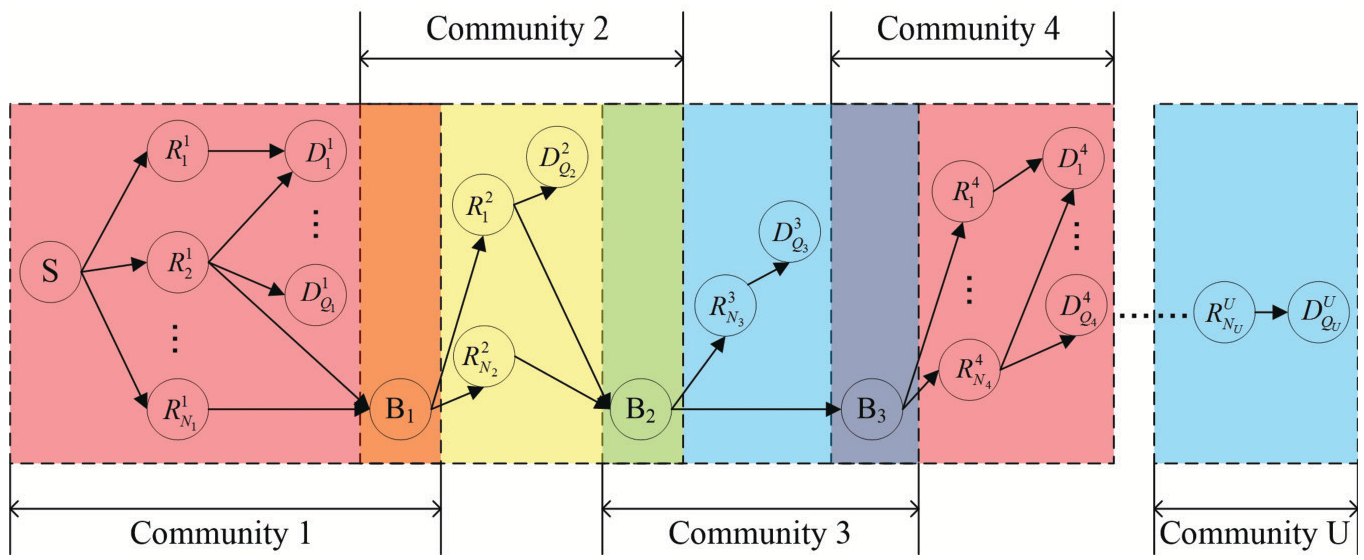 Fig 1: The network topology involving source, relays (SCBS), and communal destinations.
Analytical Bounds
The paper provides a rigorous mathematical framework to calculate the Lower Bound () and Upper Bound () of the coverage probability. This allows network designers to predict performance without running exhaustive simulations.
Experimental Showdown
The researchers compared the three approaches (Uncoded, Standard NC, and ENCFB) across different buffer sizes ( and ).
- Performance Gain: When the buffer size is small (), ENCFB outperforms traditional network coding significantly as the contact rate increases.
- Efficiency (Relay Count): To hit a 98% reliability target ( items), ENCFB is drastically more efficient.
| Method | Buffer Size (C=4) | Relays Needed (dr=3) |
|---|---|---|
| Standard NC | Small | 13 |
| ENCFB | Small | 7 |
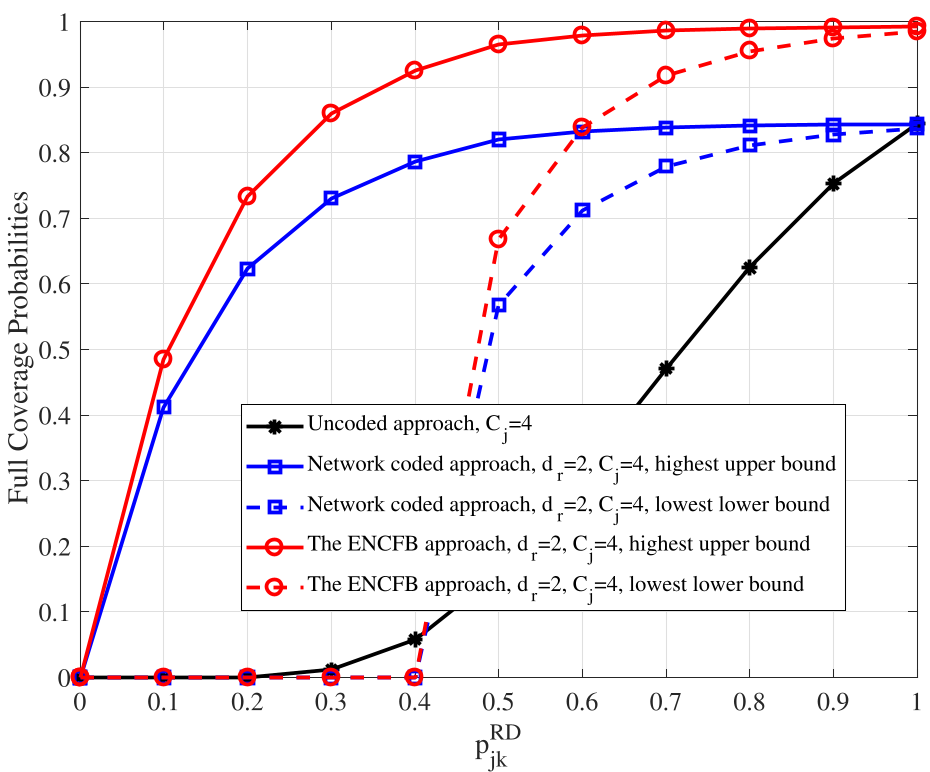 Fig 2: Full coverage probability comparison at Cu=4. Notice ENCFB (green line) maintaining superior performance at high contact rates.
Critical Insight & Practical Value
The real value of this work lies in the Optimization of Infrastructure. In a disaster recovery scenario, deploying 13 relays vs. 7 relays is a massive difference in logistics and cost. By making the coding "buffer-aware," ENCFB allows social networks to be more resilient with less hardware.
Limitations: The study assumes an XOR-type coding in . While efficient, higher-order Galois Fields might offer even better linear independence at the cost of higher computational complexity for the mobile devices.
Conclusion
ENCFB proves that intelligence in the relay (how we code) can compensate for physical limitations (buffer size). This "on-the-fly" combination strategy is a robust blueprint for future 6G communal broadcasting and resilient social network architectures.