
Bridging the Health Language Gap: Automatically Mining Consumer Expressions from Social Media
Expanding Consumer Health Vocabularies by Learning Consumer Health Expressions from Online Health Social Media
The paper introduces an automated framework for Expanding Consumer Health Vocabularies (CHVs) by mining online health social media. Using co-occurrence analysis and a customized ranking function, the method identifies alternative and related expressions for medical concepts, achieving significant increases (over 1000% in some contexts) in the retrieval of health-related social media threads.
TL;DR
Researchers from Drexel University have developed an automated method to bridge the "language gap" between patients and doctors. By analyzing how consumers talk on social media (MedHelp), they've created a system that automatically identifies colloquial health terms (e.g., "watery stools" for "diarrhea"). Their method uses co-occurrence analysis and a specialized ranking formula to expand Consumer Health Vocabularies (CHVs), resulting in a massive boost in our ability to track health trends and drug reactions online.
The "Language Gap" Problem
Medical professionals speak in a dialect of "Jargon"—terms like Paroxysmal Supraventricular Tachycardia (PSVT) or Adverse Drug Reactions (ADR). Patients, however, describe their experiences in "Consumer-speak"—heart fluttering or pills making me dizzy.
Existing vocabularies (CHVs) try to map these two worlds, but they suffer from two major flaws:
- High Manual Effort: They often require experts to manually verify lists.
- Static Nature: Social media language evolves rapidly; manual lists become obsolete quickly.
Methodology: The Logic of Co-occurrence
The core insight of this paper is the Distributional Hypothesis: words that appear in similar contexts share similar meanings. If a user mentions "Luvox" (a drug) and "suicidal thoughts," and another mentions "Luvox" and "suicidal ideations," the system can infer a relationship.
The Extraction Pipeline:
- N-Gram POS Tagging: The system doesn't just look for single words (unigrams). it uses Part-of-Speech patterns to find complex phrases like "Noun+Noun" (e.g., "Heart Disease") or "Adjective+Noun" (e.g., "Watery Stools").
- Ranking with Penalization: To avoid capturing generic words like "the" or "doctor," the authors developed a ranking score ():
- Frequency ( / ): Rewards terms frequent in a specific medical context.
- Specificity (): Penalizes terms that appear across too many different medical topics (signaling they are generic noise).

Experimental Insights
The researchers tested their method on over 170,000 messages from MedHelp.
1. The Power of Bigrams
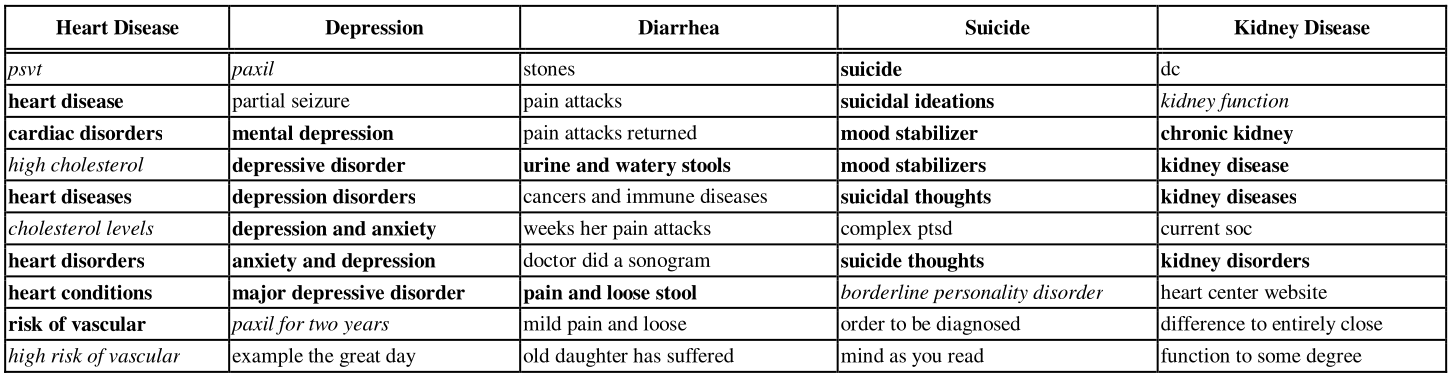
The study found that Bigrams (2-word phrases) are the "sweet spot" for medical expressions. Unigrams (1-word) are often too noisy, while 3 and 4-grams become too rare. As shown in the performance table, bigrams strike the best balance between being descriptive and being frequent.
2. Radical Performance Gains
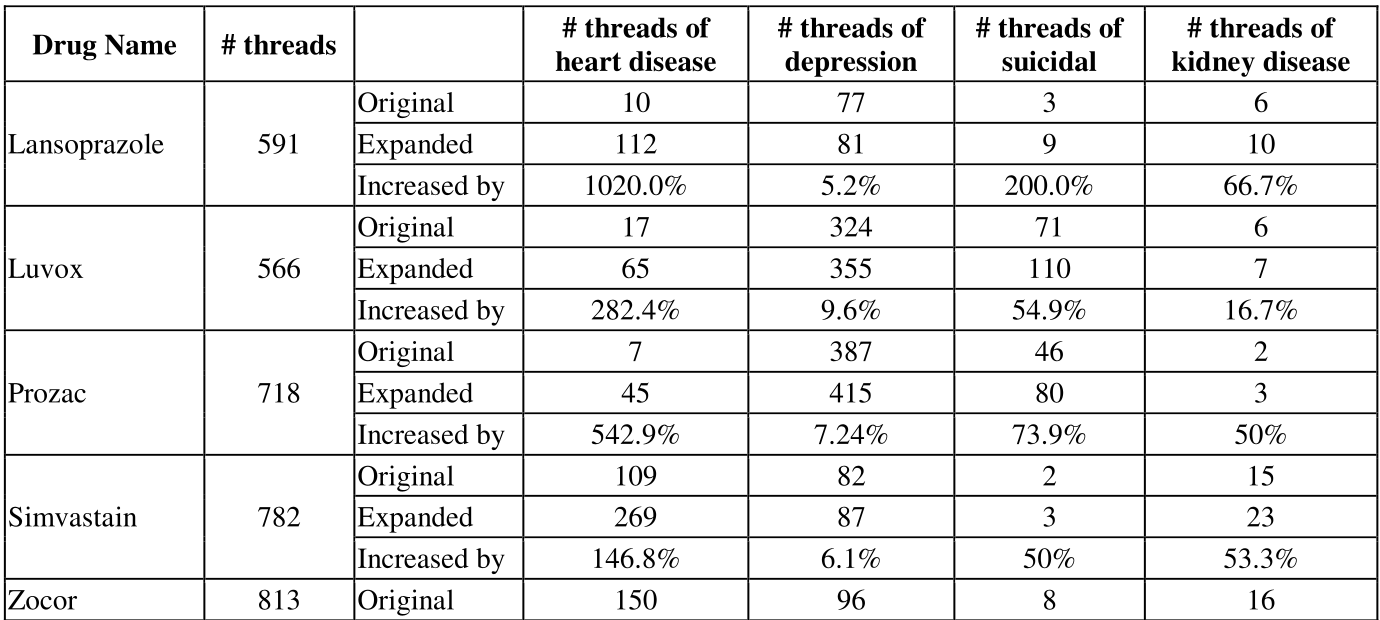
When the authors used their "Expanded CHV" to search for health threads, the results were staggering. For the drug Lansoprazole, the number of identified "heart disease" related threads increased by 1020%. This proves that patients rarely use the "official" names for their symptoms; without an expanded vocabulary, we are missing 90% of the conversation.
Pro Insights & Conclusion
This work represents a shift from top-down vocabulary creation (experts telling consumers how to speak) to bottom-up discovery (listening to how consumers actually speak).
Key Takeaways for Future Research:
- Context Matters: The success of the ranking score suggests that "Specificity" is more important than "Frequency" when mining social data.
- Integration with ADR: This isn't just a linguistic exercise—it's a tool for pharmaceutical safety. By catching these colloquialisms, health agencies can detect drug side effects months before they appear in clinical reports.
Limitations: The system still struggles with very common terms like "diarrhea" because the surrounding noise (unigrams) is so high. Future iterations might benefit from integrating Deep Learning models (like BERT) to better handle the semantic nuances that simple co-occurrence might miss.