
Borrowing Interests from Friends: Solving Feature Sparsity in Social Recommendation
Expanding User Features with Social Relationships in Social Recommender Systems
This paper introduces a feature expansion strategy for social recommender systems by incorporating the attributes of a user's social neighbors. The method, built upon the SVD++ framework, significantly mitigates the feature sparsity problem in platforms like Tencent Weibo and Last.fm.
TL;DR
Recommender systems often struggle when users have little history or few profile tags—a challenge known as feature sparsity. This paper proposes a straightforward yet powerful solution: Feature Expansion. By taking the tags, keywords, and follow histories of a user's friends and injecting them into the user's own model representation, the authors achieved significant gains in accuracy on Tencent Weibo and Last.fm datasets.
The Sparsity Wall
In modern social media, we are overwhelmed by choices. Recommender systems (RS) are supposed to help, but they face a fundamental paradox: to give good recommendations, they need data; but most users provide very little.
Traditional Collaborative Filtering (CF) assumes that if User A and B liked the same items in the past, they will in the future. However, in a real-world system like Tencent Weibo, the interaction matrix density is often under 1%. Even when we use auxiliary data like tags, these are often limited—a user might only have 2 or 3 tags, which is insufficient for the model to understand their nuanced "Latent Space."
The Insight: Social Homophily as a Feature
The authors leverage the sociological concept of homophily—the tendency of individuals to associate with similar others. If your friends are interested in "Machine Learning" and "Heavy Metal," there is a high statistical probability that you share those interests, even if you haven't explicitly tagged yourself yet.
Instead of just using social links as a "regularizer" (forcing friends to have similar latent vectors), this paper treats a friend's attributes as expanded features for the user.
Methodology: Enhancing SVD++
The study builds on SVD++, an extension of Singular Value Decomposition that allows the incorporation of implicit feedback.
1. The Core Equation
The standard SVD++ model predicts a rating by combining a user's explicit latent factor with their implicit signals (like history). The authors expand this by adding a third term:
- : User's own implicit feedback (e.g., tags).
- : User's social neighbors (friends).
- : The features borrowed from friends.
2. Feature Selection Strategy
To prevent a "feature explosion" (where a user with 500 friends imports thousands of noisy tags), the authors implemented a selection strategy:
- Frequency Filtering: They select the top- (usually ) most common features among a user's friends.
- Normalization: The weight () of each expanded feature is based on its frequency within the friend group.
 (Formula represents the integration of implicit and social signals into the latent factor)
Experimental Battleground
The researchers tested their approach on two massive real-world datasets:
- Tencent Weibo: Focuses on professional status, keywords from tweets, and "follow" actions.
- Last.fm: Focuses on music artists and tagging behavior.
Key Results
The "Expanding Features" outperformed original features in several categories:
| Feature Type | Baseline (SVD) | User Only (SVD++) | Expanded (SVD++ + Social) |
|---|---|---|---|
| Keywords (Weibo) | 0.3595 (MAP) | 0.3653 | 0.3770 |
| Tags (Last.fm) | 14.91% (Recall) | 15.93% | 21.22% |
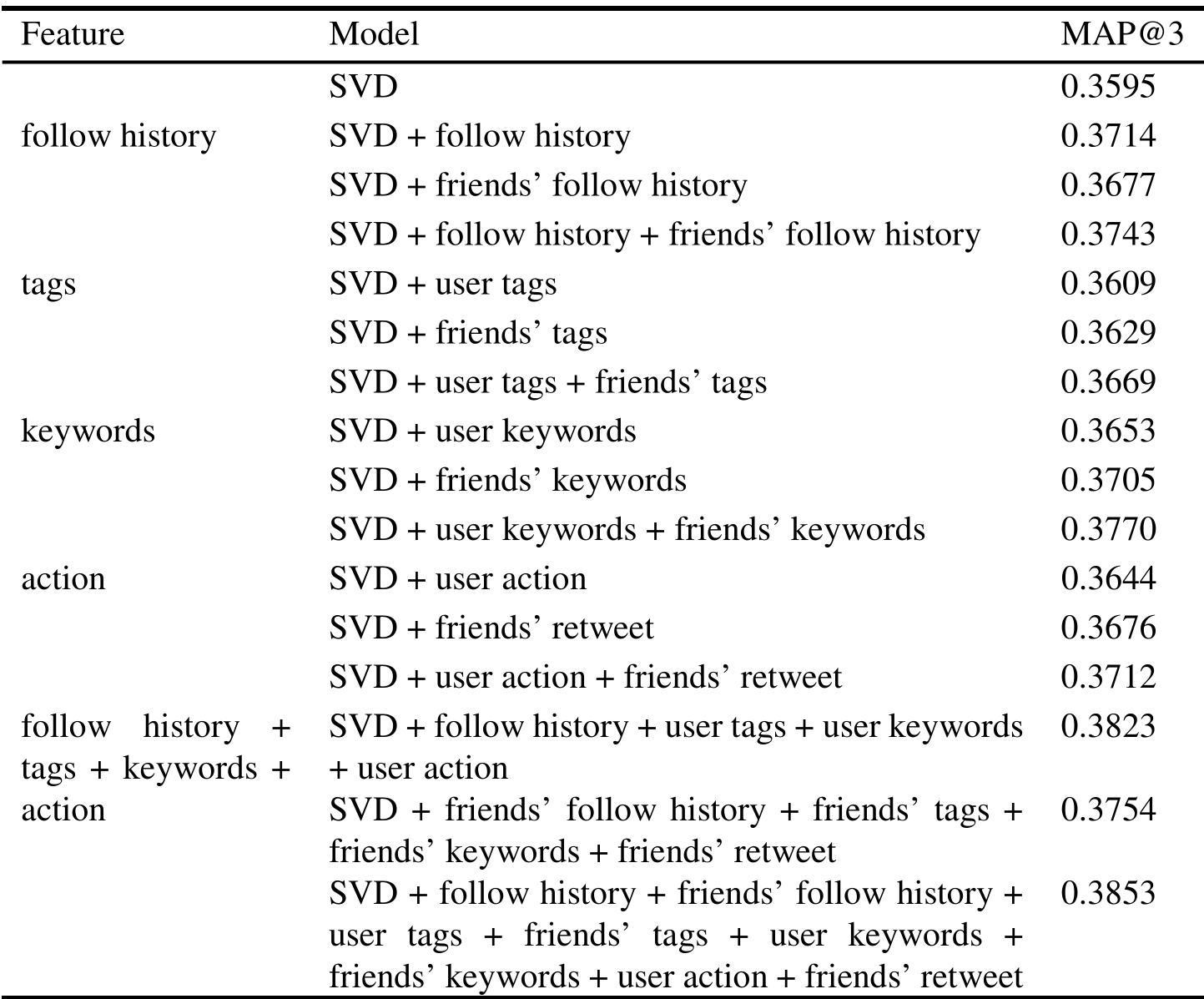 (Table shows that combining user features with friend features consistently yields the highest MAP)
Critical Insight: Why does it work?
The most striking takeaway is that for tags and keywords, friends' features were sometimes more useful than the user's own features. This suggests that our social circle often provides a "denoised" and "aggregated" view of our interests that a single sparse profile cannot capture.
Conclusion & Future Outlook
This work demonstrates that social ties are not just links in a graph; they are conduits of information. By "borrowing" features from a user's network, we can effectively bridge the gap caused by data sparsity.
Limitations: The current model uses a static selection strategy (Top-K). Future iterations could benefit from Attention Mechanisms to dynamically weight which friends are most influential for specific types of recommendations. However, in 2012, this was a pioneering step toward feature-based social recommendation.