
Beyond Static Archives: Co-Creating the Hakka Cultural Experience Through Adaptive AI
Experience Co-Creation on Ubiquitous Cultural e-Service Provision: A Case of Taiwan's Hakka Culture
This paper introduces a collaborative, mobile-based cultural recommendation service specifically designed for preserving and promoting Taiwan's Hakka culture. It employs a TF-IDF weighted tagging system and an online adaptive clustering algorithm (ECM) to purify user-contributed knowledge and provide personalized travel recommendations.
TL;DR
Preserving a fading culture requires more than just a digital library; it requires a living ecosystem. This paper presents a ubiquitous e-service for Taiwan’s Hakka culture that turns travelers into contributors. By applying TF-IDF filtering and Evolving Clustering (ECM) to user-generated tags, the system moves beyond simple keyword matching to provide a dynamic, "purified" recommendation engine that evolves as more people share their journeys.
The Problem: The "Information Cloud" and Passive Preservation
Digital cultural preservation often falls into two traps:
- Top-Down Passivity: Information curated by researchers is often too specialized or dry for the average tourist, leading to low adoption.
- The Frequency Illusion: In systems that allow user tags, common words (e.g., "Good", "Nice") often dominate the rankings. This creates a "noise" problem where the most frequent tags are actually the least informative.
The authors argue that for Hakka culture—a heritage fading as the elderly pass away—we need a Ubiquitous Experience Co-Creation model. The challenge is: how do you take thousands of messy, heterogeneous user comments and turn them into a high-quality recommendation service?
Methodology: From Raw Tags to Semantic Clusters
The researchers developed a four-component architecture (Gathering, Presentation, Database, and TF-IDF Module) to facilitate a continuous cycle of knowledge refinement.
1. The TF-IDF Filter
Instead of counting how many times a tag appears (Term Frequency), the system balances it against Inverse Document Frequency (IDF).
- The Logic: If a word like "Hakka" appears frequently in one document but is rare across the entire database, it has high discriminative power.
- The Result: Meaningless particles and overly generic adjectives are suppressed, while culturally significant terms are elevated.
2. Evolving Clustering Method (ECM)
Traditional clustering (like K-Means) is "static"—you have to tell it how many groups to find, and it can't easily handle new data. The authors opted for ECM, which is significantly more robust for e-services:
- No Historical Baggage: It updates clusters as new data flows in without re-processing the entire history.
- Self-Organizing: It generates clusters based on the actual distribution of user opinions, not a pre-set number.
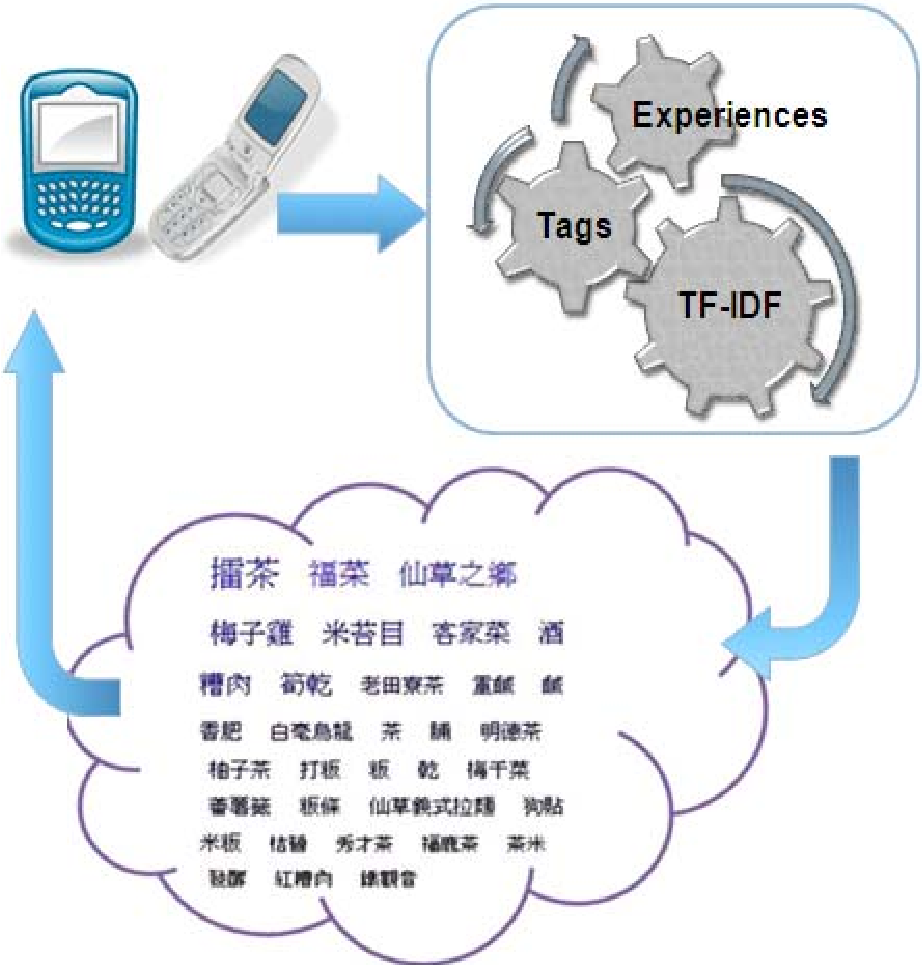 Figure: The cyclical flow of information from user contribution to purified recommendation.
Two-Stage Search: A Better UX
The methodology enables a clever search UX:
- Stage One: A user enters a query; the system finds documents with the highest TF-IDF values for those terms.
- Stage Two: Once the user selects a relevant document, the system identifies the Cluster Center that document belongs to. It then recommends "representative documents" from that cluster—essentially moving the user from a narrow keyword search to a broader exploration of related cultural topics.
Experimental Insight: Why This Works
The paper emphasizes that cultural knowledge is subjective. By using the partial Euclidean distance in their algorithms, the system can allow for an increasing number of keywords without breaking the underlying logic. This allows the "Tag Cloud" of Hakka culture to grow organically while the AI ensures that the most "representative" experience is always at the forefront.
Critical Analysis & Future Outlook
While the technical framework is sound, the authors acknowledge a critical human factor: the Will-to-Share. A recommendation system is only as good as its contributors. They propose using "e-coupons" or "reputation points" to incentivize experts and tourists.
Future Directions:
- Incentive Design: How do we gamify cultural preservation?
- Social Utility: Measuring how much of this shared knowledge actually finds its way into educational curricula.
- Cross-Modal Tags: Could this be expanded to include photos or audio snippets of the Hakka dialect?
Conclusion
This work sits at the intersection of Information Management and Heritage Preservation. It proves that by using relatively lightweight AI techniques like TF-IDF and online clustering, we can build ubiquitous services that don't just store culture, but actively "co-create" it with the community.