
Experience Discovery: Bridging Social Context and Student Growth via Hybrid Recommendation
Experience Discovery: hybrid recommendation of student activities using social network data
The paper introduces "Experience Discovery" (xDisc), a hybrid recommender system designed to suggest extracurricular activities to urban youth. It leverages a multi-layer hybrid approach combining attendance data, activity content features, and social network behavioral data to achieve 100% coverage and improved precision for diverse user profiles.
TL;DR
The Experience Discovery (xDisc) project tackles the unique challenge of recommending extracurricular activities to urban students. By moving beyond simple attendance tracking and integrating social network behavioral data (media uploads, social interactions) with activity content, the researchers developed a hybrid system that ensures every student receives a recommendation (100% coverage) and better serves students with diverse interest profiles.
Problem & Motivation: Why Student Activities are Different
Recommending an after-school workshop is fundamentally different from recommending a movie on Netflix. The authors identify three critical "domain-specific" frictions:
- Lack of Portfolio Effect: Unlike a movie you watch once, a student might attend a "book club" every week. The system must recognize that repeat attendance is a sign of high interest, not redundancy.
- Social Motivation: Students often choose activities because their friends are there, making content-based profiles (e.g., "I like math") incomplete.
- Persuasion & Depth: The goal isn't just to satisfy current interests but to nudge students from "hanging out" (casual) to "geeking out" (deep mastery).
Existing collaborative filtering (CF) methods often suffer from sparsity—if a student has only attended one or two unique events, the system can't find "neighbors" to provide recommendations, leading to low coverage.
Methodology: The Three-Way Hybrid
To solve the sparsity problem, the authors moved from simple binary vectors to a sophisticated Meta-Level Hybrid profile.
1. The Architecture
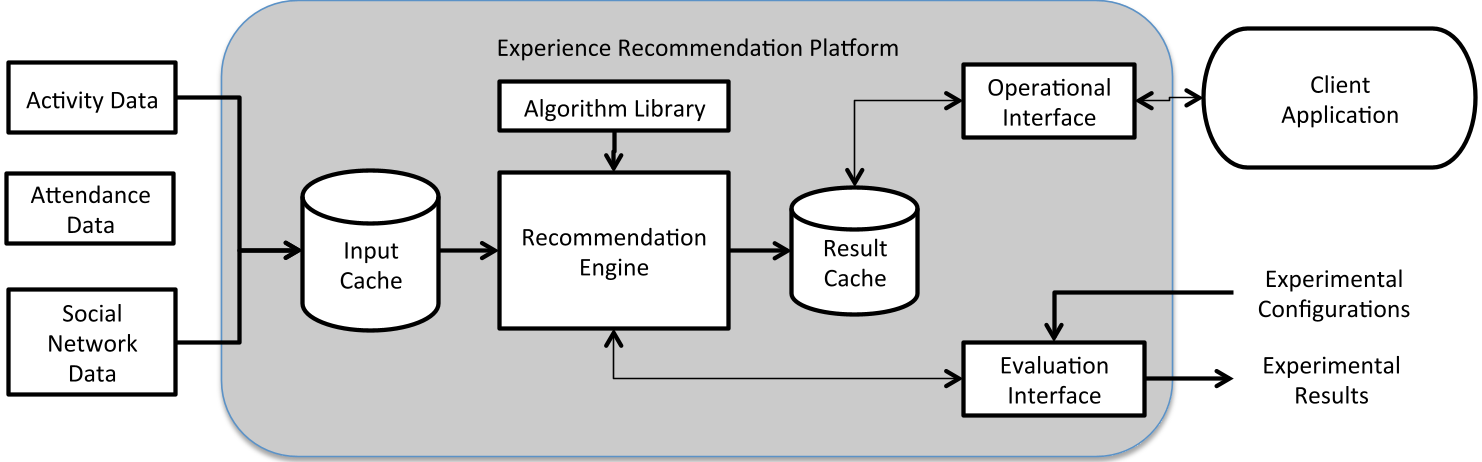
The xDisc architecture acts as a bridge between attendance databases (CitySpan) and social media platforms (YouMedia). It computes recommendation lists periodically to ensure low-latency delivery to the student-facing app.
2. Feature Engineering
The "Secret Sauce" of this paper lies in the user profile construction:
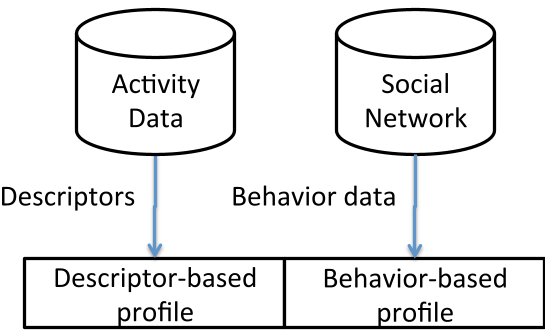
- Pseudo-Ratings: Using a modified TF-IDF, where 'Term Frequency' is the number of times a student attends an activity. This captures the intensity of engagement.
- Content Descriptors: 13 skills (Music, Career, Health, etc.) are mapped to activities.
- Social Behavior (The Social Link): They extracted 10 features from the social network, including user contributions (blog postings, photos) and social activity (outbound friend links, comments).
Experiments & Results: The Power of Social Data
The researchers compared a basic Binary model, a Rating model, and two Hybrids.
| Algorithm | MAE | Coverage | Precision@5 |
|---|---|---|---|
| Binary | 0.1097 | 57.9% | 15.7% |
| Rating | 0.0931 | 72.0% | 11.3% |
| Hybrid 2 (Social) | 0.1253 | 100.0% | 11.6% |
While the Binary model had higher precision for the users it could find neighbors for, it failed nearly 42% of the time (Low Coverage). Hybrid 2 (incorporating social data) achieved 100% coverage, meaning no student was left without a suggestion.
Deep Insight: Handling Diversity
The authors categorized users by profile size and diversity. A key finding was that for High Diversity users (U6)—those who explore many different types of activities—the social-hybrid model outperformed others.
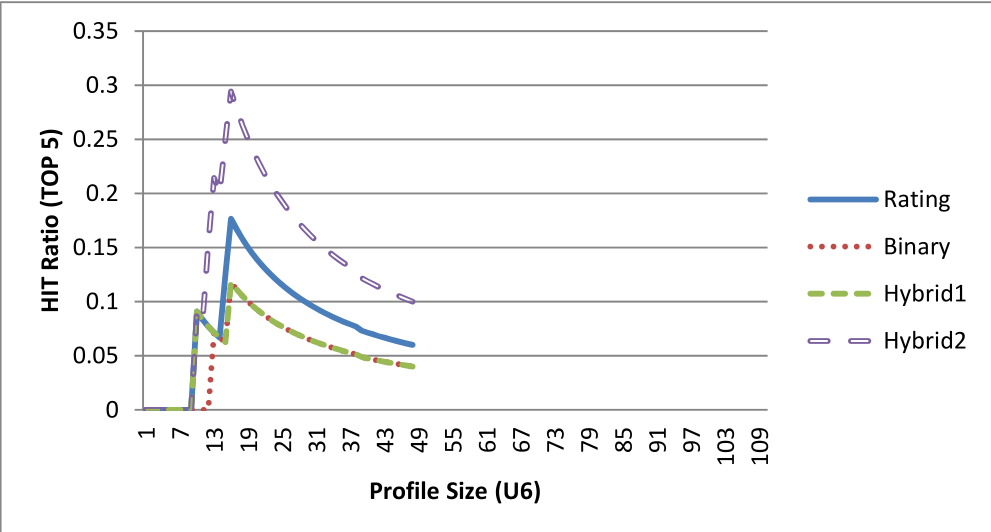
This suggests that when a student's interests are scattered, their behavioral patterns on social media (how they interact, what they upload) provide the "missing link" to identify similar peers that attendance data alone cannot find.
Critical Analysis & Conclusion
Takeaway: The "Experience Discovery" project demonstrates that in specialized domains like youth education, "more data" isn't just about quantity—it's about heterogeneity. Integrating social activity indicators allows the system to remain robust even when explicit interest data (attendance or ratings) is sparse.
Limitations:
- The dataset was relatively small (226 students), which explains the generally low precision across all models.
- The "Social Features" were aggregate counts (e.g., number of blog posts). More advanced NLP on the content of those posts could likely boost accuracy further.
Future Outlook: This work lays the groundwork for "Persuasive Recommendation"—systems that don't just follow a user's past but actively guide them toward educational growth by leveraging their social identity.