
IBM's Datalake Blueprint: Solving the Chaos of Corporate Data Ingestion
Experiences with Managing Data Ingestion into a Corporate Datalake
This paper details the architecture and operational experiences of managing a large-scale corporate Datalake at IBM. It introduces a multi-zone ingestion framework (DropZone, LandingZone, IntegrationZone) and a "data asset" abstraction to automate and govern the ingestion of heterogeneous data from distributed relational databases into a centralized HDP-based platform.
TL;DR
Building a Datalake is easy; managing its growth across a global corporation is hard. IBM Research shares their two-year journey of running a production Datalake that ingests billions of rows daily. The secret sauce? A multi-zone architecture (DropZone/LandingZone) and a clever "SQL-triggered" ingestion mechanism that bridges the gap between traditional database admins and modern Big Data ecosystems.
Problem & Motivation: The Silo Struggle
In a massive corporation, data is everywhere—geographically dispersed, locked in relational databases (DB2, MySQL, Netezza), and owned by teams with varying technical skills.
The authors identified several critical pain points:
- The Ownership Gap: Data owners understand their source systems but know nothing about Kerberos, HDFS, or Spark.
- Operational Interference: Direct ingestion from production systems often leads to locked tables or performance degradation at the source.
- Inconsistent Governance: Without a central catalog and audit trail, the Datalake quickly becomes a "Data Swamp" where no one knows the origin or sensitivity of the files.
Methodology: The Three-Zone Strategy
The core innovation lies in the architectural separation of concerns through specialized zones.
1. The Zones of Trust
- DropZone: A temporary, ungoverned area where producers move their data using their own tools (e.g., DataStage).
- LandingZone: The "Canonical" store. It is immutable, governed, and only accessible via the official ingestion process. Data is stored in Parquet format for efficiency.
- IntegrationZone: Where data is transformed and enriched for specific project needs.
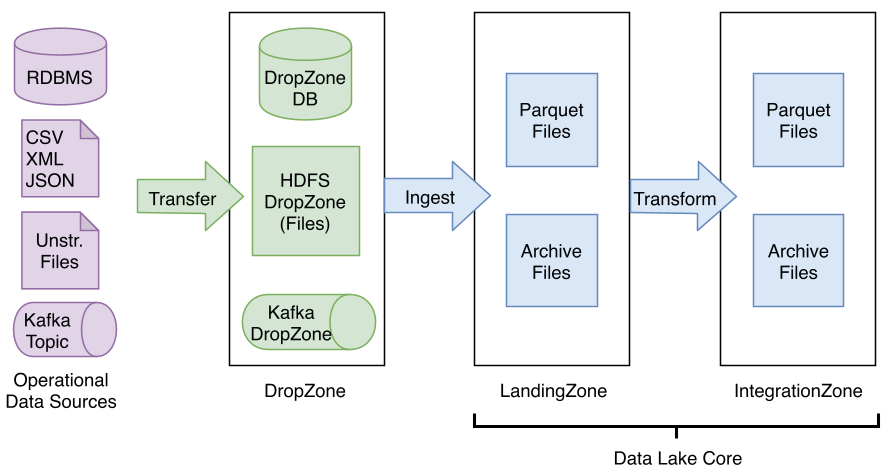
2. Implementation: SQL as the "Remote Control"
One of the most practical insights is the DropZone UDF. Instead of asking DBAs to learn REST API calls, the team created a SQL User Defined Function. A producer simply runs:
SELECT ingest_to_datalake(table_name, target_params) FROM MyDatabase;
This action signals the Ingestion Controller (IC) via Zookeeper. The IC is a stateless service running in Kubernetes that competes for jobs and kicks off Oozie workflows.
3. Handling Security with Kerberos & LDAP
Security was integrated using Kerberos for internal cluster communication and Apache Ranger for fine-grained access control. To simplify the user experience, humans interact via gateways (Knox/BigSQL) using standard corporate LDAP credentials, while the system services handle the Kerberos-level impersonation.
Experiments & Results: Performance at Scale
The platform's scale is impressive:
- Throughput: 3,000 ingestions/day, roughly 4 billion rows.
- Latency: 94% of jobs finish within 15 minutes.
- Parallelism: Thanks to YARN, up to 100 tables can be ingested simultaneously.
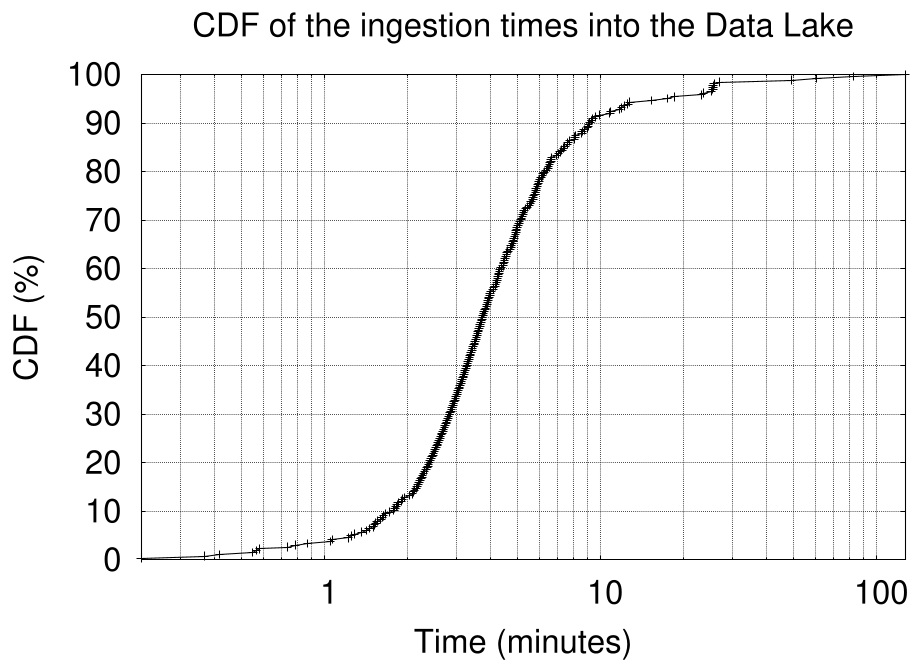
The team found that while Sqoop was the workhorse for relational data, its SPLITBY feature was often a double-edged sword. Skewed data ranges frequently caused resource waste, leading them to advise producers to use uniform distribution columns for parallel mapping.
Critical Analysis & Conclusion
The Takeaway
The IBM experience confirms that successful Datalakes are 20% technology and 80% management. The DropZone concept is brilliant because it minimizes friction for data producers while providing a "firewall" for the Datalake admins. By making ingestion "self-service" through SQL, they achieved high adoption rates.
Limitations & Future Work
- Batch vs. Streaming: While batch ingestion is mature, streaming ingestion into structured formats (BigSQL) remains difficult because Parquet files are immutable.
- Change Data Capture (CDC): Moving full tables daily is expensive. The authors are actively researching how to automate CDC—sending only modified rows—without adding complexity for the data owners.
In summary, this paper serves as a pragmatic handbook for any enterprise engineer struggling to move from a experimental Hadoop cluster to a reliable corporate data asset.