
Understanding Churn in the Digital Lab: Why Social Media Users Abandon Experiments
Designing an Experiment on Recognition of Political Fake News by Social Media Users: Factors of Dropout
This paper examines user dropout factors in social media-based (SNS) experiments focusing on political fake news recognition. Using a custom-built survey tool deployed on Facebook and Vkontakte (VK), the study identifies education level, geographic location, and response speed as critical predictors of participant retention, effectively achieving 1,816 complete responses despite high dropout rates (60-65%).
TL;DR
Conducting research on social networking sites (SNS) like Facebook and Vkontakte (VK) offers unparalleled scale but faces a "silent exit" problem. This study reveals that 60-65% of users drop out, driven primarily by low personal interest—signaled by high response speed—and lower education levels. Interestingly, technical factors like mobile usage or screen density (1 vs 2 questions) do not impact retention as much as the psychological "transition" between fun tasks and formal surveys.
The "Digital Immigrant" vs. "Digital Native" Paradox
Recruiting participants via Facebook or VK ads seems like a shortcut to representative sampling. However, the authors discovered a disturbing trend: identical ad campaigns produced opposite age biases on different platforms. VK skewed heavily toward the youth (median age 19), while Facebook skewed toward an older demographic (median age 52). This suggests that the platform’s black-box ad algorithms, rather than organic user interest, might be the "invisible hand" shaping academic datasets.
Methodology: The Experimental Pipeline
The researchers designed a 14-screen flow that moved from a "game-like" environment—judging the truthfulness of political news items—to a socio-demographic survey.
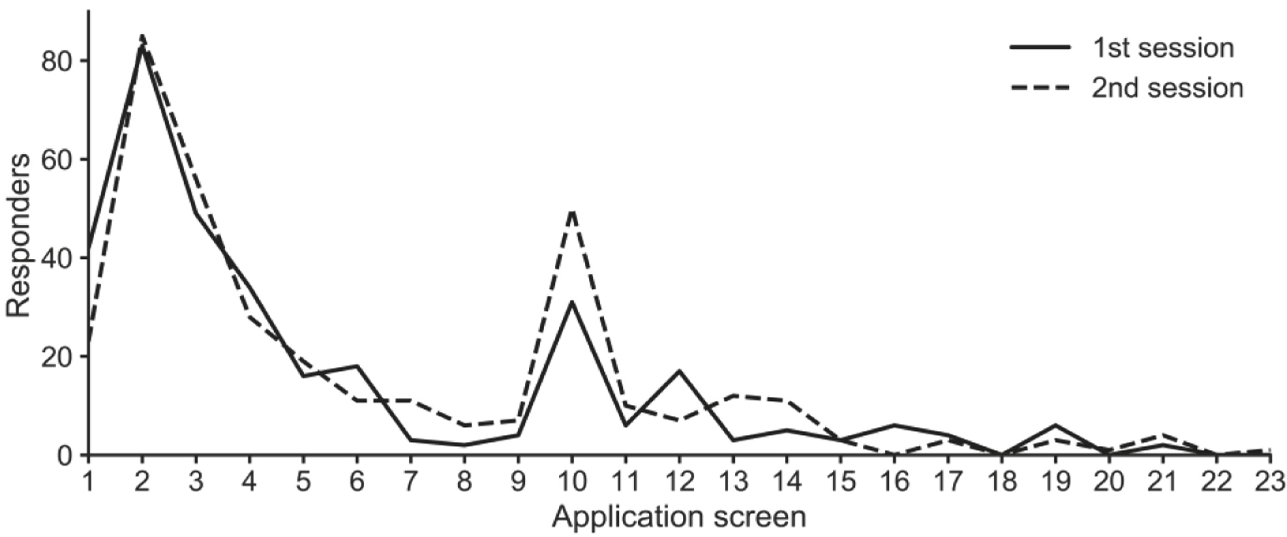 Figure 1: Comparison of dropout points between VK (App-based) and Facebook (Web-based).
By swapping the order of questions in the pilot study, the team was able to verify that the "dropout peak" wasn't caused by the content of the questions (no one ran away from political inquiries), but rather the shift in format from experiment to standard survey.
Key Insights: What Actually Drives Dropout?
1. The Speed Trap
In many UX contexts, "fast" means "efficient." In research, the authors found the opposite: high speed is a proxy for low interest. Users who eventually dropped out spent 6.3x less time per item than those who finished. They weren't struggling; they were bored.
2. The Education Barrier
Higher education was a strong negative predictor for dropout (β = -0.22). The study suggests that politically-themed experiments might be perceived as an "intellectual challenge," naturally selecting for a more educated cohort and potentially skewing "citizen awareness" data.
3. Mobile is Not the Enemy
Contrary to the long-standing belief that mobile users are too distracted to finish long surveys, the data showed no statistical difference between mobile and desktop dropout rates. Modern users are sufficiently adapted to small screens, provided the interface is responsive and eliminates the need for horizontal scrolling.
Experimental Analysis & Results
The final results, summarized in Table 2, debunked several common myths in online research:
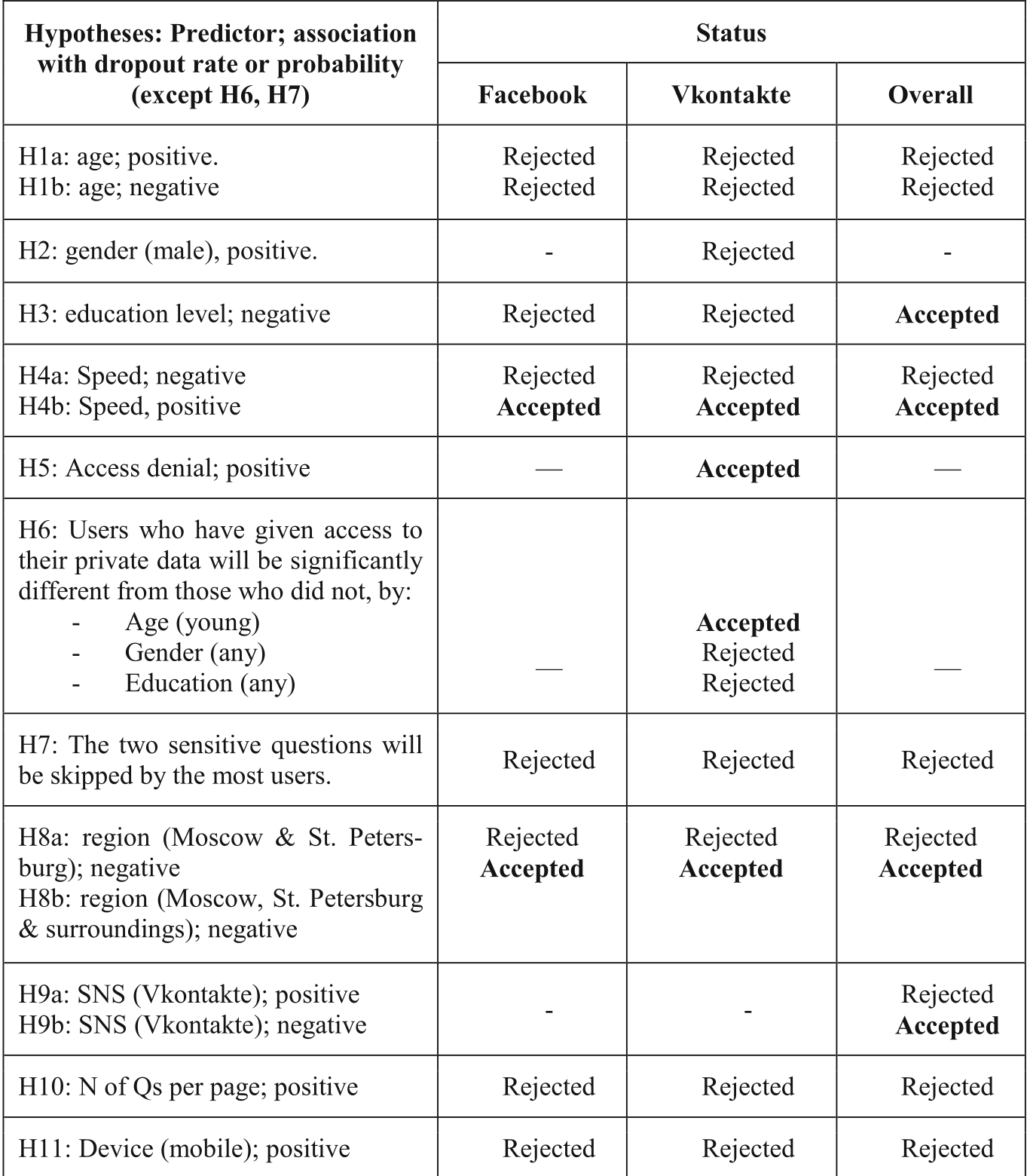 Table 2: Status of various hypotheses across platforms.
- Gender (H2): Played no role in retention.
- Privacy (H5): Users who refused to grant the app access to their account data were significantly more likely to drop out early.
- Sensitivity (H7): Questions about political loyalty to the government did not trigger abandonment, suggesting that "sensitive" topics in non-democratic contexts might not be as much of a deterrent as researchers fear once a user is already engaged.
Critical Insight & Conclusion
The "takeaway" for the modern researcher is that engagement is fragile during format shifts. The peak dropout occurred the moment the "fun" part of judging news ended and the "work" part of answering demographics began.
Future Outlook: To combat 65% churn, researchers must bridge the gap between gamification and formal data collection. If the transition feels like a different app, the user treats it like an exit. Moreover, the reliance on SNS ad systems requires rigorous "cleaning" of the resulting demographics to counteract the algorithms' inherent biases.
Limitations
The study focused on a 2019 Russian context. Changes in platform privacy APIs (like Facebook's post-2018 restrictions) and the rise of short-form content (TikTok style) may have further decreased the average user's attention span since this data was collected.