
STBAC: Redefining Social Privacy Through Dynamic Trust Computation
Experimental Analysis on Access Control Using Trust Parameter for Social Network
The paper introduces STBAC (Trust Based Access Control for Social Networks), a dynamic security framework that utilizes interaction-based trust metrics to manage data sharing. It employs four distinct parameters—Credibility, Direct Trust, Reliability, and PeerTrust—to automate the classification of friends into privileged or unprivileged zones, achieving a more granular defense against malicious nodes.
TL;DR
Social networks are moving beyond simple "Friend" or "Unfriend" buttons. This paper proposes STBAC, a system that monitors your digital interactions—likes, comments, and shares—to automatically decide who gets to see your private photos and who stays on the "unauthorized" list. By treating trust as a mathematical variable that changes over time, it effectively filters out dummy nodes and malicious users.
Background: The Static Privacy Trap
In current social platforms, privacy settings are remarkably rigid. Once you grant someone "friend" status, they typically retain access to your data indefinitely, regardless of whether you still talk to them. This creates a security gap where "dummy nodes" (inactive or malicious accounts) can harvest personal information. The authors argue that trust in the digital world should mirror real-life: it must be earned, monitored, and subject to change.
The Core Engine: How STBAC Computes Trust
The genius of the STBAC model lies in its four-pillar mathematical approach to human behavior:
- Credibility (Cr): Measures the balance of interaction. Are you just broadcasting, or is there a genuine two-way conversation?
- Direct Trust (T): Calculates the intensity of your interaction with a specific friend compared to your total social activity.
- Reliability (R): A cross-verification metric. If you interact with someone who has high credibility, your own reliability score increases.
- PeerTrust (PT): An aggregate reputation score that minimizes the impact of malicious "clusters."
System Architecture
The workflow involves a five-module pipeline: Basic Settings, Trust Standard Setting, Feedback Management, Access Control Decision, and the Trust Computation engine.
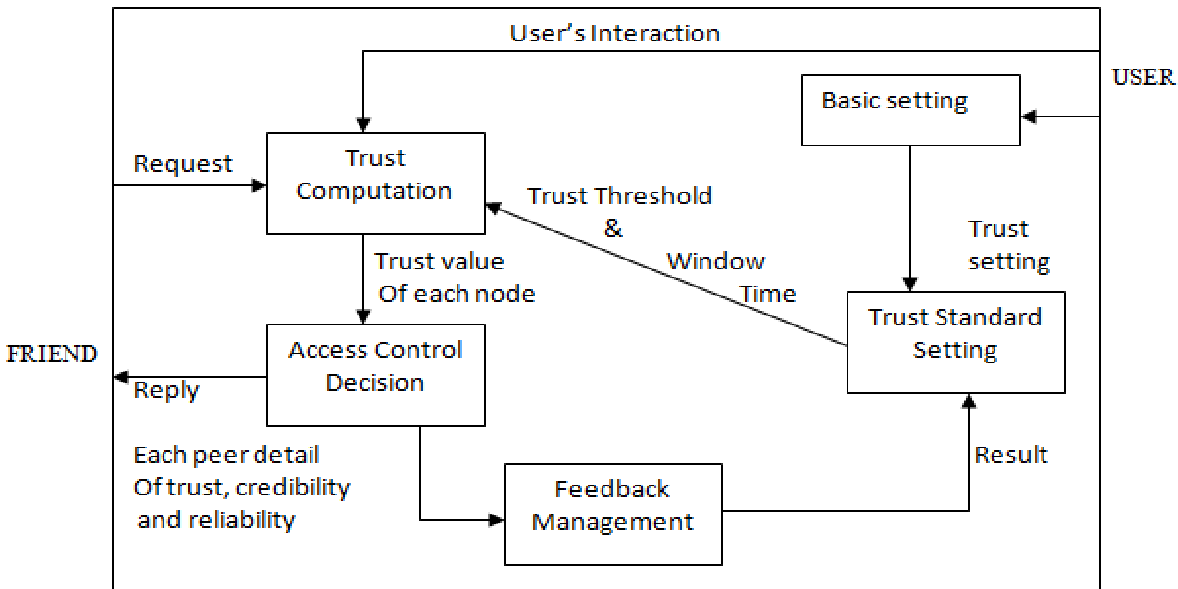
From Equations to Access Control
The methodology moves away from static roles. Instead, it uses a Trust Threshold (TTh) and a Time Window. For example, if you set a "Weekly" window with a 60% threshold, the system analyzes interactions over the last 7 days. If a friend's trust value exceeds the TTh, the system prompts a "Grant Access" notification.
The mathematical logic follows a simple but effective flow:
- Positive Transaction Balance (d > 0): Increases Credibility.
- High-Frequency Interaction: Boosts Direct Trust.
- Low Interaction / Malicious Behavior: Drops the node into the "Unauthorized" zone.
Experimental Insights: Identifying Dummy Nodes
The researchers tested the model across a sample group (Shruthi, Anil, Sayooj, etc.). The results found that the system is highly sensitive to the "quality" of connections.

As shown in the table above, users like Sayooj (83.33% Credibility) are identified as high-value peers. Conversely, the system demonstrated that interacting with low-credibility nodes (like Saumya at 28.57%) immediately reduces a user's Reliability score. This creates a "network immunity" effect where users are incentivized to maintain healthy, high-credibility interactions to keep their own status.
Critical Analysis & Conclusion
Takeaway: STBAC provides a much-needed dynamic layer to social media security. By automating the categorization of friends into "Authorized" and "Unauthorized" based on actual behavior, it reduces the manual burden on users to prune their friend lists.
Limitations:
- The model currently relies on quantitative transaction counts (numbers of likes/comments) but does not yet account for the quality or sentiment of those transactions. A malicious user could theoretically "spam" likes to harvest trust.
- High computational overhead for very large networks with millions of nodes.
Future Work: The authors suggest adding a Penalty Module—a feature that would drastically slash trust scores for suspicious activity spikes, making the system even more resilient to bot-driven social engineering.