
Better than Logarithmic: How Small Memory and Asynchrony Supercharge Rumor Spreading
Experimental Analysis of Rumor Spreading in Social Networks
This paper presents an experimental analysis of randomized rumor spreading (push-pull protocol) across various network topologies, specifically focusing on Preferential Attachment (PA) models and real-world social networks like Twitter and Orkut. The study demonstrates that equipping nodes with a tiny amount of memory (storing just one previously contacted neighbor) significantly reduces information dissemination time, especially in scale-free networks.
TL;DR
Information spreads faster on social networks than on almost any other structure. This paper proves through extensive experiments that two simple factors—one-item memory and asynchrony—are the secret sauce that allows rumors (or data) to saturate a network in sublogarithmic time. While classical networks like Hypercubes barely benefit from these tweaks, social-like Preferential Attachment (PA) graphs see massive performance leaps.
The Intuition: Why Memory Matters
In standard randomized rumor spreading, a node picks a neighbor at random. In a dense or hub-and-spoke environment (like a social network), there is a high probability of "wasting" a turn by calling the same person twice in a row.
The authors investigate the Random Phone Call model. The core insight is that by simply remembering who you just talked to and excluding them from the next round, you break the "local entrapment" of information. This isn't just a minor optimization; in Preferential Attachment graphs, it changes the fundamental complexity class of the spreading time.
Methodology: Putting Models to the Test
The researchers compared four main graph types:
- Preferential Attachment (PA): Models "rich-get-richer" social growth.
- Random-Attachment: A control group where degrees are more uniform.
- Complete Graphs: Everyone connects to everyone (the baseline for speed).
- Hypercubes: High-dimensional grids.
They tested two protocol variations:
- Memory (): A node avoids its last contacts.
- Asynchrony: Nodes don't wait for "rounds"; they act according to independent Poisson clocks.
Architecture of Spreading
The paper highlights that in PA networks, information doesn't follow the shortest paths. Instead, it takes "detours" through high-degree hubs.
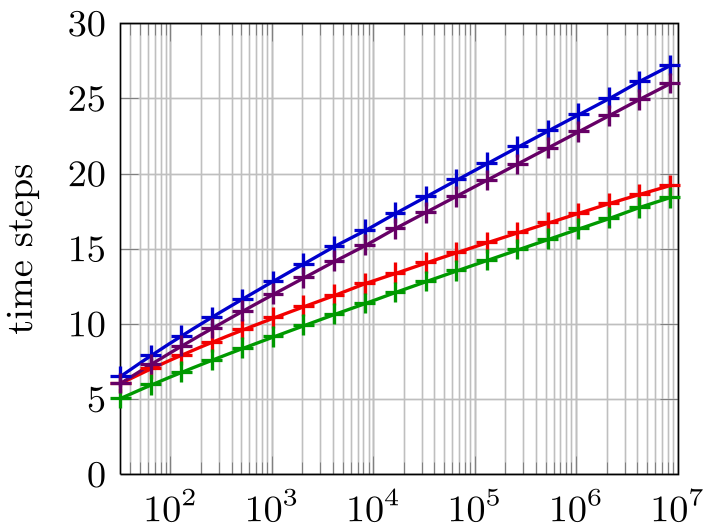 Figure 1: Comparison of broadcast times across different graph classes. Note how PA graphs (stars) outperform traditional models as increases.
Key Findings: The Power of One
The most striking result is the "Law of Diminishing Returns" for memory.
- Zero to One: Moving from no memory to a 1-item memory reduces spreading time in PA graphs by up to 21%.
- One to Infinity: Adding more memory slots (up to 25 or more) only provides an additional ~2% gain.
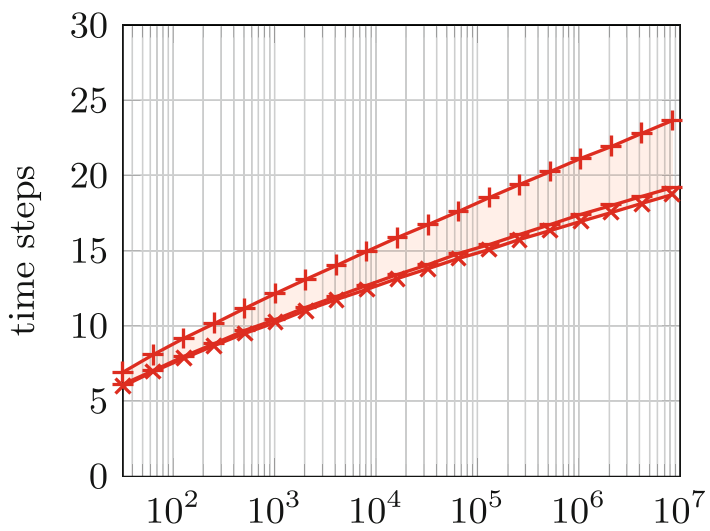 Figure 2: The effect of memory size on different topologies. PA and Random-Attachment graphs show a visible gap between "no memory" and "memory," while Hypercubes and Complete graphs show almost overlapping lines.
Real-World Validation: Twitter and Orkut
Theory is good; Twitter data is better. The authors used a crawl of 51 million Twitter nodes.
- Finding: News spreads even faster in real-world social networks than in the mathematical PA model.
- Asynchrony: Real-world communication isn't clocked. When the authors simulated an asynchronous model, the speedup was dramatic. In the Orkut network, the asynchronous version reached nearly 100% saturation while the synchronous version was still struggling at 84%.
Critical Analysis
Why does this work?
In a Preferential Attachment graph, "hubs" (nodes with massive degrees) act as information super-highways. In a synchronous, memoryless model, a hub might be contacted by hundreds of nodes simultaneously, leading to redundant "pulls." Asynchrony staggers these interactions, ensuring the hub's capacity to spread information is used more efficiently over time rather than being overwhelmed in a single discrete round.
Limitations
- Undirected Modification: The authors converted Twitter's directed graph to an undirected one. In reality, "Follower" vs "Following" relationships create a bottleneck that might slow down rumors.
- The "Last Node" Problem: While 99% of a network is informed rapidly, the last 1% (isolated nodes) always takes significantly longer, a tail-end latency that memory doesn't fully solve.
Conclusion and Future Work
This study bridges the gap between theoretical "big-O" notation and practical network engineering. It proves that to optimize a distributed system (like a P2P network or a content delivery network) that has scale-free properties, you don't need complex tracking—just a simple 1-item cache and asynchronous execution.
For future research, the authors point toward exploring "knowledge-based" protocols where nodes know which neighbors are already informed, further pushing the boundaries of dissemination efficiency.
Academic Insight: This work reinforces that the "topology-aware" design of randomized algorithms is crucial. A protocol that is "just okay" on a Hypercube can be "state-of-the-art" on a Social Network if it leverages the specific degree distribution of that network.