
Beyond the "Like" Button: How Groups Actually Reach Consensus on Complex Arguments
Experimental Assessment of Aggregation Principles in Argumentation-Enabled Collective Intelligence
This paper presents the first experimental assessment of aggregation principles in "contested domains" using Abstract Argumentation Frameworks. It compares the Argument-Wise Plurality Rule (AWPR) against Sceptical/Credulous Operators (SSCOs) to determine how collective intelligence should resolve conflicting claims.
TL;DR
When we argue online, we don't just vote on isolated facts; we navigate a web of interconnected claims. This paper identifies that while people generally prefer "Majority Rule" (Plurality) for group decisions, they instinctively switch to more "Cautious Consensus" (Compatibility) when a decision might hurt someone or when the opposition is significant.
Background: The Limits of Social Media Voting
Current collective intelligence tools (Facebook, Twitter, Reddit) are flat. They allow us to "Like" or "Upvote" individual posts, but they ignore the logical structure of an argument. If Argument A is defeated by Argument B, and I accept B, I must reject A.
The authors position this work at the intersection of Social Choice Theory and Artificial Intelligence, moving from purely mathematical "postulates" to human-centric behavioral evidence.
The Core Conflict: Plurality vs. Compatibility
The study pits two fundamental philosophies of collective intelligence against each other:
- AWPR (Argument-Wise Plurality Rule): Every argument is decided by a local majority. It's efficient and respects the most votes, but it can lead to "Irrational" collective outcomes where the group accepts a conclusion but rejects the very premises it's built on.
- SSCOs (Sceptical/Credulous Operators): These adhere to the Compatibility Principle. An argument is only "In" (accepted) if it doesn't directly contradict any individual's firm belief. It's democratic and safe, but often results in the group being "Undecided."
Methodology: Testing the Human Intuition
The researchers used a between-subject design. Participants were shown "Argument Graphs" (like the one below) and asked how the committee should proceed.
 In this framework, nodes represent claims, and arrows represent a 'defeat' relation. If B is accepted, A is logically dead.
The experimenters manipulated:
- The Stakes: Does the decision ban a player from a game (Harm) or just decide on government medicine stockpiles (No Harm)?
- The Buffer: Is the minority huge (6:4) or tiny (9:1)?
- The Blame: Do committee members have to "defend" the outcome even if they voted against it?
Key Findings: When Do We Stop Following the Majority?
The results provide a nuanced "map" for designing future social platforms:
- Plurality is the Default: In most low-stakes scenarios, humans want the majority to rule.
- The "Personal Harm" Effect: As soon as the decision has a victim (e.g., banning a player), the preference for plurality drops significantly. People become more "Sceptical" and prefer the group to stay "Undecided" rather than risk a wrong, harmful decision.
- The Narrow Margin: If the group is split 6:4, the "Plurality Principle" loses its moral authority. People feel the minority is too large to ignore.
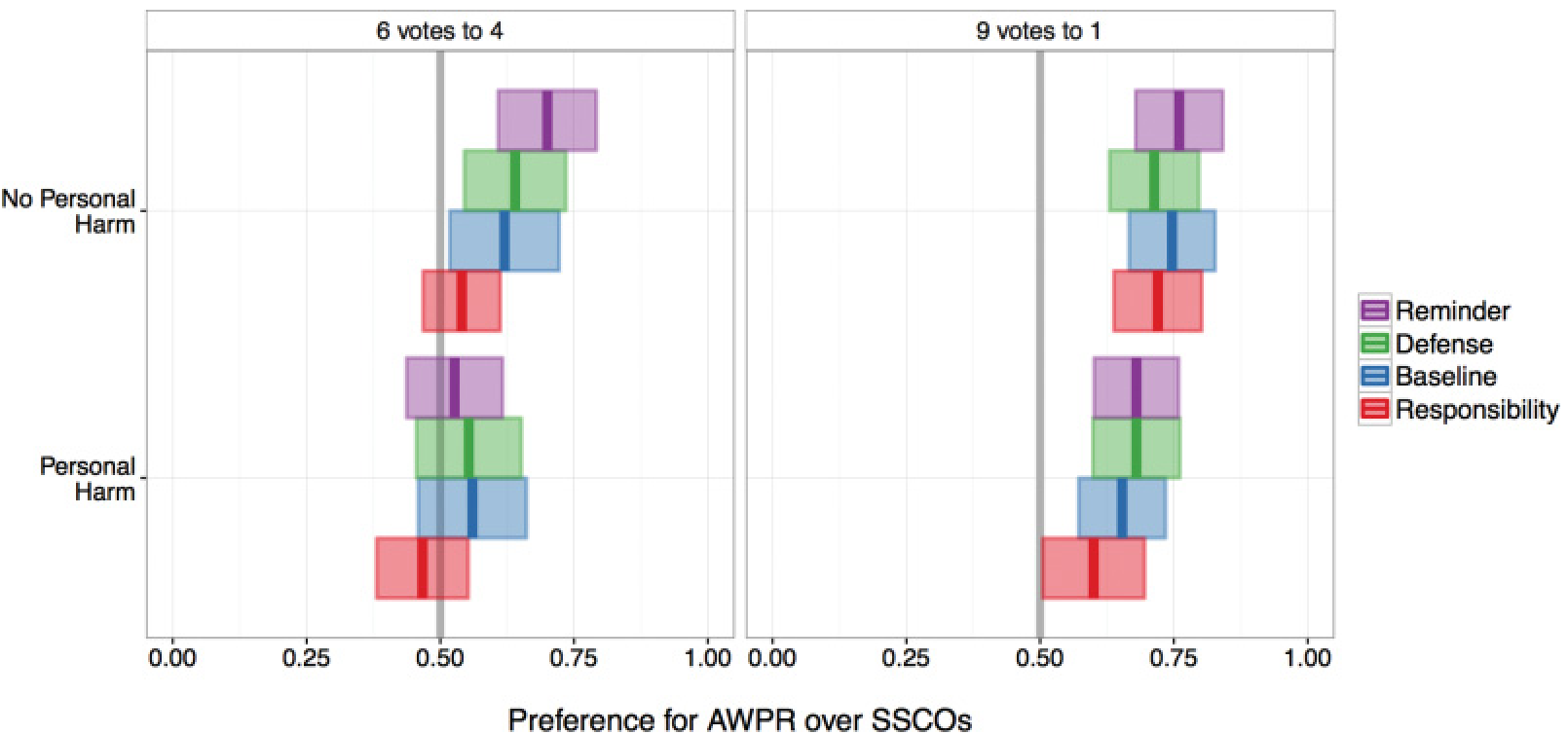 The chart shows the shift: As we move from 'No Harm' to 'Harm' (left columns), the preference for the Plurality Principle (AWPR) shrinks toward the indifference line.
Critical Insight & Future Outlook
The most surprising result? Accountability doesn't change much. Even when told they would share the blame for a mistake, participants still leaned toward Plurality. This suggests that the "Majority Rule" is a deeply ingrained heuristic for fairness in Western cultures, specifically US residents in this study.
Limitations
- Demographics: The study was limited to US residents on the Crowdflower platform. Cultural norms regarding "unanimity" vs. "plurality" vary wildly across the globe.
- Complexity: Real-world arguments are often much more tangled than the 3-5 argument chains used here.
Conclusion (Takeaway)
If you are building a platform for high-stakes deliberation—like a legal jury tool or a corporate ethics board—do not use a simple majority vote. Instead, implement rules that detect when a "Personal Harm" threshold is met or when the "Compatibility Principle" should trigger a postponement of the decision.