
Optimizing CNNs for e-Discovery: A Practical Guide to Legal Text Categorization
Experimental Evaluation of CNN Parameters for Text Categorization in Legal Document Review
This paper presents an empirical evaluation of Convolutional Neural Networks (CNNs) for Predictive Coding in the legal domain. By testing various hyperparameters on TREC legal datasets, the authors demonstrate that optimized CNN configurations significantly outperform traditional methods in classifying document relevance for e-Discovery.
TL;DR
In the high-stakes world of legal e-Discovery, traditional keyword searches are being replaced by Predictive Coding. This paper provides an exhaustive empirical roadmap for applying Convolutional Neural Networks (CNNs) to legal documents, proving that with the right combination of multiple kernels and dynamic embeddings, deep learning can drastically reduce manual review costs.
Background: The Legal AI Frontier
Predictive Coding (also known as Technology-Assisted Review or TAR) isn't just about accuracy; it's about efficiency. In a legal investigation, a million documents might only contain 1% relevant info. The goal is to find that 1% while looking at as few "non-responsive" documents as possible. While Logistic Regression and SVMs were the old guard, CNNs are the new heavy hitters—if you can figure out how to tune them.
The "Why": Why Legal Data is Different
The authors identify a critical gap: most CNN research uses "standard" datasets like IMDB reviews or News. Legal data is different because:
- Domain Jargon: Terms like "privilege" or "responsive" have specific technical meanings.
- Imbalance: Unlike balanced sentiment datasets, legal data is often 90%+ "garbage" (non-responsive).
- Context Length: Responsiveness is often determined by the whole document context, not just a single sentence.
Methodology: Peeling Back the CNN Layers
The research utilized a 1D-CNN architecture (inspired by Yoon Kim’s seminal 2014 work) and tested it against the TREC Legal Track datasets.
1. The Embedding Dilemma
The study compared three strategies:
- Static Pre-trained: Use GloVe/word2vec vectors as-is.
- No Pre-trained: Learn embeddings from scratch on legal data.
- Dynamic: Take GloVe and fine-tune it during training.
Insight: Static vectors performed the worst. Legal language is too specialized for "general purpose" vectors to capture without adaptation.
2. The Power of Multiple Kernels
One of the most significant findings was the impact of "filter kernels." A kernel of size 3 "sees" 3 words at a time (tri-grams).
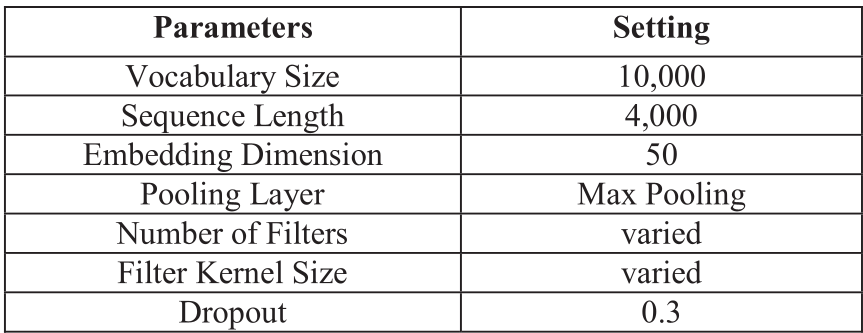
The authors found that using multiple kernels (e.g., looking at 3, 4, and 5 words simultaneously) consistently beat any single kernel size. This allows the model to capture both short-range phrases and slightly longer conceptual clusters.
Experiments & Key Results
The researchers focused on Precision at 75% Recall. In legal terms, this means: "If we want to find 75% of all relevant documents, what percentage of the documents we flagged were actually correct?"
Performance Gains
| Metric | Best Single Kernel | Best Multiple Kernels |
|---|---|---|
| Precision (D2) | 87.25% | 92.27% |
| Precision (D3) | 50.27% | 52.68% |

Efficiency vs. Complexity
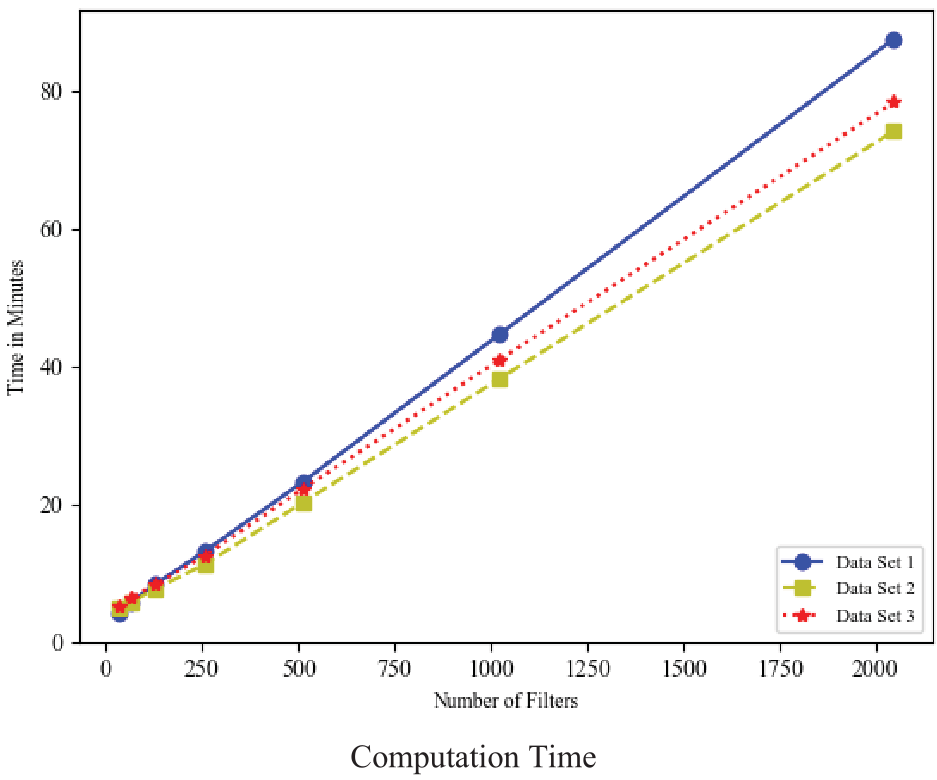
The team also looked at the number of filters. While more filters (up to 2048) continue to improve precision slightly, the "sweet spot" for efficiency was found between 200 and 500 filters. Beyond this, computational time increases linearly without significant ROI in performance.
Deep Insight: Takeaways for Practitioners
- Don't Trust Static Embeddings: Legal terminology is a "foreign language" to models trained on Wikipedia. Always use dynamic or domain-specific embeddings.
- Breadth over Depth: In a shallow CNN, having a diversity of kernels (different sizes) is more effective than just stacking more layers.
- 1-Max Pooling is King: For text categorization, capturing the strongest signal in a document (the existence of a key phrase) is more effective than averaging the signals.
Conclusion & Future Outlook
This paper serves as a vital bridge between deep learning theory and legal practice. While newer models like BERT have since emerged, the fundamental insights here—the importance of domain-specific tuning and the value of multi-scale feature extraction—remain cornerstones of Applied AI. As the legal industry moves toward even larger datasets, the balance between precision and computational cost will prioritize these highly optimized, "slim" CNN architectures.