
The Physics of Flaming: Can We Predict Online Toxicity Using Vibration Theory?
Experimental Study on Detecting the Omen of Flaming Phenomena in Online Social Networks: Testing the Theory of the Oscillation Model for Online User Dynamics
This paper validates an "oscillation model" for detecting "flaming" (explosive user dynamics) in Online Social Networks (OSNs). It demonstrates that low-frequency beats and increased amplitudes serve as measurable omens of impending social media volatility, verified through spectral analysis of logs from Japan's "2-Channel" forum.
Executive Summary
TL;DR: Researchers have discovered that "flaming" in online forums behaves remarkably like physical resonance. By applying an oscillation model to user interactions, this study proves that "low-frequency beats"—a specific rhythmic pattern in posting activity—appear as a mathematical omen before a discussion explodes into toxicity.
Context: This work bridges the gap between Sociology and Spectral Graph Theory. It moves beyond simply counting likes or shares, treating the social network as a dynamic system that can "vibrate" and eventually "break" if the network structure becomes too asymmetric.
Problem: The Unpredictability of Social Explosions
Why do some online discussions remain civil while others spiral into a "flaming" phenomenon? Conventional metrics like Node Centrality (Degree or Betweenness) tell us who is important, but they don't tell us when the system is about to become unstable.
The authors argue that the "rapidity" and "anonymity" of SNS platforms create a "synchronization pressure" that, under certain network topologies, causes user state energy to diverge. The challenge is identifying the omen—the warning sign that occurs before the explosion.
Methodology: The Social Spring-Mass System
The paper treats each user as a node with a state (representing their opinion or activity level). The interaction between users is modeled as a restoring force, similar to a spring connecting two masses.
1. The Laplacian Framework
The core of the theory lies in the Laplacian Matrix () of the directed social graph. When a network is "asymmetric" (Information flows more strongly in one direction), the eigenvalues of this matrix can become complex numbers.
- Real Eigenvalues: The system oscillates stably.
- Complex Eigenvalues: The system's energy diverges—this is Flaming.
2. The Omen: Low-Frequency Beats
Before the eigenvalues become complex, they must first "collide" or get very close to each other on the real axis. When two frequencies are nearly identical, they create a beat phenomenon.
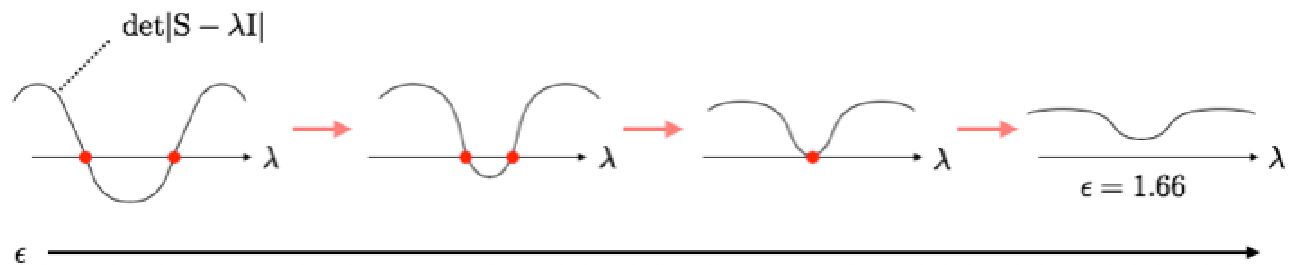 Fig 1: As the network parameter increases, eigenvalues approach each other, creating the "beat" omen seen in the bottom-right spectral transition.
Experiments: Real-World Validation on 2-Channel
The researchers tested this on logs from the Japanese forum 2-Channel, analyzing threads on Economics, Stocks, and Baseball. They used Fast Fourier Transforms (FFT) to compare "Heavy Posting" (High Flaming Risk) vs. "Light Posting" (Stable) periods.
Key Findings:
- Shift to Low Frequency: In all three threads, periods of intense activity showed a significant increase in lower-frequency oscillation modes.
- Amplitude Growth: As users become less "orthogonal" (more synchronized/polarized), the amplitude of these beats increases, signaling that the system is losing its ability to dampen the discussion.
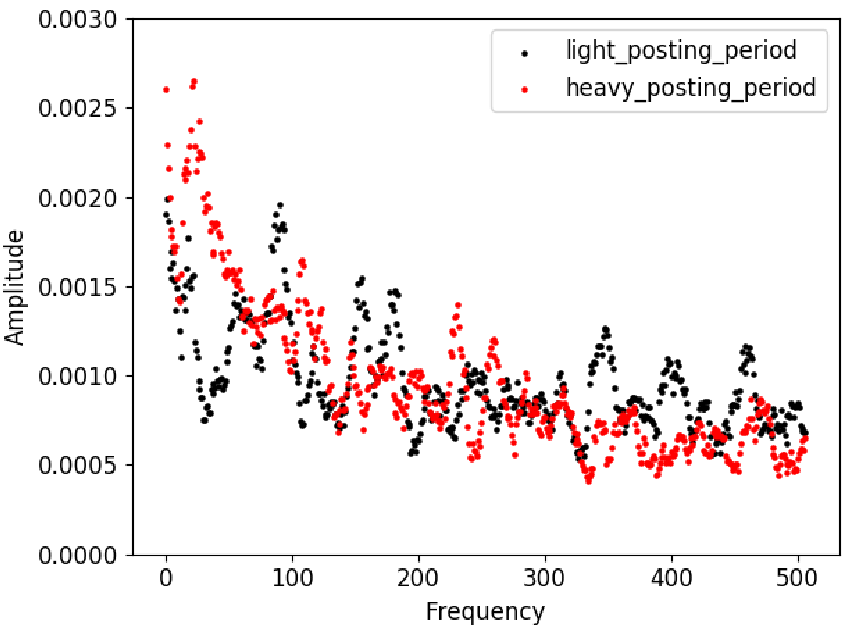 Fig 2: FFT analysis showing the "Heavy Posting" (Red) period having significantly higher power in the low-frequency spectrum compared to the "Light Posting" (Black) period.
Critical Insight & Conclusion
Takeaway
The most profound contribution of this study is the realization that social stability is structural. Flaming isn't just caused by "bad actors"; it is fueled by a network topology that allows energy to build up in low-frequency modes.
Limitations & Future Work
While the "beat" is a reliable omen, the current study relies on post-hoc analysis. The next frontier is real-time detection: building moderator tools that monitor the "spectral pulse" of a thread to trigger damping mechanisms (like slowing down posting rates or highlighting diverse opinions) before the "beat" turns into a "blast."
Conclusion
By treating social media as a vibrating physical system, we gain access to the tools of engineering to solve the problems of sociology. The appearance of low-frequency beats is the "thumping" sound before the engine fails—and now, we know how to listen for it.