
Testing the Semantic Social Network Hypothesis: Do Similar Ontologies Mean Closer Friends?
Experimenting with ontology distances in semantic social networks: Methodological remarks
This paper explores the relationship between ontology distances and social affinity within Semantic Social Networks. It proposes a methodological framework for testing the hypothesis that users with similar personal ontologies share higher social affinity, ultimately reporting experimental results that challenge this common assumption.
TL;DR
In the world of Semantic Social Networks, it is often assumed that if two people organize their knowledge (ontologies) similarly, they are likely to have a strong social affinity. This paper puts that assumption to the test through a rigorous methodological experiment. The surprising result? The hypothesis was largely invalidated. Despite using complex similarity measures, the way people categorized information showed little correlation with their actual social connections.
The "Common Sense" Motivation
The semantic web isn't just about data; it's about the people who structure it. Researchers have long theorized that our "cognitive dispositions"—how we perceive and categorize the world—are reflected in the ontologies we use.
If User A and User B both categorize "Shark" under "Marine Predator" rather than "Fish," do they share a "state of mind"? If so, we could theoretically build social networks not by asking "who do you know?" but by analyzing "how do you think?" The authors set out to determine if ontology distances could serve as a proxy for social distance.
Methodology: The "Zoo" Experiment
Because massive semantic social networks (where every user has a personal ontology) don't truly exist yet in the wild, the authors had to build a lab-controlled "micro-world."
The Setup
- Subjects: 19 AI students.
- The Task: Annotate 22 wildlife images and build a personal ontology to structure those annotations.
- The Ground Truth: A questionnaire where students identified their actual social affinities and "states of mind" peers.
Measuring Similarity
The authors didn't just look at word overlaps. They used the OntoSim library to compare:
- Ontology Space: Lexical names and triple structures (TFIDF, Cosine distance).
- Alignment Space: Finding paths and mappings between two different ontologies to see how easily one could be "translated" into the other.
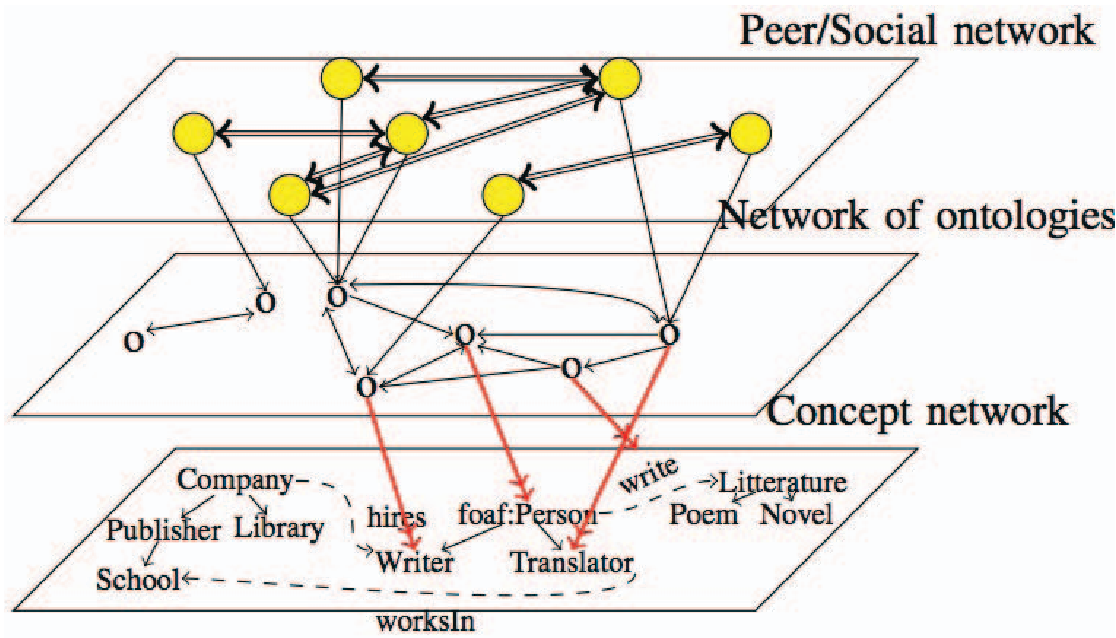 Fig 1. The three-layer architecture: Concept, Ontology, and Social layers.
Key Insights: Why the Hypothesis Failed
The paper reveals a fascinating discrepancy. While the students naturally converged on six "domains" (like species, diet, and geography), the way they used these domains did not map to their friendships.
- Standardization vs. Personalization: Many students defaulted to standard classifications (e.g., Wikipedia-style taxonomy), which created "false" similarity between people who didn't actually know each other.
- Alignment Space Wins (Slightly): Alignment-based measures (focusing on how ontologies map to one another) performed better than simple lexical overlaps, but still failed to predict social groups accurately.
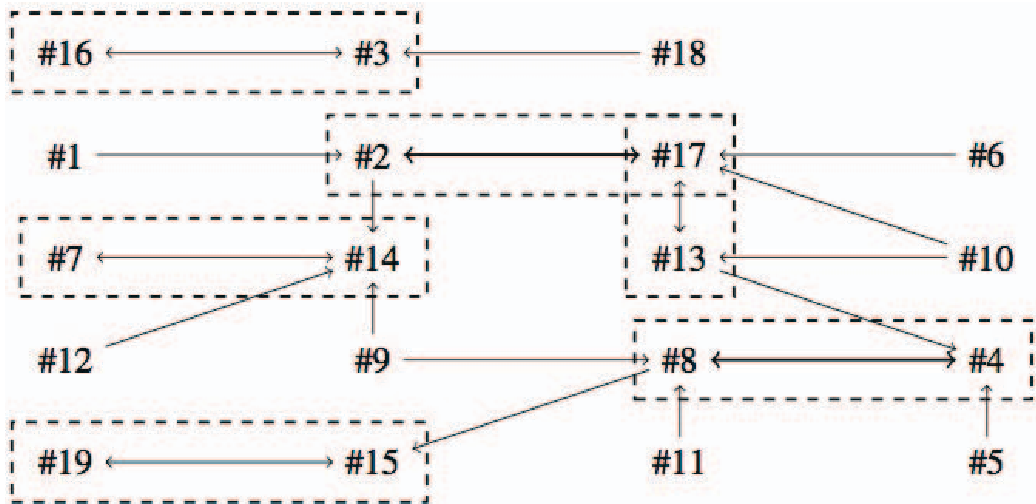 Fig 2. Social graphs generated from ontology similarity—notice how the complete subgraphs (bold) don't align with the reported social reality.
Critical Analysis & Conclusion
This paper serves as a vital "reality check" for the Semantic Web community. It suggests that social affinity is far more complex than shared semantics.
Limitations & Future Outlook
- Sample Size: 19 students is a small "social network." The dynamics might change in a community of thousands.
- The "Unknown Proximity" Defense: The authors raise a clever point—perhaps ontology similarity reveals potential friendships that the users haven't discovered yet, rather than existing ones.
- The Need for Real Data: To truly validate this, we need platforms like "Semantic Flickr" or "Semantic LinkedIn" where personal knowledge modeling is part of everyday utility.
In conclusion, while we may think alike, it doesn't mean we're friends. The bridge between the Ontology Layer and the Social Layer remains more mysterious than we previously hoped.