
Expert vs. Non-expert: Who Should We Trust on the Future of Work?
Expert and Non-expert Opinion About Technological Unemployment
This paper presents a large-scale comparative survey investigating predictions of technological unemployment. It compares the views of over 300 AI and robotics experts with 500+ non-experts regarding job automation risks and the timeline for High-Level Machine Intelligence (HLMI).
TL;DR
A comprehensive survey by Toby Walsh reveals a stark "perception gap" in the AI revolution. While the public fears a rapid wave of technological unemployment, AI and robotics experts are far more skeptical about the speed of progress. Experts predict that human-level machine intelligence—and the resulting job displacement—is likely decades further away than common headlines suggest.
Background: The Fear of the 47%
Since the landmark 2013 Frey and Osborne study suggested that 47% of US jobs are at risk of automation, "technological unemployment" has moved from Philip K. Dick novels to the front pages of global newspapers. However, these figures often rely on small groups of researchers labeling training sets. This paper asks a critical question: Do the people actually building the technology see the same "job apocalypse" as the rest of us?
Methodology: Tapping the "Wisdom of the Crowd"
To find out, the author surveyed three distinct groups:
- AI Experts: Authors from top-tier conferences like AAAI and IJCAI.
- Robotics Experts: IEEE Fellows and ICRA authors.
- The Informed Public: Readers of "The Conversation" (educated non-experts).
The participants were asked to evaluate the original 70-occupation training set used by Frey and Osborne and to provide a timeline for High-Level Machine Intelligence (HLMI)—defined as when a computer can perform most human professions as well as a human.

Key Insight 1: Experts are Cautious Realists
The data shows a statistically massive divide (p < 0.0001). While non-experts generally agreed with the high-risk estimates of previous studies (predicting 37/70 jobs at risk), robotics and AI experts were notably more conservative, predicting only 29-31 jobs were likely to be automated in the next two decades.
The reason? Technical Barriers. Experts are acutely aware of the "hard problems" that remain unsolved:
- Complex Manipulation: Fine motor skills in unstructured environments.
- Common Sense Reasoning: Navigating the nuances of human logic.
- Natural Language Understanding: Moving beyond pattern matching to true semantics.
Key Insight 2: The Timeline Gap
The most striking discrepancy lies in the arrival of HLMI.
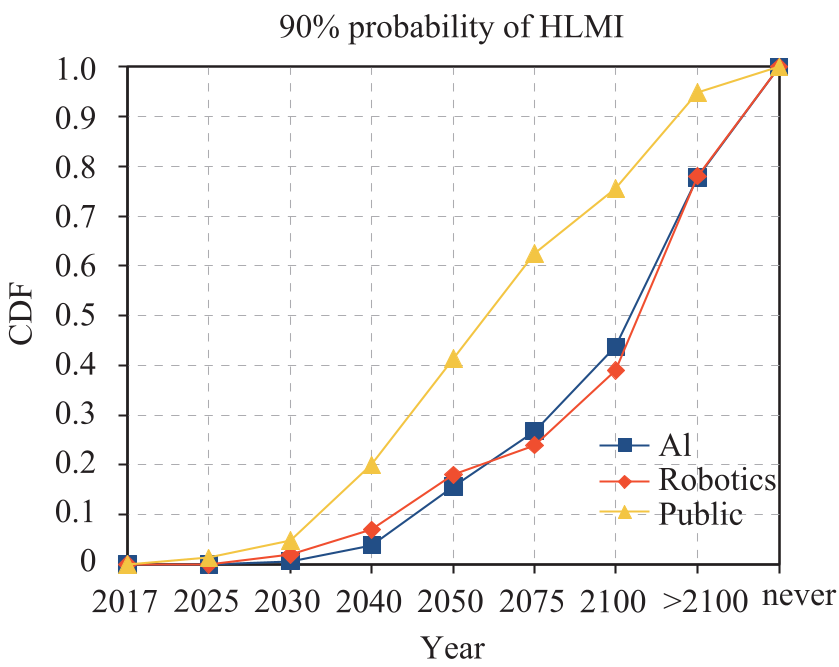
As shown in the Cumulative Distribution Function (CDF) above:
- Non-experts predict a 50% chance of HLMI by 2039.
- AI/Robotics Experts push that date back to 2061-2065.
This 20+ year gap suggests that while the public perceives a "sprint" toward general intelligence, the researchers see a "marathon."
Discussion: The Danger of Overselling AI
The paper highlights specific occupations where the views diverge sharply. For example, 39% of non-experts думают, что экономисты будут автоматизированы, compared to only 12% of experts. Similar gaps exist for Engineers and Technical Writers.
The author warns that if public expectations are not dampened, we risk another "AI Winter"—a period where funding and interest collapse because the technology failed to live up to the hype.
Critical Analysis & Conclusion
Takeaway
The "automation of everything" is a question of when, not if. However, the when is likely much further out than the current discourse suggests. This "extra time" is a gift to policy makers, allowing for more thoughtful transitions in education and social safety nets.
Limitations
The study was conducted in early 2017. Since then, the explosion of Large Language Models (LLMs) like GPT-4 has significantly moved the goalposts for "Natural Language Understanding." It would be fascinating to see if the "Expert Cautiousness" remains as high today, or if the experts have been surprised by their own progress.
Future Outlook
We must shift the focus from replacement to augmentation. By understanding that technical barriers (like social intelligence and manipulation) are persistent, we can better design AI that works alongside humans rather than simply deleting their roles.