
Identifying the "Answer Person": A Robust Graph-Based Approach to Expert Discovery in Support Communities
Finding Expert Role in Social-Support Online Community
This paper introduces a graph-based feature selection technique, the Δ (Delta) measure, specifically designed to identify expert roles in social-support online communities. Tested on the WebMD Anxiety and Panic community dataset, the method achieves superior classification performance (F-measure 0.73) compared to traditional ranking algorithms like PageRank.
TL;DR
In the ecosystem of online support communities, a tiny fraction of users—the experts—carry the weight of providing almost all social and technical assistance. This paper presents a computationally efficient graph-based metric called the Δ (Delta) measure. By analyzing the asymmetric relationship between giving and receiving help, the authors prove that simple local graph features can outperform industry staples like PageRank in identifying high-value community members.
The Motivation: Why PageRank Fails in Social Support
Most expert-finding systems treat social networks like the World Wide Web. However, a "link" in a support community (answering a question) is fundamentally different from a "hyperlink" between websites.
In a social support context (like the WebMD Anxiety & Panic community analyzed here), the "Expert" role has a specific structural signature: they are hubs of information who provide many answers but seek few. Traditional algorithms like PageRank often fail because they are designed to find "authoritative" nodes that are linked to by other authoritative nodes, whereas experts in support groups are characterized by their outward-bound assistance.
Methodology: The Geometry of Expertise
The researchers utilized two layers of analysis to validate their approach: Visual Signatures and the Mathematical Δ Measure.
1. Visual Structural Signatures
By using egocentric network visualization, the authors identified that experts possess a "star-shaped" pattern. These users are connected to many "isolates"—people who come to the community, ask one question, receive help from the expert, and then stop interacting.
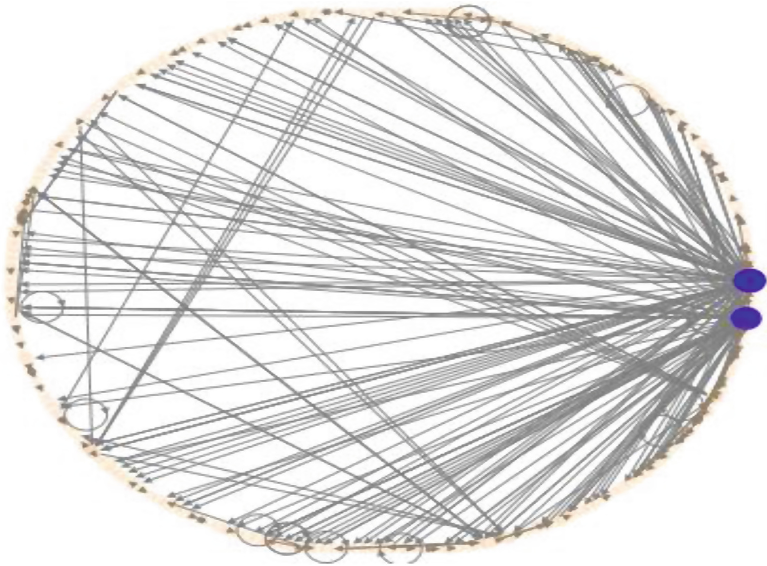 Figure: Mapping Betweenness (color) and Eigenvector Centrality (size) to identify central expert actors.
2. The Δ Measure
To move beyond visualization into automation, the authors proposed the following formula:
Where:
- (Alpha): Out-degree (number of answers given).
- (Beta): In-degree (number of questions asked/replies received).
The Logic: A positive identifies an "answer person." The larger the value, the more active the expert. Unlike recursive algorithms, this can be calculated in O(V+E) time, making it highly scalable for massive communities.
Experimental Results: Dominating the Baselines
The authors compared the Δ Measure against PageRank and Expertise-Rank using a dataset from WebMD's Anxiety and Panic (A&P) community.
| Metric | Δ Measure | PageRank | Expertise-Rank |
|---|---|---|---|
| Precision | 0.83 | 0.29 | 0.67 |
| Recall | 0.78 | 0.43 | 0.73 |
| F-Measure | 0.73 | 0.35 | 0.69 |
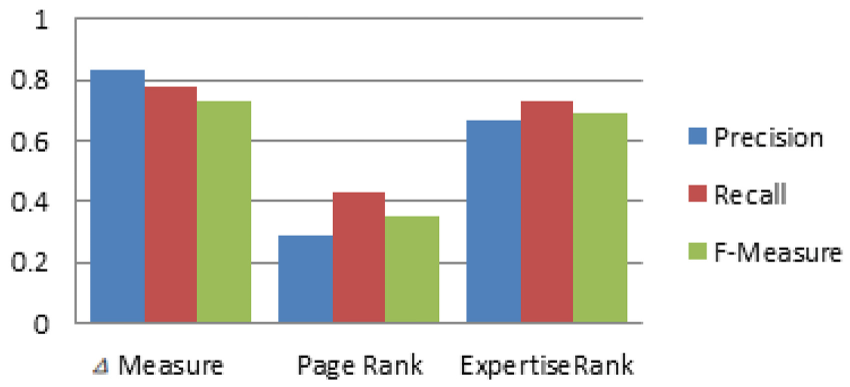
The Δ Measure achieved a Precision of 0.83, significantly higher than PageRank's 0.29. This confirms that PageRank’s assumption—that importance is derived from being pointed to—is frequently inverted in social support communities, where importance is derived from pointing outward (providing help).
Critical Analysis & Conclusion
The value of this research lies in its simplicity. While most current research trends toward complex Deep Learning on graphs (GNNs), this paper reminds us that a carefully crafted heuristic based on domain-specific "structural signatures" can be more effective and drastically cheaper to compute.
Takeaways for the Industry:
- Context Matters: Ranking algorithms are not "one size fits all." A model meant for the web may be useless for social dynamics.
- Structural Signatures: Identifying a "star" pattern in egocentric networks is a robust indicator of an expert role in medical and social help contexts.
Limitations: The formula is highly dependent on the "directedness" of the graph. In communities where threaded conversations become bidirectional "chats," the distinction between and might blur, potentially requiring a temporal decay factor to identify current active experts versus historical ones.
Future Work: This method could be extended by incorporating Natural Language Processing (NLP) to weight the quality of the out-degree (answers) rather than just the quantity, ensuring that "experts" are not just frequent posters, but high-quality contributors.