
Dynamic Expertise: Beyond Static Profiles in Social Network Search
An expert search scheme using user activities and reliabilities in social networks
The paper introduces a dynamic expert search scheme for social networks that moves beyond static profile matching. By integrating real-time user activity analysis, reputation-based reliability scores, and historical response ratings, the system identifies experts with higher precision and reduced latency.
TL;DR
In the fast-moving world of Social Network Services (SNS), an "expert" today might be irrelevant tomorrow. This paper proposes a system that ditches static biographies in favor of dynamic activity analysis, reputation scoring, and ontology-driven queries. The result? A 43% reduction in search time and a dramatic leap in search precision.
The Problem: The "Stale Profile" Trap
Most social network search engines treat user profiles as source-of-truth. However, users rarely update their "interests" or "skills" sections. Furthermore, a user might be knowledgeable but toxic or unresponsive. Existing SOTA methods often suffer from:
- Low Accuracy: Simply matching keywords doesn't prove actual expertise.
- Lack of Trust: They don't account for whether a user provides reliable or malicious information.
- High Latency: Searching an entire social graph for every query is computationally expensive.
Methodology: The Trident of Expert Discovery
The authors break the "expertise" problem into three distinct, measurable components:
1. Dynamic User Profiling (The "Recent Activity" Factor)
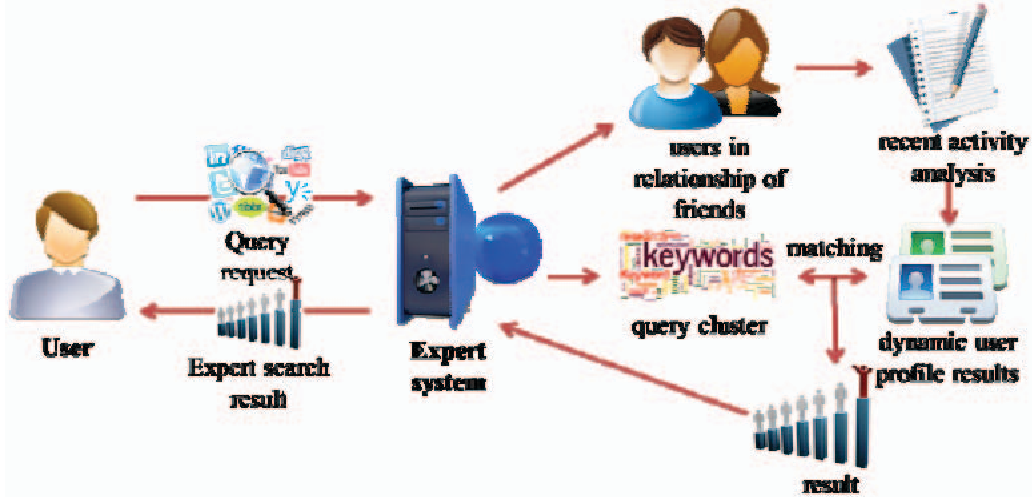
Instead of looking at what you said you knew 5 years ago, the system looks at what you posted last week. Using text mining, it extracts keywords from recent documents ().
- Physical Intuition: If your posts get more scraps, recommendations, and positive comments, your "Special Expertise" () score for those keywords increases.
2. Social Reliability (The "Trust" Factor)
To filter out malicious actors, the system calculates a reliability score () between users using friendship paths (up to the 6th degree, though 3rd is used for efficiency).
- Formula Logic: Reliability is an objective aggregation of reputation scores across the social network path, preventing "friend-bias" from skewing the results.
3. Response Ratings (The "Helpfulness" Factor)
An expert is useless if they don't answer. The system assigns a User Answer Score (UAS) based on:
- Reply frequency and speed
- Reply length and quality (ratings from the requester)
Evaluation: Efficiency Meets Accuracy
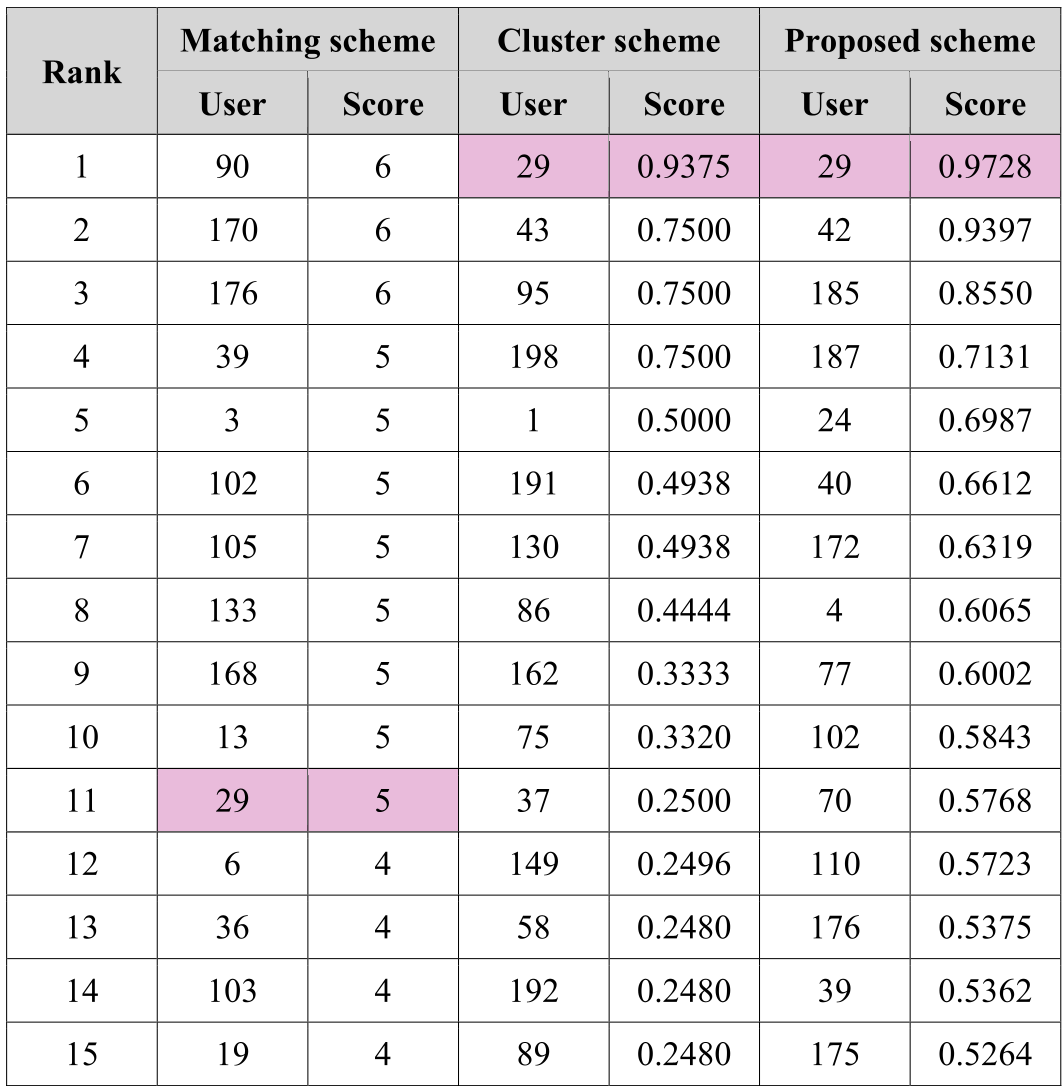
The researchers compared their approach against Simple Matching and Cluster Matching.
- Accuracy: In test scenarios (e.g., searching for "User 29"), the proposed scheme correctly ranked the target as #1 with a score of 0.9728, whereas simple matching ranked them #11 because it lacked synonym expansion via ontology.
- Performance: By monitoring activities periodically and creating pre-processed dynamic profiles, the system avoids the "search-everything-at-once" bottleneck, cutting time costs by 43%.
Critical Insight & Future Outlook
The true value of this work lies in its holistic definition of an expert. It recognizes that expertise is not just a semantic match (NLP) but also a social position (Graph Theory) and a behavioral trait (Activity Analysis).
Limitations: The reliance on third-degree friendships for efficiency might miss "hidden gems" in the broader network. Future iterations could leverage more advanced embeddings (like Node2Vec or GraphSAGE) to capture these relationships without the computational overhead of path-based reliability sums.
Conclusion: As SNS continues to evolve into a primary information source, systems that prioritize proven recent activity over static claims will become the backbone of reliable knowledge sharing.