
Evolutionary Strategy in Opinion Mining: Solving the "Multiple Polarities" Problem
Expert Systems With Applications
This paper presents a novel opinion mining framework designed for "emotion-embedded" products (e.g., movies, music) using a two-phase approach. It utilizes an Evolutionary Strategy (ES) to optimize sentiment weight tables for different product genres and a multi-class Support Vector Machine (SVM) for document-level classification.
TL;DR
In the world of sentiment analysis, context is everything. A word like "unpredictable" is a compliment for a thriller but a critique for a car's handling. This paper introduces a sophisticated framework that uses Evolutionary Strategies (ES) to optimize genre-specific sentiment weights and a Multi-class SVM to aggregate these into document-level insights. By moving away from "one-size-fits-all" lexicons, the authors achieved a 15% relative improvement in F-measure for emotion-heavy content like movie reviews.
Why Context Kills Traditional Sentiment Analysis
Most sentiment analysis tools rely on a fixed dictionary where "happy" is +1 and "sad" is -1. However, for emotion-embedded products (movies, music, art), the rules change.
- The Problem: In a horror movie review, "I was terrified and couldn't sleep" is a glowing 5-star review. In a drama, it might mean the movie was poorly paced or disturbing in a negative way.
- The Challenge: How do we mathematically shift the "weight" of an emotion based on the genre without manually rewriting dictionaries for every possible category?
Methodology: Evolution Meets Emotion
The authors propose a two-phase engine to solve this.
Phase 1: Mapping to Universal Emotions via ConceptNet
Instead of looking for "good" or "bad" words, the system translates Chinese review words into a matrix of 10 basic emotions (Joy, Sadness, Fear, etc.). It uses ConceptNet, a common-sense knowledge graph, to calculate the "Inference Distance" between a word in a review and these core emotions.
Phase 2: The Evolutionary Strategy (ES)
This is the "brain" of the operation. For each movie genre (e.g., Horror vs. Drama), the system initializes a Weight Table.
- Selection: Weight tables that predict sentiment more accurately (closer to human labels) are "selected" as parents.
- Crossover & Mutation: These tables exchange "genes" (weight values) and undergo random mutations to find the global optimum.
- Optimization: Over many generations, the ES settles on a weight table where labels like "Fear" are assigned positive weights for Horror movies and negative ones for Romances.
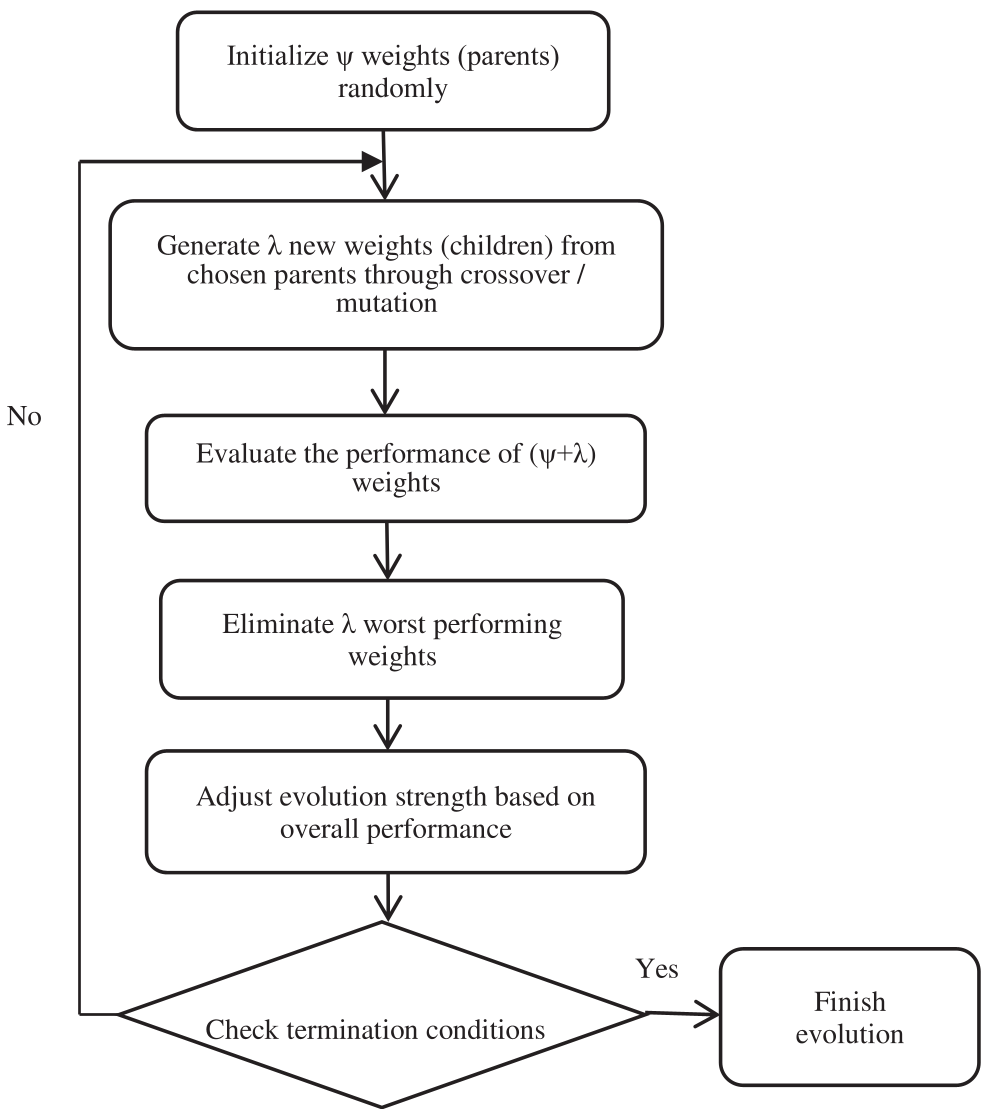 Figure 1: The Evolutionary Strategy workflow for optimizing genre-based weights.
Document-Level Aggregation: Beyond Just Averaging
A review isn't just a collection of sentences; it has a flow. To capture this, the authors used an SVM with seven specialized measures:
- Weighted Averages: Giving more weight to the middle and end of a review where the "verdict" usually lies.
- 8-Quantiles: Dividing the text into 8 segments to capture distribution.
- Fluctuation Type: Identifying if the tone starts high and drops (disappointment) or builds up to a climax.
Experimental Results
The researchers tested their model against traditional methods using a dataset from PTT (a major Taiwanese forum) and Yahoo! Movies.
| Method | Precision | Recall | F-Measure |
|---|---|---|---|
| Conventional (Single Type) | 62.5% | 59.5% | 61.0% |
| Proposed (Multi-Type optimized) | 73.0% | 67.5% | 70.1% |
The results in the table above show a clear dominance of the multi-type approach. Furthermore, the Optimized Weight Table (shown below) reveals the "logic" the AI discovered: for horror movies, "Fear" has a high positive weight (0.63), whereas for dramas, "Sadness" actually contributes positively to the review's quality score.
 Figure 2: The divergent weights discovered by the ES for Horror vs. Drama genres.
Critical Insights & Future Work
This work proves that sentiment is a manifold, not a linear scale. By using heuristic optimization (Evolutionary Strategy), the authors found a way to bridge the gap between "cold" dictionary definitions and "warm" human context.
Limitations:
- The system currently relies on authors explicitly tagging the product type (e.g., "Horror"). Future iterations could include an automatic genre-detection layer.
- While effective, ES can be computationally expensive compared to simple linear classifiers during the training phase.
Bottom Line: For businesses in the entertainment or service sectors, this methodology offers a blueprint for building "Context-Aware" sentiment monitoring tools that understand why a customer is using a specific emotion.