
Hybrid Emotion Analytics: Decoding the Human Spectrum in Online Activities
Expert Systems With Applications
This paper introduces a hybrid emotion detection framework that expands beyond primary emotions (Ekman's six) to include social emotions and general affective states. By combining machine learning classifiers with lexicon-based intensity scoring, the system achieves SOTA performance on the SemEval-2007 dataset and effectively classifies nuanced emotions in multi-platform online activities (Twitter, Facebook, News).
TL;DR
This research moves beyond simple "thumbs up/down" sentiment analysis to detect a wide spectrum of 12 emotions, including social states like "shame" and "rejection." By fusing lexicon-based linguistic rules with machine learning's statistical power, the authors achieved a 13.43% performance boost over traditional SOTA methods, validating their system across Twitter, Facebook, and News headlines.
Background: Why "Primary" Emotions Aren't Enough
In the world of Affective Computing, we often fall back on Ekman’s Six Primary Emotions: Anger, Disgust, Fear, Joy, Sadness, and Surprise. While these are universally recognized, online social interactions are far more complex. We express Social Emotions (e.g., shame, enthusiasm) and Affective States (e.g., anxiety, interest) that dictate our digital behavioral norms.
The authors argue that existing work is polarized:
- Lexicon-based methods provide high precision but suffer from low recall (they miss words not in the dictionary).
- Machine Learning methods have high recall but often miss the "physiological intuition" of intensifiers (e.g., "very happy") and negations ("not sad").
Methodology: The Hybrid Engine
The core of this paper is the Hybrid Feature Generation process. Instead of picking one side, the authors build a feature vector that includes:
- Lexicon-Based Features: Utilizing WordNet-Affect and EmoLex to map words to specific emotional synsets.
- Document Feature Vectors: Standard TF-IDF weighting to capture semantic relationships.
- Visual Cues: Vectorization of emoticons based on their emotional intensity (from -1 to 1).
- Contextual Valence Shifters: A mathematical adjustment for intensifiers and negations to refine the "score" of an emotion.

Breaking Down the Math
The authors define the intensity of a word () by considering its base score modified by an intensifier (): This ensures that "extremely angry" is weighted more heavily than just "angry," a nuance often lost in standard Bag-of-Words models.
Experiments & Results
The study was conducted across three distinct environments:
1. The Baseline (SemEval-2007)
Testing against news headlines, the hybrid model outperformed established systems like SWAT and UA, reaching a precision of 59.38%.
2. The Global Spectrum (Twitter)
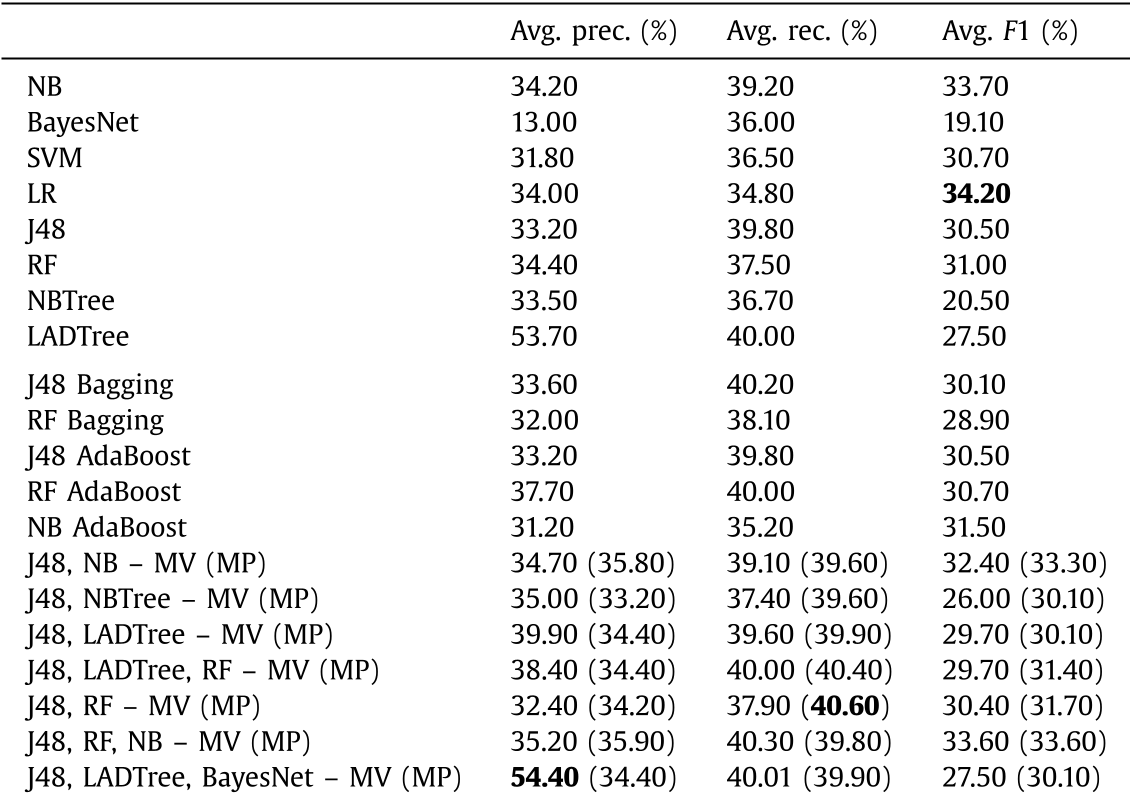
The authors collected 3,000 tweets and used crowdsourcing to label them across the expanded 12-emotion set. Interestingly, they found a "fair agreement" (Fleiss’ Kappa = 0.26) among human annotators, highlighting how difficult it is even for humans to distinguish emotions in text without vocal inflections or gestures.
3. Implicit vs. Explicit (Facebook Case Study)
In a unique experiment, users reported their feelings (Explicit) while the system monitored their chat logs (Implicit). The results showed a high prevalence of Joy and Calm, affirming the sociological theory that users on Social Networks (OSNs) often attempt to "manage impressions" by presenting a more positive version of themselves.
Critical Insight: The "Social" Ceiling
The study reveals a significant drop in performance when moving from primary emotions to social ones.
- Joy (Primary): F1-score of ~56%
- Rejection/Shame (Social): F1-score of <10%
Why? Social emotions are highly dependent on "appraisals of others' thoughts." Detecting "shame" in a single sentence like "I can't believe I did that" is nearly impossible without knowing the social context or the relationship between the interlocutors.
Conclusion & Future Work
The paper confirms that a hybrid scheme is essential for capturing emotional nuances. However, the next frontier isn't just better lexicons—it's contextual awareness. Future systems must consider the user's personality, cultural background, and previous conversation history to truly "understand" the silence or sarcasm between the lines.
The authors have shared their annotated Twitter dataset to encourage further research in this "wider spectrum" of digital humanity.