
SOSML: Bridging the Gap Between Sentiment Analysis and Multi-Document Summarization
Expert Systems With Applications
The SOSML system is a machine learning-based framework for sentiment-oriented multi-document extractive summarization. It uniquely integrates high-coverage sentiment knowledge, deep-learning-inspired word embeddings (Word2vec), and linguistic/statistical features. The method achieved state-of-the-art results on DUC and Movie datasets, significantly outperforming existing baselines with an average ROUGE score improvement of up to 16.52% over the previous best method.
Executive Summary
TL;DR: The SOSML (Sentiment-Oriented Summarization using Machine Learning) framework introduces a comprehensive pipeline that combines deep semantic word embeddings with fine-grained linguistic treatment. By solving critical issues like low lexicon coverage and contextual polarity shifts, it achieves a significant performance leap (up to 16.52% improvement in ARS) over existing SOTA methods on benchmark datasets like DUC.
Background: In the landscape of Opinion Mining, summarization is more than just compression—it's about capturing the "vibe" of thousands of reviews accurately. SOSML positions itself as a robust supervised learning approach that fuses traditional statistical relevance with modern deep-learning-inspired semantics.
The "Why": Why Traditional Methods Fail
Summarizing opinions is notoriously harder than summarizing generic news. The authors identify three major pain points:
- The Coverage Limit: Sentiment lexicons are static. If a user uses slang or specific adjectives not in the dictionary, the engine is blind to that sentiment.
- Contextual Shifters: A sentence containing the word "excellent" is usually positive, but "not excellent" or "not as excellent as I hoped" represents a total polarity reversal or a but-clause conflict.
- Sentence Types: Questions ("Is this battery life good?") and conditional statements ("If the screen were larger, it would be perfect") contain sentiment words but do not express factual opinions about the product.
Methodology: The SOSML Pipeline
The power of SOSML lies in its multi-layered feature extraction process.
1. Linguistic & Sentiment Knowledge
The authors didn't just use one dictionary; they merged ten distinct sentiment resources into a High-Coverage Lexical resource (HCLr). For words still missing, they implemented a Semantic Sentiment Approach (SSA) that uses WordNet synonyms to estimate the sentiment score of unknown terms.
2. Deep Semantic Vectors
To understand that "cheap" and "inexpensive" share a latent space while "cheap" and "sturdy" do not, SOSML integrates Word2vec embeddings. This provides the model with a dense vector representation of each sentence, augmenting the sparse linguistic features.
3. Feature Selection & Classification
Not all features are created equal. The authors tested four feature selection techniques (Relief-F, IG, GR, SU) and seven classifiers. The winner? Information Gain (IG) coupled with Support Vector Machines (SVM).
 Figure 1: The conceptual pipeline of the SOSML framework, highlighting the flow from raw text to extractive summary.
Experiments and Results
The model was benchmarked against four major baselines across eight different subset datasets from DUC and Movie reviews.
Key Metrics:
- Performance Peak: SOSML reached an average ROUGE score of 0.3859, compared to the 0.3312 of the previous leader, OMSHR.
- Component Impact: The study found that a unified feature set (Linguistic + Sentiment + Embedding) consistently outperformed any subset, proving that sentiment analysis is a multi-dimensional problem.
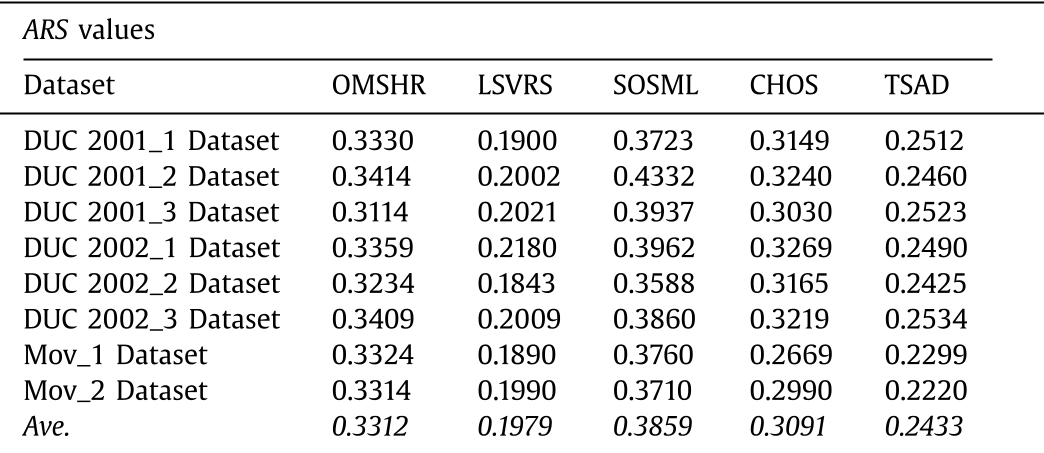 Table 1: Competitive analysis showing SOSML outperforming LSVRS, OMSHR, TSAD, and CHOS across all benchmark datasets.
Critical Insight: The Value of Linguistic "Treatment"
What sets this paper apart is its refusal to rely solely on "black box" deep learning. By explicitly programming rules for negation handling and but-clause analysis, the authors provide a safety net for the classifier. This "linguistic treatment" ensures that the model doesn't just recognize sentiment words, but understands how they interact within the syntax of a sentence.
Conclusion & Perspective
SOSML demonstrates that even as we move toward an era of massive transformer models, structured linguistic knowledge remains a powerful ally for specific tasks like opinion mining.
Future Work: The authors suggest moving toward Deep Neural Networks (RNNs, LSTMs, and CNNs) and addressing more complex nuances like sarcasm detection, which remains the "final boss" of sentiment analysis.
Takeaway for Industry: For product managers and data scientists building review aggregators, the SOSML approach proves that combining lexicon-based "logic" with embedding-based "intuition" is the fastest path to a reliable opinion summary.