
IAALPA: Adaptive Link Prediction for Cross-Marketing in Brand Communities
Expert Systems With Applications
The paper introduces IAALPA, an intelligent link prediction algorithm specifically designed for friend recommendation in online brand communities. It adaptively constructs Attention Allocation Indices (AAI) based on network topology to facilitate cross-marketing between different user circles.
TL;DR
This study presents IAALPA, a framework that automates the selection and combination of link prediction indices. By analyzing the "attention" common friends allocate within a network's triadic closure, it effectively identifies potential friendships between users in different brand circles, overcoming the chronic problem of network sparsity in cross-marketing.
The Core Challenge: Sparsity and Over-Generalization
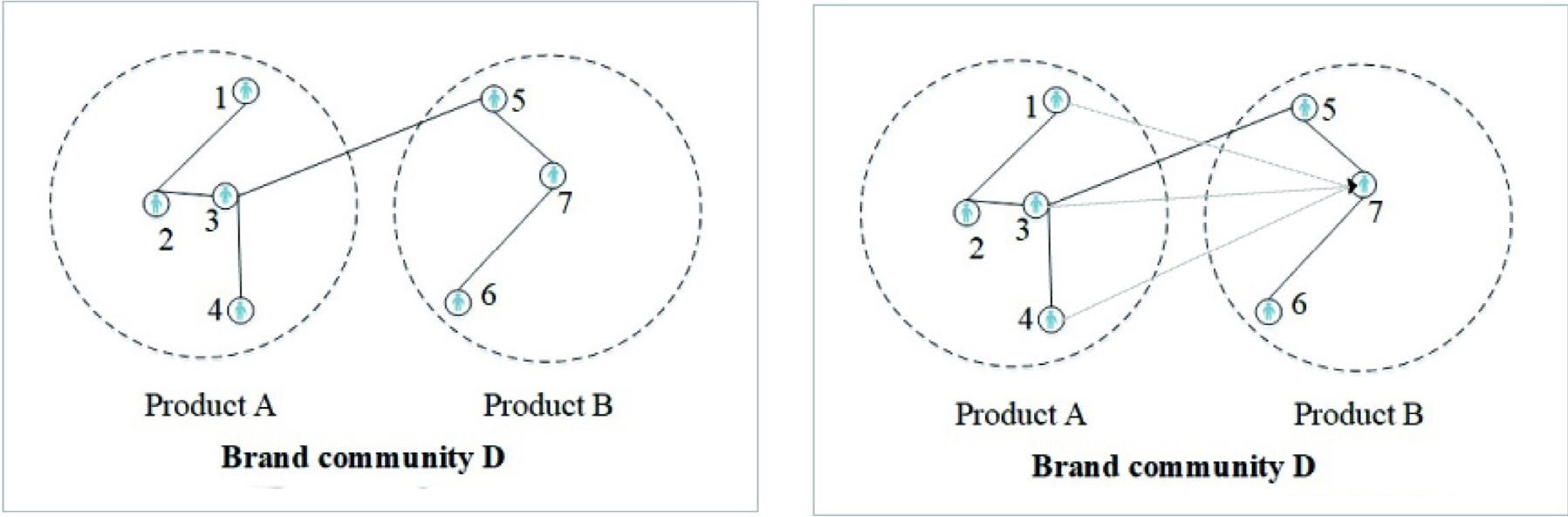
Online brand communities are often fragmented into sub-groups or "circles" (e.g., users interested in Product A vs. Product B). For marketers, the goal is cross-marketing: recommending a user in Circle A to a friend in Circle B.
However, two major hurdles exist:
- Data Sparsity: Users in different circles have few direct connections, making standard local-similarity heuristics (like Common Neighbors) perform poorly.
- Algorithmic Rigidity: No single link prediction algorithm (SLP) fits every network structure. A "one-size-fits-all" approach leads to suboptimal recommendations.
Methodology: The IAALPA Framework
The authors suggest that the weight of a connection is defined by the Attention Allocation Index (AAI). If a common friend has many connections, their "attention" to any specific pair is diluted. IAALPA uses a three-stage pipeline to optimize this logic:
1. Multi-Level Feature Extraction
The authors developed new AAIs based on macrostructures (indirect neighbors):
- WA1: Considers attention from indirect common neighbors.
- WA2: Integrates clustering coefficients to weigh direct vs. indirect attention.
- RWA (Resource Weighted Attention): A composite of microstructure (direct) and macrostructure (indirect) indices.
2. Adaptive Selection via Decision Trees
Instead of manually picking an index, they use a C4.5 Decision Tree. The tree analyzes network features (e.g., dispersion of attention, common friend density) to output the most "suitable" primary AAI for that specific community structure.
3. Complementary Index Fusion via SVM
To prevent overfitting and ensure robustness, an SVM identifies indices that are complementary to the DT-selected one. These are then combined into a final Composite AAI using weighted averaging.
Experimental Validation
The model was tested against thousands of user circles from Twitter and Google+.
Key Findings:
- Higher Accuracy: In Google+ datasets, IAALPA reached an average AUC of 0.8927, compared to just 0.8492 for the standard Resource Allocation (RA) index.
- Robustness to Density: As seen in the results, IAALPA maintains high performance in both extremely sparse networks (where nodes per circle are few) and dense networks.
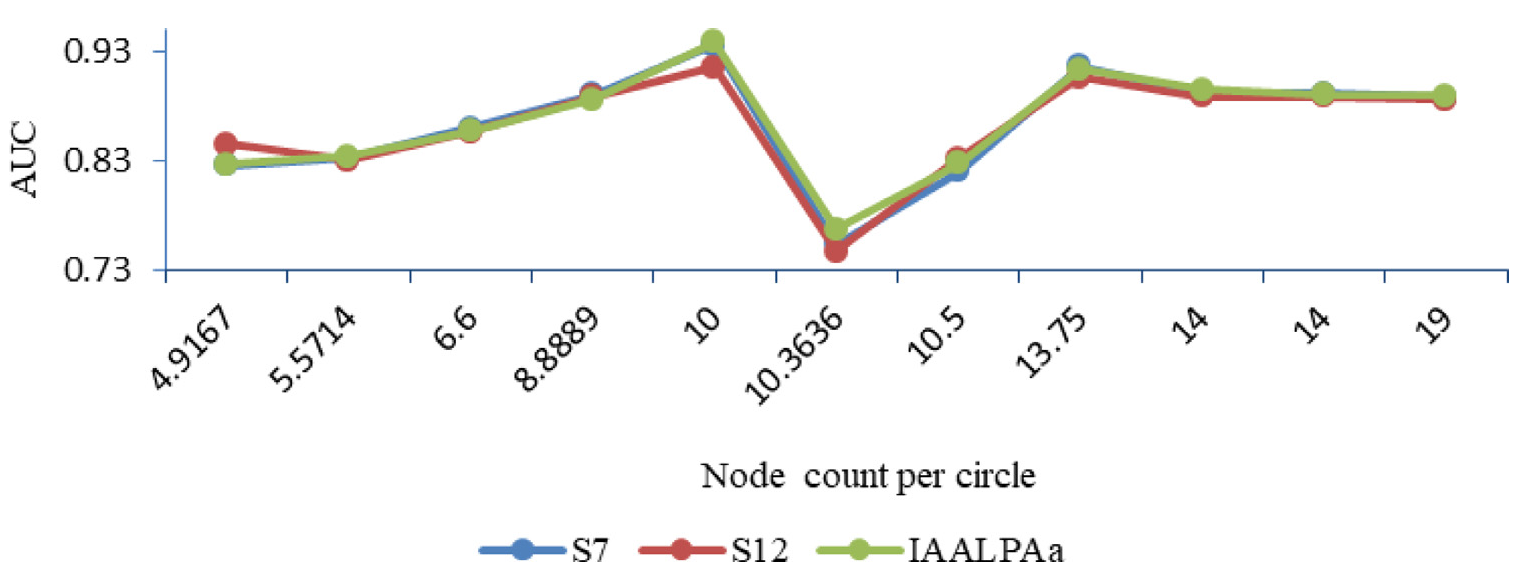 Fig: Performance comparison across different node densities in Twitter.
Critical Insight: Why it Works
The "Secret Sauce" is the inclusion of Macrostructure AAIs. By calculating the degrees of friends-of-friends (), the model bridges the gap between disparate circles. Standard indices only look at one-hop neighbors; IAALPA looks at how the "influence" flows through two-hop paths, which is essential when direct common neighbors are missing.
Conclusion and Future Work
IAALPA provides a sophisticated, automated tool for digital marketers to leverage social influence for cross-selling. By moving away from fixed algorithms toward an adaptive, ensemble-based approach, it sets a new SOTA for link prediction in sparse environments.
Future research directions include integrating temporal dynamics (how friendships evolve over time) and exploring deep learning architectures to further automate feature extraction.