
EMPNGA: A Multi-Stage Strategy for Mastering Credit Scoring
Expert Systems With Applications
The paper introduces a novel multi-stage hybrid credit scoring model that integrates feature selection, classifier selection, and ensemble learning. It leverages a newly developed Enhanced Multi-Population Niche Genetic Algorithm (EMPNGA) to optimize feature and classifier subsets, achieving State-of-the-Art (SOTA) performance across five real-world credit datasets.
TL;DR
Researchers have developed a sophisticated multi-stage hybrid model that automates the selection of both features and classifiers. By introducing the Enhanced Multi-Population Niche Genetic Algorithm (EMPNGA), the system avoids the common "local optimum" trap of standard optimization, leading to superior predictive stability and accuracy in credit risk assessment.
Problem & Motivation: The Complexity of Credit Risk
Credit scoring is a high-stakes binary classification task. While machine learning has been widely adopted, two major hurdles remain:
- Feature Redundancy: Financial datasets are often cluttered with irrelevant indicators, increasing computational costs and noise.
- Model Selection Bias: There is "no free lunch" in machine learning; a classifier that works for one bank's data may fail for another. Manually choosing base models for an ensemble is often unscientific.
The authors' insight was to treat the selection of features and classifiers as a joint optimization problem, solved via an evolutionary process that mimics biological diversity.
Methodology: The EMPNGA Framework
The core of this paper is the EMPNGA, which improves upon the standard Genetic Algorithm (GA) in several critical ways:
- Niche Step: Ensures diversity within a population by penalizing individuals that are too similar (based on Hamming distance).
- Migration Step: Periodically shares "elite" individuals between populations to prevent stagnation.
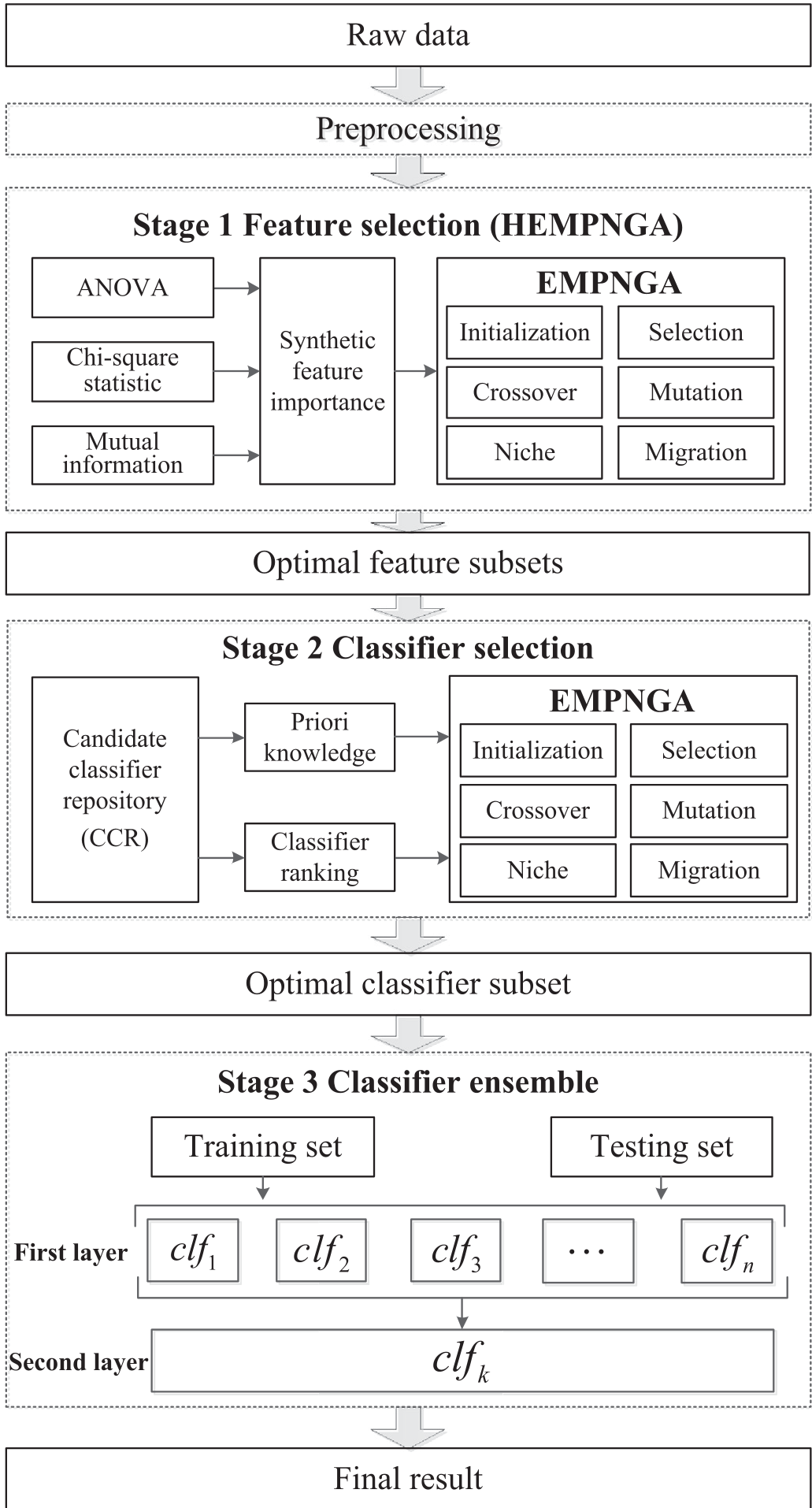
- Synthetic Priority: Instead of random initialization, it uses a weighted fusion of filter methods (Chi-square, ANOVA, Mutual Information) to guide the search.
The Multi-Stage Pipeline
The architecture is divided into three logical phases:
- Feature Selection: Using EMPNGA to find the optimal subset of attributes.
- Classifier Selection: Selecting the most effective base learners (e.g., XGBoost, RF, LR) from a candidate pool.
- Heterogeneous Ensemble: Combining the selected models through Stacking, where a second-layer meta-learner makes the final call.
Experiments & SOTA Results
The model was rigorously tested on five datasets, including UCI Australian and high-volume datasets like Kaggle's GMSC and PPDai.
Performance Gains
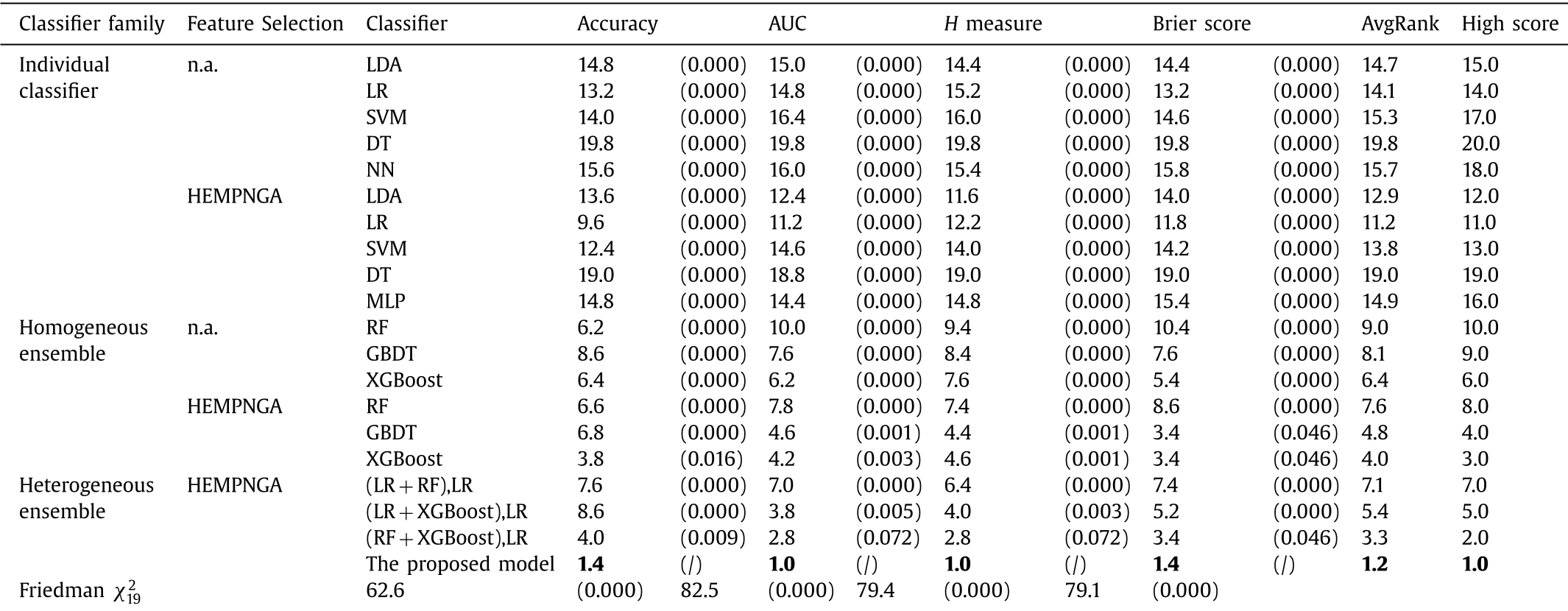
The hybrid approach consistently achieved the lowest Average Rank across four metrics: Accuracy, AUC, H-measure, and Brier Score. Notably, the H-measure (specifically designed to address AUC's flaws in cost-sensitive scenarios) showed substantial improvements, indicating the model is better at minimizing the actual financial cost of misclassification.
Iterative Efficiency
As shown in the fitness curves, EMPNGA converges faster and to higher fitness values than standard GA or Particle Swarm Optimization (PSO), proving that the niche and migration operators effectively "break through" local optimization boundaries.

Critical Analysis & Conclusion
Takeaway: The study proves that how you select your features and models is just as important as the models themselves. By using an enhanced evolutionary strategy, the authors removed the "human-in-the-loop" bias.
Limitations:
- The computational cost of running multi-population GA is higher than simple training (though the authors argue this is an offline cost).
- The repository of candidate classifiers is still predefined; future work could explore truly "open" architecture search.
Future Outlook: This framework is not limited to finance. The logic of EMPNGA-driven feature/classifier selection can be migrated to medical diagnosis, fraud detection, and customer churn prediction where the "cost" of errors is high.