
PlanTour: Bridging Social Networking and Automated Planning for Personalized Tourism
Expert Systems With Applications
PlanTour is an automated tourist route planning system that leverages crowdsourced data from the minube social network to generate personalized, multi-day itineraries. By combining clustering techniques with a domain-independent PDDL planner (Metric-FF), it achieves state-of-the-art performance in solving the Tourist Trip Design Problem (TTDP) while maintaining realistic user constraints.
TL;DR
PlanTour is an intelligent system that transforms the chaotic heap of social media data into structured, realistic, and personalized multi-day tourist itineraries. By treating travel planning as an Automated Planning problem and modeling human physiological "drives" like hunger, it bridges the gap between simple POI recommendation and real-world execution.
The Motivation: Why Your Current Travel Planner Fails
Most travel apps are either static lists of "Top 10 Things to Do" or glorified search engines. From an AI perspective, the Tourist Trip Design Problem (TTDP) is notoriously difficult because it is an oversubscription problem: there are far more interesting places to visit than time allows.
Existing solutions often fail because:
- Cold Start/Static Data: They rely on proprietary databases that go out of date.
- Logistical Blindness: They suggest great places but treat the movement between them as an afterthought.
- Ignoring the Human Factor: They don't account for opening/closing times, travel fatigue, or the simple fact that a tourist needs to eat at reasonable intervals.
Methodology: The Core Architecture
PlanTour addresses these issues through a sophisticated three-layer architecture:
1. Data Harvesting (Social Intelligence)
The system pulls real-time data from minube, a global traveling social network. This provides "Human-in-the-loop" knowledge—scores, photos, and time-span constraints—ensuring the information is always fresh and culturally relevant.
2. Problem Decomposition (Balanced K-Means)
To prevent computational explosion, PlanTour uses a modified k-means clustering algorithm. Unlike standard clustering, it enforces balance to ensure each day of a trip has a geographically cohesive and manageable number of POIs.
 Figure: The PlanTour architecture showing the flow from social data to final visualized maps.
3. Declarative Planning (The PDDL Engine)
The core of PlanTour is it turns the problem into a PDDL (Planning Domain Definition Language) task. This allows the system to use Metric-FF, a high-performance planner.
- Utility Model: Maximizes the "score" of visited POIs (treating them as soft goals).
- Travel Model: Once POIs are selected, the planner runs a second pass to find the shortest path between them.
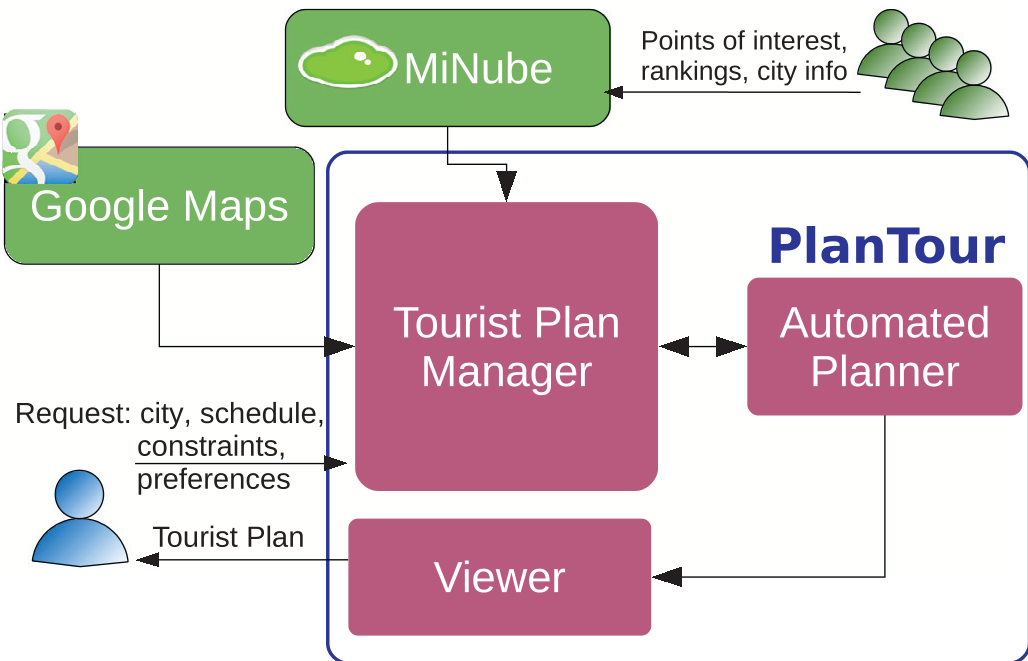 Figure: Balanced clusters generated for London over 3 days, ensuring geographic proximity within each day's plan.
Modeling the "Hunger Drive"
One of the most innovative aspects of this paper is the inclusion of "drives." The planner tracks a hunger fluent. If the user hasn't eaten within a certain window (), the planner is forced to trigger an eat action at a nearby restaurant POI, ensuring the generated plan is actually livable.
Experimental Results: Fast and Feasible
The authors tested PlanTour across London, Rome, Madrid, and other regions.
- Efficiency: Total planning time (including data processing) averaged under 20-30 seconds, with the actual search process () taking less than 4 seconds.
- Quality: The ratio of visited POIs vs. the best possible selection () consistently hit 80-90%, indicating that the planner is highly efficient at picking the "highest value" experiences within time limits.
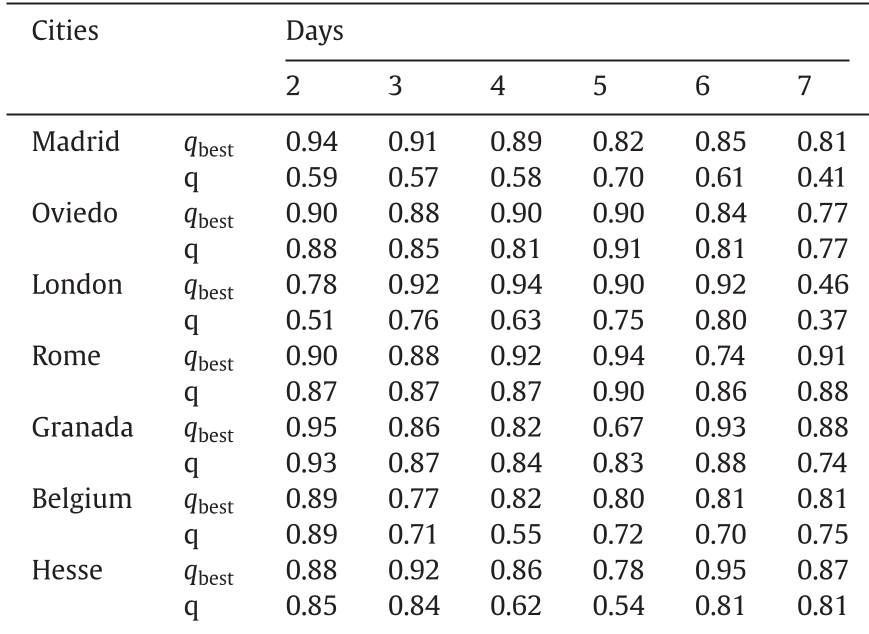 Table: Performance metrics () across different cities and trip durations.
Critical Insights & Future Work
PlanTour proves that Automated Planning provides a superior framework for recommendation compared to pure Reinforcement Learning or simple heuristics because it naturally handles hard constraints (like opening hours) and soft goals (preferences).
Limitations:
- Fatigue Modeling: While "hunger" is modeled, physical "stamina" is not yet dynamically adjusted.
- Real-time Adaptation: Currently, if a user spends too long at a museum, the system doesn't automatically "repair" the plan in real-time.
Future Outlook: The next frontier for PlanTour is online learning—observing user behavior during the trip to refine the planner's internal weights for future days. This shifts the AI from a travel guide to a truly adaptive travel companion.