
HKS: Breaking the K-Shell Resolution Limit to Find True Network Influencers
Expert Systems With Applications
2025-01-01
Summary
Problem
Method
Results
Takeaways
Abstract
The paper introduces the Hierarchical K-Shell (HKS) method, a novel node-ranking algorithm that identifies influential spreaders in complex social networks. By decoupling a node's distance from the network periphery and its closeness to high-density cores, HKS achieves superior accuracy in ranking spreading capability compared to classic k-shell and hybrid centralities.
## TL;DR
Finding influential nodes in massive social networks is crucial for viral marketing and disease control. While the **k-shell** method is a standard tool, it is often too "blunt" to distinguish between nodes in the same shell. This paper presents **Hierarchical K-Shell (HKS)**, which introduces a "depth-based" ranking system. By measuring how far a node is from the edge vs. how close it is to the core, HKS provides a high-resolution, high-accuracy ranking that correlates much more closely with real-world spreading processes.
## The Problem: The "Same Shell, Different Influence" Paradox
The classic k-shell decomposition (Kitsak et al., 2010) is beloved for its efficiency ($O(n)$ complexity). However, it suffers from a major structural blindness: it assumes every node within the same "shell" has the same spreading potential.
In reality, one node might be tucked away in a remote corner of the core, while another is a bridge connecting the core to vast peripheral clusters. Prior "semi-local" or "hybrid" methods (like Cnc+ or MDD) tried to fix this by looking at neighbor degrees, but they still lacked a formal understanding of the **network's hierarchy**.
## Methodology: Measuring Structural Depth
The authors’ core insight is that a node's position should be defined by two vectors:
1. **Periphery Distance ($b_i$):** How many steps away is this node from the ultimate network edge?
2. **Core Proximity ($f_i$):** How close is this node to the most densely interconnected cluster (the "Dominant Core")?
### The HKS Equation
The final influence value is calculated in two stages. First, a local sum ($S$) targets the structural weight of neighbors using their hierarchical indices:
$$S(v_i) = \sum_{v_j \in N_i} d_j \cdot (b_j + f_j)$$
Then, the global HKS value is the second-order summation of these local weights, ensuring that "influential nodes are those surrounded by other influential nodes."

*Fig 1: Schematic showing how different shells (colors) and topological positions are distinguished by the hierarchical approach.*
## Experiments & Results: Precision at Scale
The researchers tested HKS against six leading methods (Degree, k-shell, MDD, Cnc+, KS-IF, and EW) across 14 diverse datasets, from the small "Karate Club" to the massive "Enron" email network.
### 1. Monotonicity ($M$)
A higher $M$ value indicates fewer "rank ties" (where different nodes are given the same rank). HKS consistently achieved $M$ values near **0.99**, whereas standard k-shell often lingered around 0.3-0.5.
### 2. Spreading Accuracy (SIR Model)
Using the **Susceptible-Infectious-Recovered (SIR)** model to simulate an actual epidemic, the authors calculated the Kendall’s tau ($ au$) correlation.
* **Key Finding:** HKS consistently mapped more accurately to the actual number of infected nodes.
* **Performance:** In the *PowerGrid* network, HKS outperformed the nearest competitor by nearly **8%** in correlation accuracy.
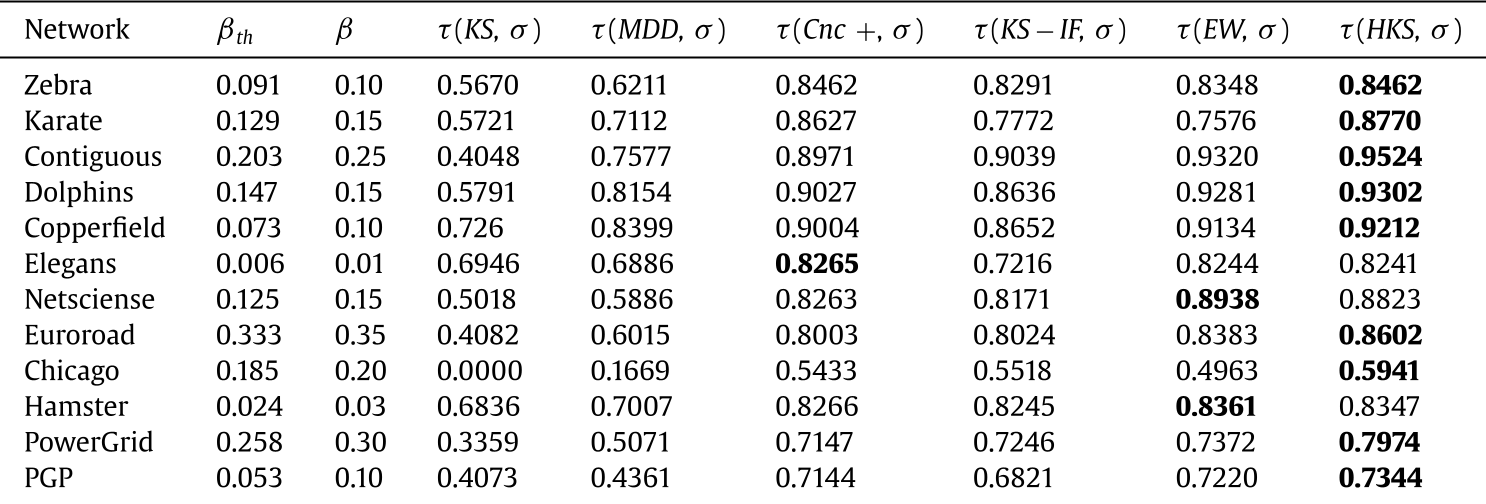
*Table 1: Influence of HKS vs competitors. Notice the HKS column consistently maintains the highest $ au$ values.*
## Critical Analysis: Why This Matters
The brilliance of HKS lies in its **computational economy**. Despite adding hierarchical logic, it maintains **$O(n)$ complexity**, making it usable for real-time analysis on platforms like Twitter or LinkedIn.
**Limitations:**
While HKS is robust for undirected, unweighted graphs, the authors acknowledge that it does not yet account for **edge weights** (e.g., the strength of a friendship) or **directionality** (e.g., a follower vs. a following relationship).
## Conclusion
HKS marks a significant shift from simply counting connections to understanding the **topology of influence**. For researchers and marketers, this method provides a sharper scalpel for identifying the "super-spreaders" who can trigger a cascade across an entire network.
**Takeaway:** If you want to spread a message, don't just find the busiest node; find the node that sits at the perfect hierarchical depth between the core and the periphery.