
Beyond Linear Ratings: Socially-Influenced Conditional Preferences in Recommender Systems
Expert Systems With Applications
The paper introduces TrustFVSVD and CondTrustFVSVD, two novel latent factor models that incorporate socially-influenced feature value preferences and conditional dependencies into Probabilistic Matrix Factorization (PMF). By integrating explicit trust relationships and item feature value discrepancies, the methods achieve state-of-the-art (SOTA) accuracy on benchmark datasets like Epinions and Ciao.
TL;DR
Researchers have long struggled with the "Black Box" nature of Matrix Factorization. This paper introduces TrustFVSVD and CondTrustFVSVD, models that break the assumption that all users view item features (like price or quality) the same way. By incorporating social trust and conditional feature dependencies, the authors achieve a significant leap in prediction accuracy, particularly for "Cold-Start" users who have few ratings but active social ties.
The Problem: The Flaw of Uniformity
Most Latent Factor Models (LFM) operate on a dangerous assumption: that lower prices or higher technical specs are preferred by everyone. In reality, user preferences are discrepant:
- One user might see a high price as a mark of "Prestige," while another sees it as a "Budget Barrier."
- Preferences are often conditional: You might want a hotel in the mountains during winter, but by the sea in summer.
- These tastes aren't formed in a vacuum; they are shaped by Social Influence (Homophily).
Existing SOTA models like TrustSVD fail to model these fine-grained feature-value nuances and the non-linear dependencies between features.
Methodology: Engineering Tastes and Trust
The authors propose two major extensions to the Probabilistic Matrix Factorization (PMF) framework:
1. TrustFVSVD (The Feature Value Extension)
Instead of a simple dot product between User and Item latent vectors, the authors introduce W (Gradient) and Z (Intercept) matrices. This allows the model to learn a specific "Preference Function" for each user-feature pair.
- Physical Intuition: Matrix W captures the sensitivity of a user to a feature value, while Z captures the baseline preference for that feature.
2. CondTrustFVSVD (The Conditional Logic)
To handle dependencies (e.g., "I like Feature A only if Feature B is present"), a quadratic interaction matrix Y is introduced. This transforms the linear model into a polynomial expression capable of capturing complex logic.
 Note: The graphical models illustrate how social trust (Matrix T) and implicit feedback (Matrix y) are fused into the latent feature space.
Experiments and Results
The models were tested against 15+ baselines, including KNN, SVD++, and SocialMF across three datasets: Epinions, Filmtrust, and Ciao.
Key Findings:
- Cold-Start Supremacy: For users with zero or few ratings, the model uses "Social Trust Propagation" to accurately predict tastes.
- Statistical Significance: On Epinions, the improvement over TrustSVD was verified with a confidence level of over 99.99%.
- Feature Sensitivity: The authors observed that increasing the number of latent factors (D) beyond a certain point causes overfitting, proving that quality of feature modeling beats quantity of dimensions.
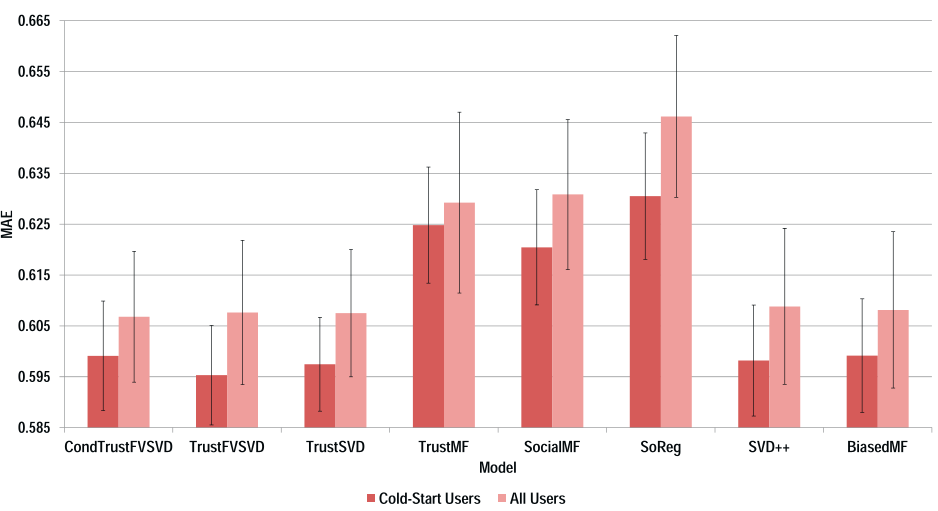 The charts above show TrustFVSVD (red/blue lines) consistently outperforming baselines like TrustSVD and PopMF.
Critical Insight & Conclusion
The Takeaway
The success of CondTrustFVSVD proves that bias modeling is often more important than the interaction itself. By capturing the discrepancy in how users value features, we can move closer to "Explainable AI" in recommendations.
Limitations
While powerful, the computational complexity scales with . Although linear relative to the number of ratings, calculating large interaction matrices (Y) for items with thousands of features may require specialized sparse-matrix optimizations in production environments.
Future Outlook
The next frontier is replacing the linear individual feature value functions with Non-linear Neural Networks, while still retaining the interpretability of social trust matrices.