
DRR: Balancing Reliability and Travel Cost in Spatial Crowdsourcing via Fractional Optimization
Expert Systems With Applications
This paper introduces a novel framework for dynamic task assignment in spatial crowdsourcing, termed Minimum-Cost Maximum Reliability Assignment (MC-MRA). The authors propose the Distance-Reliability Ratio (DRR) algorithm and its adaptive variant DRR-UCB, which combine combinatorial fractional programming with semi-bandit learning to jointly optimize task completion reliability and travel costs.
Executive Summary
Spatial crowdsourcing (SC) is the backbone of the gig economy—think Uber, TaskRabbit, or disaster response apps. The core challenge is the Server Assigned Task (SAT) problem: how do we match dynamic workers to physical tasks to ensure the highest success rate at the lowest cost? This paper proposes the MC-MRA (Minimum-Cost Maximum Reliability Assignment) framework. It moves away from "static" assumptions by treating task assignment as a combinatorial fractional optimization problem and introduces DRR-UCB, an algorithm that learns worker reliability on the fly.
The Problem: The Reliability-Cost Dilemma
In the real world, two things are rarely certain:
- Worker Reliability: Will the worker actually show up and finish the task?
- Efficiency: Is a reliable worker worth the 10km travel cost if a less reliable one is only 200m away?
Prior works either ignored travel costs to maximize completion or assumed we knew exactly how reliable every worker was (). Neither assumption holds in dynamic, large-scale deployments.
Methodology: Fractional Programming & Semi-Bandit Learning
The authors' "Secret Sauce" lies in how they define the objective function. Instead of choosing between reliability and cost, they optimize the Ratio.
1. The DRR Objective
The problem is formulated as: By minimizing this ratio, the system naturally seeks workers who provide the "best bang for the buck" in terms of distance covered per unit of reliability.
2. Linearization via Newton's Method
Solving non-linear fractional programs is computationally expensive. The authors use Newton's parametric method to transform the ratio into an equivalent linear assignment problem: This allows the use of the efficient Hungarian Algorithm to solve the matching in time per round.
3. Learning Under Uncertainty (DRR-UCB)
When worker reliability is unknown, the paper treats each worker as an "arm" in a Combinatorial Multi-Armed Bandit (CMAB).
- Exploitation: Assign tasks to workers who have high historical success.
- Exploration: Assign tasks to new workers to estimate their true reliability. The DRR-UCB algorithm uses an interval estimation heuristic, adding an uncertainty bonus to the reliability score:
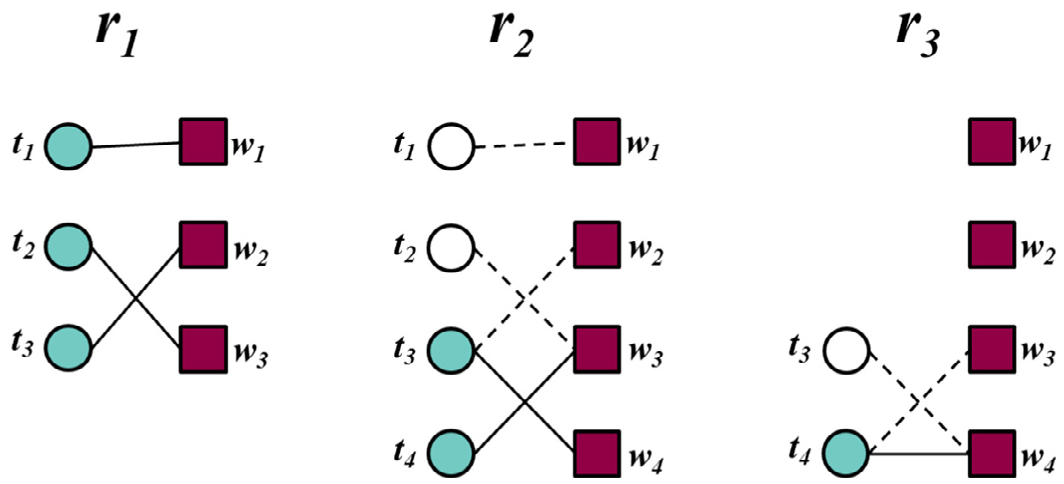 Figure: The interaction protocol between Requesters, Platform, and Workers.
Experimental Insights
Tested against Foursquare check-in data (NYC), the results are striking:
- Travel Cost Savings: DRR reduced travel costs by 80% compared to standard MWBM (Maximum Weighted Bipartite Matching).
- Learning Efficiency: Despite starting with zero knowledge of workers, DRR-UCB converged to near-optimal reliability within a few dozen rounds.
- Task Completion: The server-assigned mode achieved over 90% completion rates, proving far more effective than the "worker-selected" (WST) mode where search friction often prevents matches.
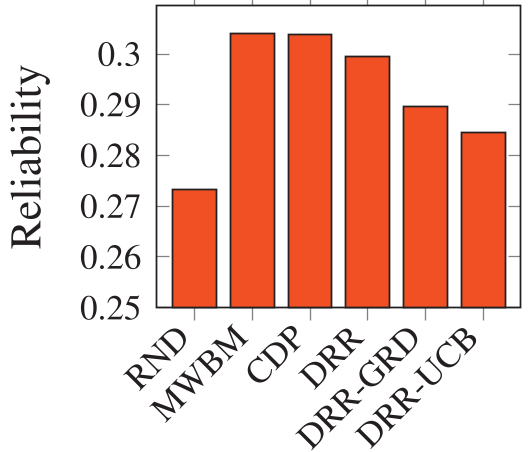 Figure: Average travel cost comparison across different algorithms.
Critical Analysis & Conclusion
The beauty of this work is its generality. Any expert system that deals with "ratio-based" objectives—such as energy efficiency (output/input) or ROI—can use this fractional programming approach.
Limitations:
- The model assumes a worker handles one task per round. In reality, workers might chain tasks together (e.g., a delivery driver taking three orders at once).
- It assumes independent worker reliabilities, ignoring potential "group effects" or adversarial behavior where workers might strategically fail tasks.
Takeaway: If you are building an assignment engine for the physical world, don't just optimize for the "best" result. Optimize for the efficiency ratio and acknowledge that your understanding of the user (reliability) must be learned dynamically.