
KD-FF: Elevating Social Media Query-Reply through Time-Frequency Feature Fusion
Expert Systems With Applications
2025-01-01
Summary
Problem
Method
Results
Takeaways
Abstract
This paper proposes a novel framework for automatic query-reply in social networks by integrating high-quality information extraction with query-oriented summarization. The core method, KD-FF, leverages time-frequency transformation and EM-based feature fusion to achieve SOTA-level noise reduction and redundancy elimination on microblog data like Sina Weibo.
## TL;DR
In the chaotic sea of social media—where noise and redundancy are the norms—getting a straight answer is hard. This paper introduces a sophisticated framework that treats social media features as signals. By applying **Wavelet Transformation** and **EM-based feature fusion**, the authors filter out the "garbage" to extract high-quality messages, then use a query-oriented summarizer to provide brief, accurate replies.
## The Problem: The "Signal-to-Noise" Crisis in Social Networks
Social networks like Twitter and Sina Weibo are goldmines of real-time information, but they are notoriously difficult to mine. The authors identify three primary hurdles:
1. **Highly Noisy Data**: Slang, arbitrary symbols, and informal grammar break traditional NLP tools.
2. **Massive Redundancy**: 30-60% of messages in a hot topic are repetitive.
3. **Feature Fragmentation**: Content alone isn't enough; one must consider user authority (followers), engagement (retweets), and external links (URLs).
Existing SOTA methods often ignored these social-specific "authority" features or failed to handle the computational complexity of massive data streams.
## Methodology: Treating Text as a Multidimensional Signal
The proposed **KD-FF (K-Dimensions Feature Fusion)** method operates through a clean, two-stage pipeline.
### 1. High-Quality Information Extraction (The Filter)
Instead of just looking at keywords, the authors build a K-dimensions feature matrix $F$ capturing social, content, and authority attributes.
* **The Innovation**: They transform these features into the **time-frequency domain** using Wavelet Transformation (specifically Haar and Daubechies7 wavelets). This allows the system to analyze components at different scales and resolutions, drastically reducing noise.
* **Feature Weighting**: They use an **Expectation-Maximization (EM) Algorithm** to calculate the "contribution degree" of each feature, ensuring that high-influence users and high-engagement posts weigh more than bot-like activity.
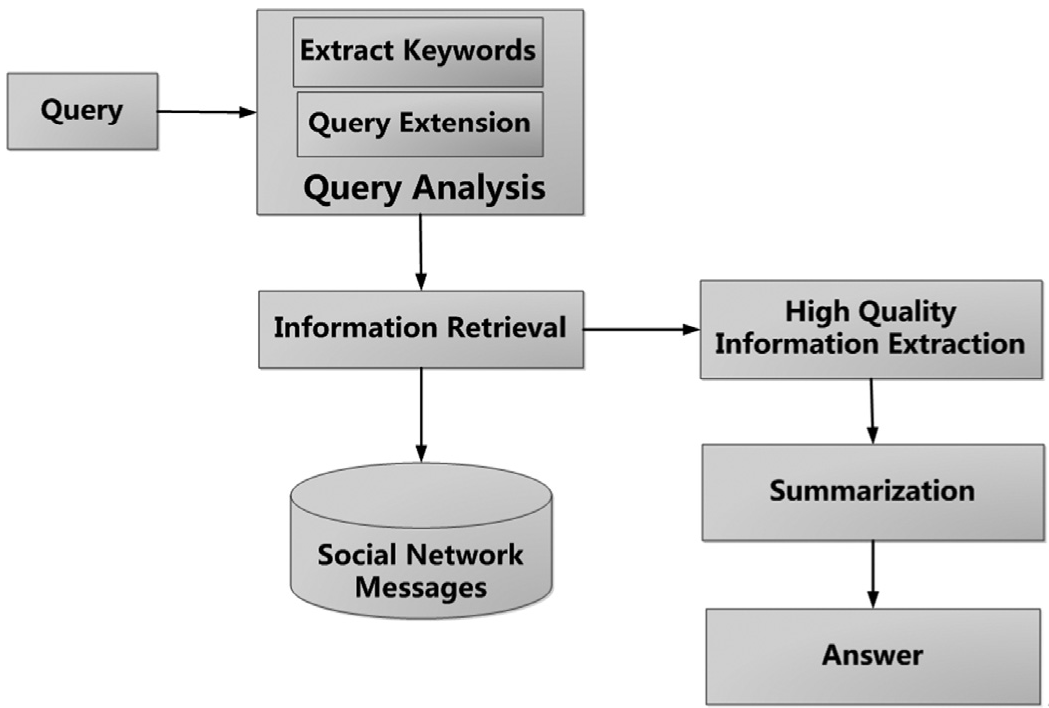
*Figure 1: The overall architecture of the High Quality Information Extraction and Summarization system.*
### 2. Query-Oriented Summarization (The Reply)
Once the "high-quality" set is extracted, the system scores sentences based on three weights:
* **Content Weight**: TF-IDF score of words.
* **Location Weight**: Proximity to high-scoring messages in the extraction pool.
* **Similarity Weight**: Cosine similarity to the user's specific query.
To ensure the final reply isn't repetitive, they apply **Simpson Distance** to maintain diversity among the top-selected sentences.
## Experimental Results: Outperforming the Baselines
The authors tested their approach on six trending topics from Sina Weibo (e.g., H7N9 Bird Flu, Real Estate Policy).
### Automatic Evaluation (ROUGE-1)
The Haar Wavelet variant (**KD-FF_HW**) dominated the rankings. In many cases, it even outperformed manual summaries in precision because it could aggregate facts across thousands of posts more comprehensively than a human volunteer.
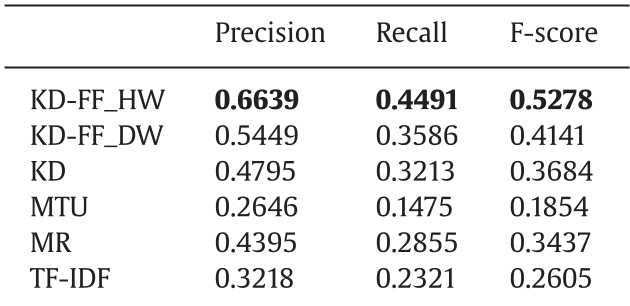
*Table 1: Average ROUGE-1 performance across all topics. KD-FF_HW leads significantly in F-score.*
### Manual Evaluation
Humans rated the summaries on Grammaticality, Redundancy, and Informativeness. The KD-FF_HW method achieved a **Comprehensive Quality score of 3.83/5**, proving that the "signal processing" approach yields highly readable and useful results.
## Critical Analysis & Future Outlook
**Why does it work?** The brilliance of this paper lies in the **Time-Frequency Transformation**. By treating social metrics as signals, the authors mitigate the volatility of social media data. The EM algorithm acts as a dynamic balancer, automatically determining if "Follower Count" is more important than "Retweet Count" for a specific topic.
**Limitations**:
* **Semantic Depth**: The similarity is still largely based on Cosine similarity/TF-IDF. Modern LLM-based embeddings would likely improve the "Grammaticality" even further.
* **Complexity**: While the wavelet transform is efficient ($O(N)$), the feature selection still requires significant pre-processing.
**Takeaway**: This work proves that in the age of Big Data, **Information Extraction (IE)** must precede **Summarization**. You cannot summarize a mess; you must clean it first.
## Conclusion
By merging signal processing techniques with NLP, this paper offers a robust blueprint for building automatic reply systems that are actually helpful. For developers in the social CRM or news aggregation space, the KD-FF framework remains a highly relevant model for noise reduction.