
DRR: Balancing Reliability and Travel Efficiency in Spatial Crowdsourcing via Fractional Optimization
Expert Systems With Applications
The paper introduces a novel framework for dynamic task assignment in spatial crowdsourcing, utilizing a Combinatorial Fractional Programming approach alongside Semi-Bandit Learning. The core contribution is the DRR (Distance-Reliability Ratio) algorithm and its adaptive variant DRR-UCB, which jointly optimize for maximum task reliability and minimum travel costs under conditions of unknown worker reliability.
TL;DR
In the physical world of spatial crowdsourcing (e.g., Uber, TaskRabbit), assigning the "right" worker to a task is a high-stakes balancing act between reliability (will they finish it?) and cost (how far must they travel?). This paper introduces the Distance-Reliability Ratio (DRR) algorithm, which treats task assignment as a combinatorial fractional programming problem. By integrating Semi-Bandit Learning, the system actually learns worker reliability on-the-fly, reducing travel costs by up to 80% without sacrificing task completion rates.
Problem & Motivation: The Uncertainty of the "Human Link"
In spatial crowdsourcing, "Server Assigned Tasks" (SAT) are algorithmically matched. However, most existing SOTA models suffer from two fatal flaws:
- Deterministic Assumptions: They assume we know exactly how reliable a worker is. In reality, a worker's success rate is a stochastic variable.
- Conflicting Objectives: Maximizing reliability often leads to assigning distant "expert" workers, skyrocketing travel costs. Conversely, assigning the nearest worker might lead to frequent task failures.
The authors' key insight: instead of optimizing for reliability and cost sequentially (which leads to local optima), we should optimize for their ratio using fractional programming.
Methodology: From Ratios to Assignments
1. The DRR Algorithm
The authors formulate the objective as a combinatorial fractional program, where the goal is to minimize:
To solve this non-linear objective, they employ Newton’s Method (Dinkelbach's Algorithm). This transforms the ratio into a parameterized linear assignment problem: Where is updated iteratively until convergence. This allows the system to use the efficient Hungarian Algorithm to find the optimal matching in polynomial time.
2. Learning under Uncertainty (DRR-UCB)
When worker reliability is unknown, the problem shifts into the realm of Multi-Armed Bandits (MAB). The authors propose DRR-UCB, which uses an interval estimation heuristic.
- Exploration: Selecting workers with high uncertainty to learn their true reliability.
- Exploitation: Selecting workers known to be highly reliable.
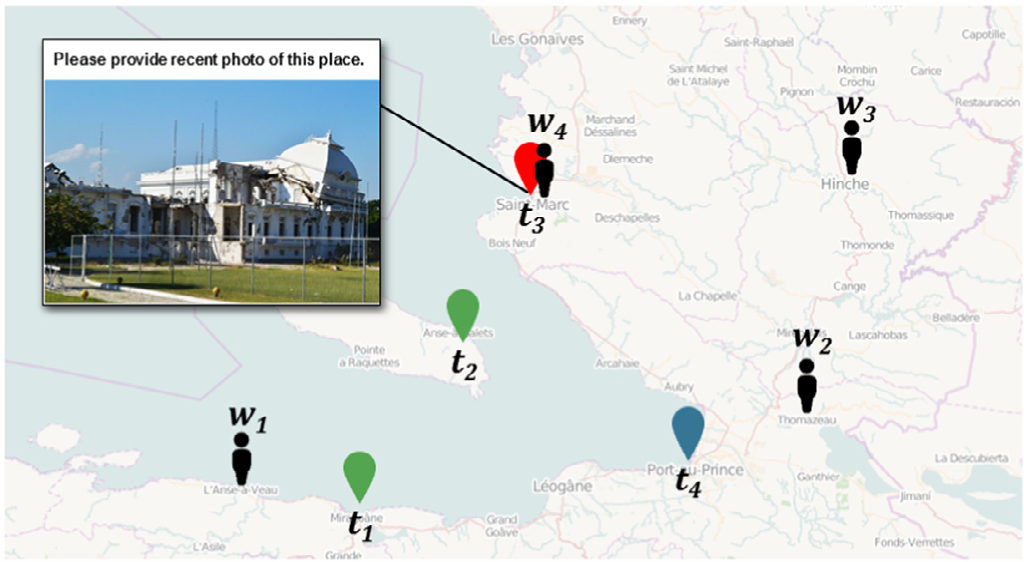 Figure 1: The interaction between the platform, workers, and tasks in a dynamic environment.
Experiments & Results: Slashing Costs
The authors benchmarked their work against MWBM (Max Weight Bipartite Matching) and CDP (Close Distance Priority).
- Travel Efficiency: DRR slashed travel costs by ~80% compared to MWBM.
- Reliability Convergence: In real-world Foursquare data (New York check-ins), the DRR variants maintained high task completion rates (~70%+) even with unreliable worker populations.
- Scalability: The execution time for DRR remains sub-second for 500-task/100-worker rounds, making it viable for real-time mobile platforms.
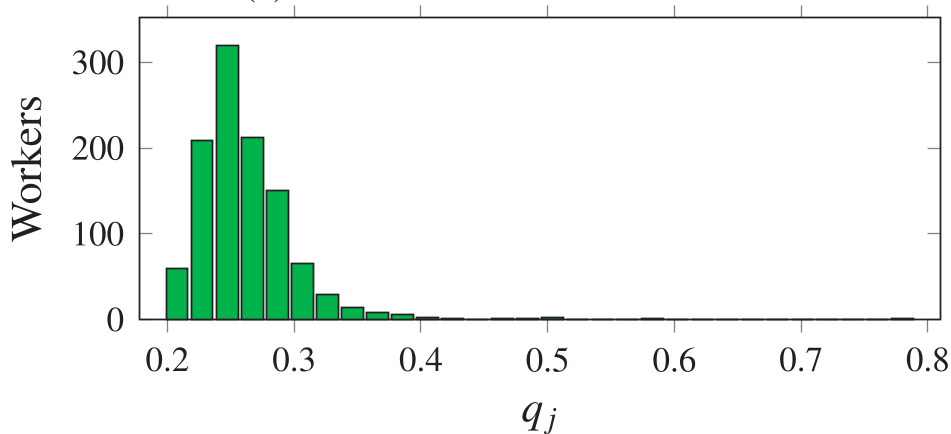 Figure 2: Performance metrics showing the stability of DRR across different worker reliability ranges.
Critical Analysis & Conclusion
Takeaway
The genius of this work lies in its transformation of a messy bi-objective problem into a structured fractional one. By using Semi-Bandit feedback (where outcomes are only observed for assigned workers), the platform bridges the gap between theoretical optimization and the messy reality of human behavior.
Limitations
- Immediate Feedback: The model assumes we observe a task's success or failure at the end of each round. In real life, tasks might have varying "Chain lengths" or delayed reporting.
- Worker Centricity: The model focuses on the platform's utility; future work should consider "Social Welfare" or worker fatigue to ensure long-term retention.
Outlook
As mobile crowdsensing evolves into "human-in-the-loop" AI training, algorithms like DRR will be essential for orchestrating massive distributed workforces with minimal physical (carbon) footprint and maximum data reliability.