
Beyond Static Triggers: Predicting Banking Crises with Dynamic Bayesian Networks
Expert Systems With Applications
The paper proposes a novel Early Warning System (EWS) for systemic banking crises using Dynamic Bayesian Networks (DBNs). It introduces the Switching Linear Dynamic System (SLDS) and the Naïve Bayes SLDS (NB-SLDS) to model the temporal dynamics of financial indicators, significantly outperforming traditional signal extraction and logit models.
TL;DR
Financial crises aren't just points on a graph; they are dynamic processes. This paper shifts the paradigm of Early Warning Systems (EWS) from static logic (if , then warning) to a dynamic state-space approach. By using Switching Linear Dynamic Systems (SLDS) and Naïve Bayes SLDS, the authors demonstrate that we can catch systemic banking crises with significantly higher precision than traditional models, often identifying the "slide into chaos" years before it manifests.
The Failure of Static EWS
For decades, the financial world relied on two main tools:
- Signal Extraction: A heuristic that triggers when a single variable crosses a percentile-based threshold.
- Logit Models: Logistic regression that attempts to separate "crisis" from "tranquil" using a hyperplane.
The fatal flaw? They ignore time. A sudden spike in credit growth might be healthy in a recovery phase but catastrophic in a saturated market. Traditional models can't distinguish between the two because they don't model the evolution of the system.
The Methodology: Modeling the "Hidden" Economy
The core insight of this paper is that the "banking system state" is a latent variable. We cannot see the state directly, but we can observe its "emissions" (GDP, house prices, loans).
1. The Switching Linear Dynamic System (SLDS)
The SLDS models the economy as a series of different "regimes" (e.g., Tranquil vs. Crisis). In each regime, the financial indicators follow different linear rules.
- The Transition: A Markov process determines when the system shifts from one regime to another.
- The LDS Step: Within a regime, the indicators are "tracked" like a radar tracks a target, calculating current values and their rates of change.
2. The Naïve Bayes Innovation (NB-SLDS)
Modeling every financial variable in a single giant matrix leads to the "curse of dimensionality." The authors utilize an NB-SLDS, assuming that given the regime state, the dynamics of individual indicators (like debt-to-GDP vs. asset price index) are independent.
The benefit? It handles missing data gracefully. If one country fails to report quarterly household debt, the model doesn't crash; it updates the regime probability based on the remaining visible indicators.
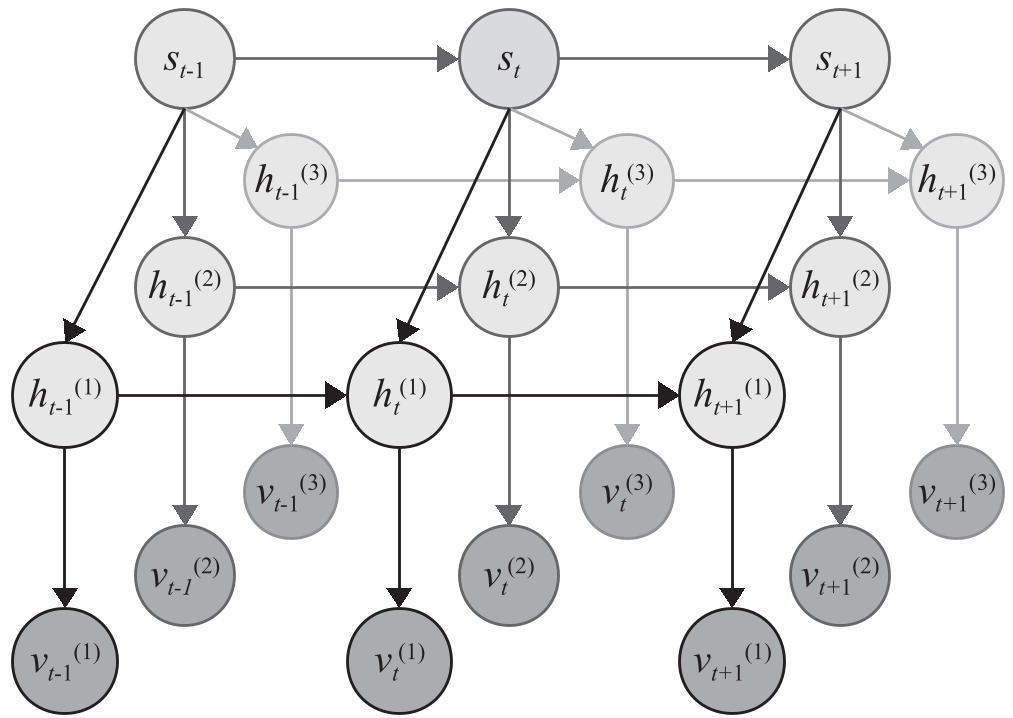 Figure 1: The NB-SLDS structure, where the latent state influences multiple independent linear dynamic systems.
Experimental Showdown: DBN vs. The World
The authors tested their models using a dataset of 11 European countries from 1980 to 2013, including 19 systemic crisis events.
Crisis Predictability (The 3-Year Lead)
Instead of just checking if the model can label a crisis while it is happening, the authors measured the predictive horizon—the 12 quarters leading up to the crash.
| Method | Accuracy | Precision | F-Score |
|---|---|---|---|
| Logit Model | 0.60 | 0.37 | 0.38 |
| Signal Extraction | 0.74 | 0.67 | 0.62 |
| NB-SLDS | 0.74 | 0.71 | 0.68 |
The NB-SLDS provides a much narrower variance in results, meaning it is more reliable across different national economies compared to the volatile performance of the signal extraction method.
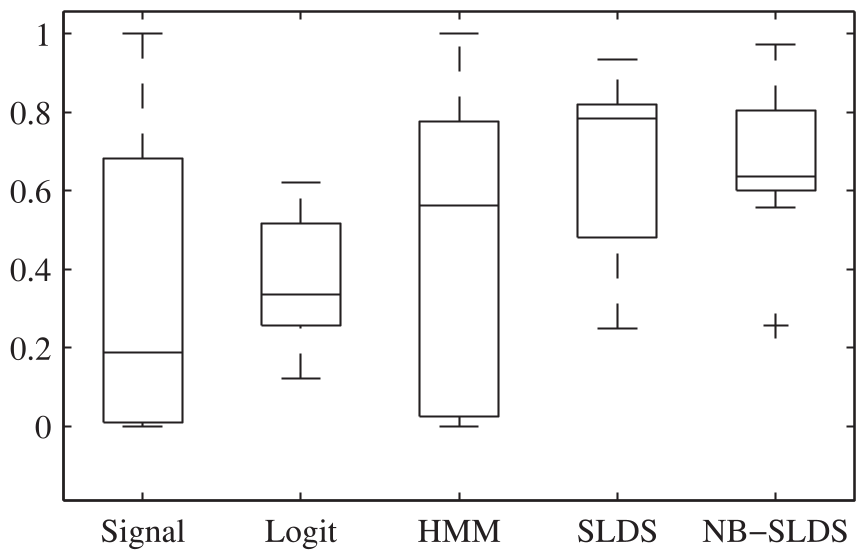 Figure 2: Box plots showing the superior stability and higher median precision of the NB-SLDS compared to traditional methods.
Deep Insight: Why Why it Works
The DBN models (SLDS/NB-SLDS) provide something a Logit model cannot: Probabilistic Severity. As the system moves closer to a crisis, the probability increases gradually. This provides policy makers with a "speedometer" of risk rather than an "on/off" switch.
The paper also observes that Consumer Price Index (CPI) became a highly informative feature in the DBN framework, suggesting that the inflation dynamics often contain hidden clues about financial instability that static models overlook.
Conclusion & Future Outlook
This work demonstrates that the financial architecture is a dynamic machine. By treating crisis detection as a state-space tracking problem rather than a classification problem, we can gain precious years of warning time.
Limitations: The computational complexity of SLDS (requiring Expectation-Maximization and Kalman filtering) is higher than simple regression. However, given the multi-billion dollar cost of a systemic banking failure, a few extra seconds of CPU time is a negligible price to pay.