
CSD: Rethinking Scalable Community Recommendation via Multi-User Similarity
Expert Systems With Applications
The paper introduces Community Similarity Degree (CSD), a novel and computationally efficient multi-user similarity metric designed for Online Social Networks (OSNs). CSD identifies optimal communities for group-based item recommendations, achieving state-of-the-art efficiency by processing 1 million communities in under an hour.
TL;DR
Recommending a movie to a group of friends is much harder than recommending to one person. Most systems struggle because they try to force-feed recommendations to groups that have no common ground. This paper introduces Community Similarity Degree (CSD), an ultra-fast metric that identifies which groups are actually "recommendable" before wasting compute power on complex algorithms. By selecting high-CSD groups, recommendation precision can jump by 700%.
Background: The "Whom to Recommend" Problem
In Online Social Networks (OSNs) like Facebook, communities are ubiquitous. However, "Friendship" does not always equal "Shared Interest." A family group might share blood but zero taste in music.
Current SOTA methods focus on the How: "Given this group, what item should I pick?" This paper asks the Why: "Why are we recommending to this group at all if they share nothing?"
The bottleneck is that comparing everyone to everyone else in a group (Pairwise Similarity) is too slow for billions of communities. We need a global, linear-time metric.
Methodology: The Logic of CSD
The authors define CSD using a beautiful physical intuition. Instead of pairwise comparisons, CSD uses a approach based on the "Weight" of the community.
The Formula
Where:
- : Total number of "fans" across all interests in the group.
- : Number of distinct interests.
- : Number of users.
The Intuition: If every user shares the exact same interests, the average popularity equals the number of users, and CSD becomes 1. If no two users share a single interest, CSD drops to 0.

Empirical Insights: Not All Groups are Created Equal
The researchers emulated four types of Facebook communities: Friend-based, Interest-based, Location-based, and Random.
- Complexity vs. Size: CSD decreases as community size increases. It's much harder for 1,000 people to agree than for 5.
- The Interest-Based Advantage: Users who share one specific interest (e.g., a specific movie) are significantly more likely to share other hidden interests than users who are simply friends or live in the same city.
- Music is Special: In FB data, music-based groups showed the highest CSD, suggesting music is a stronger "social glue" than movies or books for small groups.
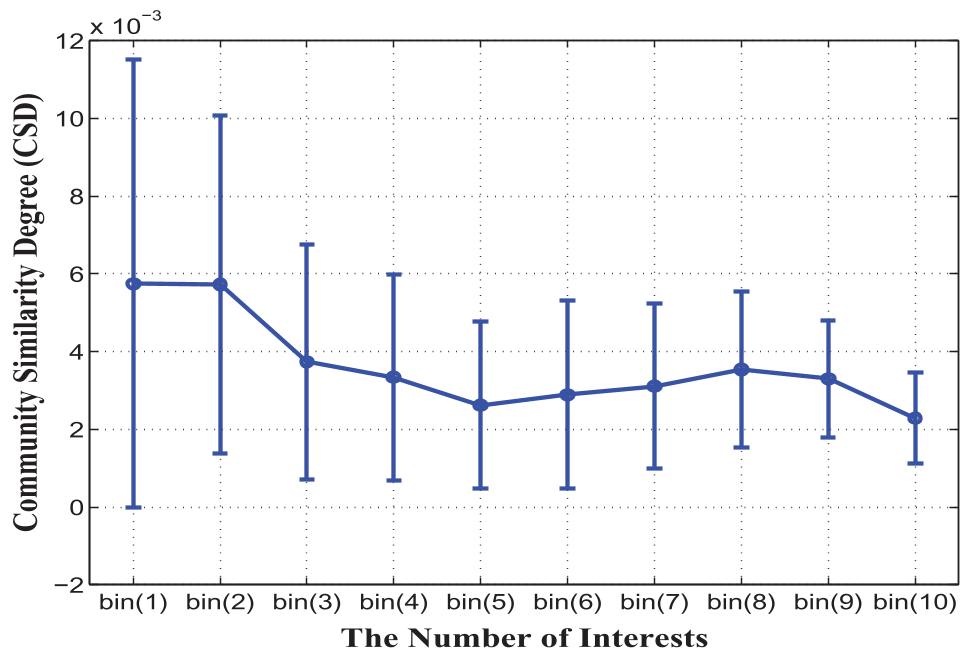 Figure: CSD naturally decays as group size grows, but the rate of decay varies by community type.
Experiments: Proof of Value
The ultimate test: Does a high CSD actually mean better recommendations? Using a collaborative filtering backbone, the authors ranked communities by CSD and measured Mean Average Precision (MAP).
- Top 100 Communities (High CSD): MAP@3 = 0.112
- Bottom 100 Communities (Low CSD): MAP@3 = 0.014
- Result: High CSD groups are 8 times more responsive to recommendations.
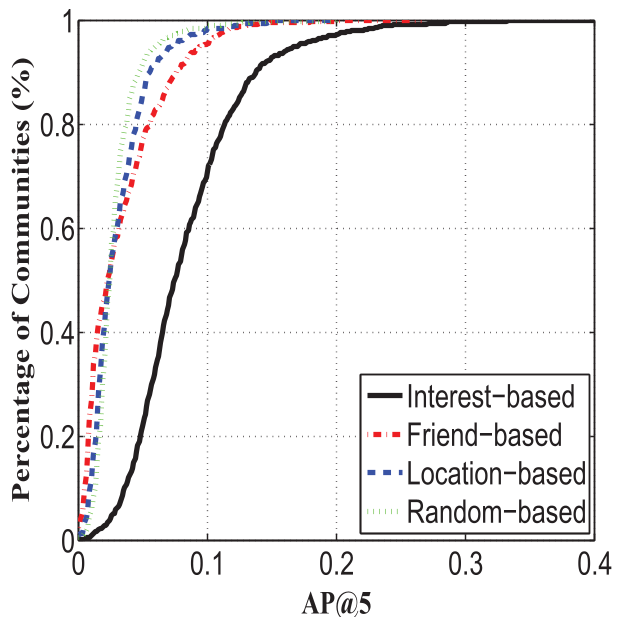 Figure: The Cumulative Distribution Function (CDF) shows a clear shift: top-CSD communities (TC) consistently outperform bottom ones (BC).
Critical Analysis & Future Work
Efficiency: CSD is remarkably fast. 1 million communities in 41 minutes on a standard laptop means this can be deployed in real-time pipelines.
Limitations:
- Semantic Blindness: CSD treats "Harry Potter 1" and "Harry Potter 2" as completely different interests. It lacks a latent semantic layer.
- Uniformity Bias: It doesn't distinguish between a group where one interest is hyper-popular and a group where many interests are moderately popular.
Conclusion
This work provides a pragmatic tool for OSN architects. Instead of building "smarter" recommendation models that try to solve the impossible, we can use CSD to find the groups where recommendation is actually likely to succeed. It's a filter, a metric, and a strategic tool for group-based marketing.