
Unmasking the Puppeteers: A Deep Dive into Malicious Social Bot Taxonomy and Detection
Expert Systems With Applications
This paper provides a comprehensive survey and a refined taxonomy of malicious social bots in Online Social Networks (OSNs). It classifies bot attacks into three distinct stages (Initiation, Listening, and Execution) and evaluates state-of-the-art detection approaches, including graph-based, machine learning, and emerging coordinated attack detection methods.
TL;DR
Malicious social bots have evolved from simple spam scripts into sophisticated, multi-stage "social botnets" that utilize OSNs as C&C channels. This survey by Majd Latah provides a definitive taxonomy of these threats—categorizing them by attack stages (Initiation, Listening, Execution)—and critiques the current detection landscape, emphasizing a shift toward collective behavioral analysis.
Academic Positioning: This work serves as a high-level cartography of the social bot battlefield, moving beyond coarse-grained surveys to provide a detailed methodology-centric critique of SOTA defenses.
Problem & Motivation: The Evolution of Stealth
The fundamental challenge in social bot detection is the "Arms Race." Traditional bots were loud and predictable. Modern bots, however, exploit the "Impact of a Crowd" and principles like Triadic Closure (making friends with friends) to infiltrate legitimate communities.
The author argues that prior work failed to account for the multi-stage nature of these attacks. A bot might remain dormant (Listening-stage) for months, mimicking human-like temporal patterns, only to launch a coordinated stock manipulation or political campaign (Execution-stage) in a single synchronized burst.
Methodology: The Three Pillars of Detection
The paper categorizes detection into three major technical families:
1. Graph-Based Approaches
These rely on the topological structure of the social graph.
- Strong Assumption Models: (e.g., SybilGuard, SybilLimit) Assume "fast-mixing" graphs where honest regions are easily separable from bot regions.
- Relaxed Assumption Models: (e.g., SybilRank, SybilBelief) Use weighted trust propagation and Loopy Belief Propagation (LBP) to handle the noise of real-world "friendship" interactions.
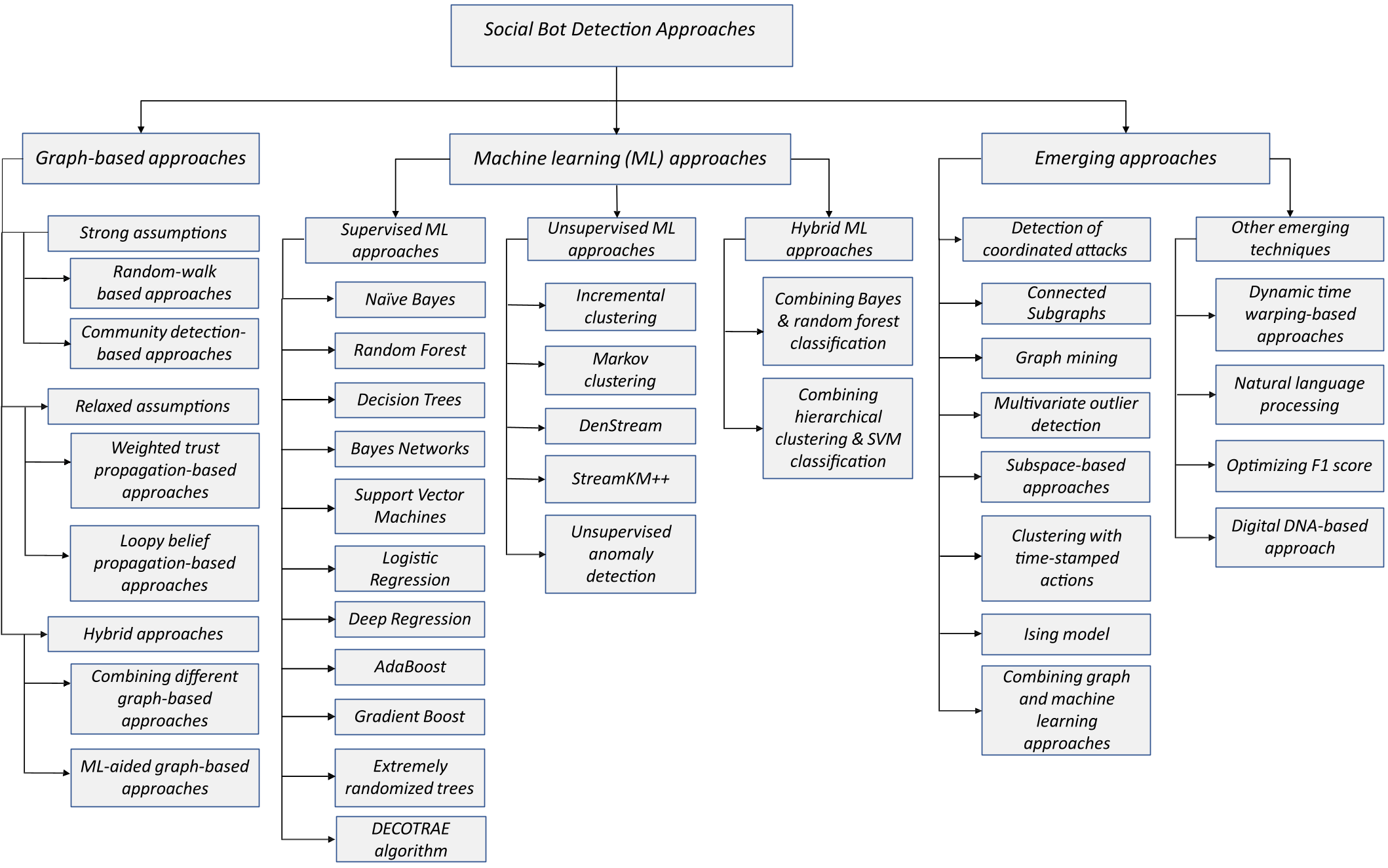 Figure 1: The proposed hierarchical taxonomy of social bot detection approaches.
2. Machine Learning Approaches
- Supervised: Utilizing over 1,000 features (metadata, sentiment, entropy). The paper highlights Botometer (formerly BotOrNot) as a classic example.
- Unsupervised/Hybrid: Clustering-based methods (e.g., DenStream) that identify anomalies in data streams without labeled ground truths.
3. Emerging Coordinated Detection
The most cutting-edge area involves Digital DNA. By representing user actions (Tweet, Retweet, Reply) as an alphabet of symbols, researchers can use string alignment algorithms (like Longest Common Subsequence) to find groups of accounts sharing "evolutionary" behavior patterns.
Experiments & Results: The Performance Gap
The survey compares results across various benchmarks (Twitter, Facebook, RenRen).
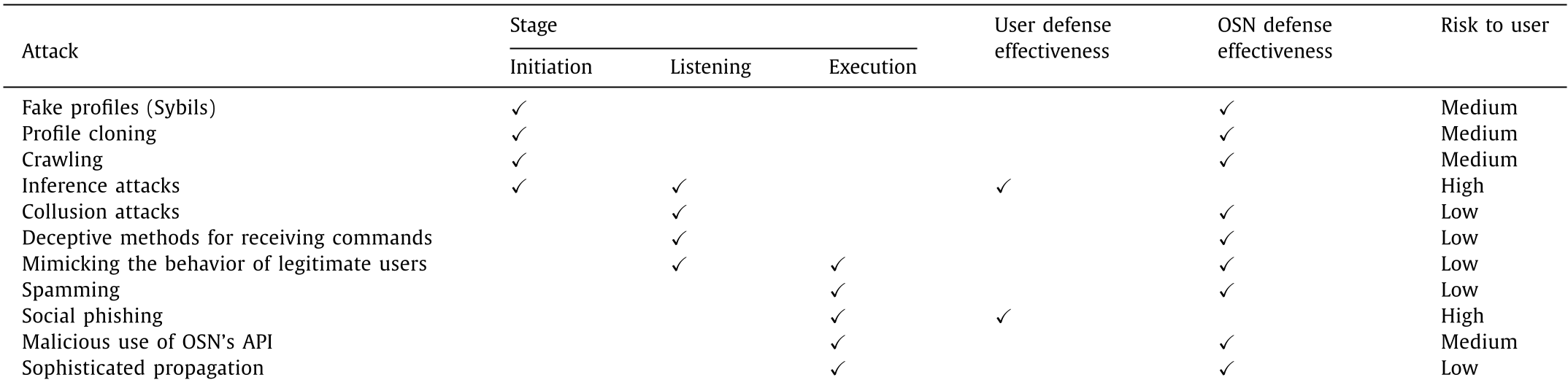 Table 1: Effectiveness of defenses against different attack stages. Note the "High" risk assigned to Inference and Social Phishing attacks.
Key findings include:
- SybilRank is effective but suffers when bots successfully "farm" links from real users.
- Coordinated Attack Detection (e.g., CopyCatch, SynchroTrap) achieves >90% precision by pivoting from "who the bot is" to "what the botnet does in lockstep."
Critical Analysis & Future Outlook
Limitations:
- Computational Cost: Extracting community-based or graph-centric features from billion-node graphs remains prohibitively expensive for real-time blocking.
- Zero-Day Bots: Most ML models still struggle with previously unseen bot behaviors that do not exist in training datasets.
The Road Ahead: The author suggests a transition to Systematic Synthetic Bot Generation. By using optimization algorithms and GANs to create "super-bots" that mimic humans perfectly, we can proactively train the next generation of general-purpose detection systems.
Final Takeaway: Social bot detection is no longer just about identifying a "fake profile." It is about understanding the temporal signature and coordinated trajectory of groups acting in unison to tilt digital influence.