
Decentralized Expertise: How Crowdsourcing Replaces Centralized Search in Social Networks
Expertise Discovery in Decentralised Online Social Networks
2017-07-31
Summary
Problem
Method
Results
Takeaways
Abstract
The paper introduces a crowdsourcing-based approach for expertise discovery in Decentralised Online Social Networks (DSNs). It addresses the information retrieval challenge inherent in peer-to-peer social architectures by optimizing worker selection, task allocation, and reward distribution to locate experts without a central authority.
## TL;DR
Finding an expert in a decentralized social network (DSN) is like finding a needle in a haystack where no one has a map of the farm. This paper proposes a crowdsourcing framework that uses local neighbor influence and smart incentives to locate expertise. The result? A search efficiency that rivals centralized systems without compromising user privacy.
## The Decentralization Dilemma
In a Centralized Online Social Network (OSN) like LinkedIn or X, the platform provider owns a global index. When you search for a "Machine Learning Expert," the server scans its entire database and returns a result in milliseconds.
In a **Distributed Social Network (DSN)**, you own your data, and it stays on your personal server (or "pod"). There is no central index. To find an expert, you have to ask your friends, who ask their friends—a process known as a **Cascade**. Without a control mechanism, these cascades either fail to find the expert or flood the network with redundant queries, leading to massive overhead.
## Methodology: The Three Pillars of Social Search
The authors move away from "blind flooding" by treating the search as a crowdsourcing task. The framework is built on three algorithmic components:
### 1. Worker Selection (Intelligence Filtering)
Instead of asking everyone, the system identifies "workers"—nodes that are strategically positioned. The algorithm calculates the **maximum weighted path** back to the initiator. It prioritizes users who are not just connected, but connected via "strong" edges (e.g., frequent co-authorship in a citation network).
### 2. Task Selection (Query Routing)
Once a worker is selected, they are tasked with recommending a fraction of their neighbors who best match the query's required expertise. This creates a directed search rather than a broadcast.

*Note: The algorithm simulates how influence propagates through the network based on local expertise matching (P1 and P2).*
### 3. Reward Distribution (Truthfulness Incentives)
Why would a user help you find an expert? The paper adopts a **hierarchical reward system**. If an expert is found, the reward is split among the "chain" of people who led to that expert. This encourages users to be truthful and precise; if you recommend a "fake" expert, you gain nothing.
## Experimental Validation
The researchers tested their approach using an ACM citation network (2002–2011). They compared their crowdsourcing heuristics against a **Greedy Algorithm**—a theoretical benchmark that has "God-mode" access to all network data.
### Key Findings:
* **Cascade Control**: The crowdsourcing algorithms (Heuristics-1 and Heuristics-2) drastically reduced the number of participants compared to naive search (Algo-1), preventing network congestion.
* **Near-Optimal Efficiency**: As shown in the figures below, the cascade size of the decentralized crowdsourcing method was remarkably close to the Greedy baseline.
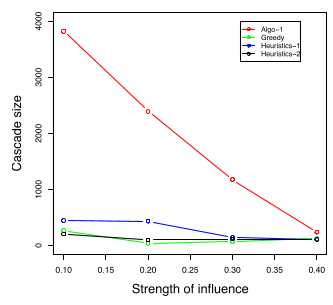
*Figure: Comparative analysis of cascade size across different influence strengths. Note how crowdsourcing tracks closely with the optimal greedy approach.*
### Quality vs. Quantity
While naive flooding (Algo-1) technicaly finds "higher quality" matches occasionally, it does so by involving thousands more users. The crowdsourcing approach maintains high solution quality (similarity to the query) while keeping the participant pool small and motivated.
## Critical Insight: The "Who You Know" Advantage
The core philosophy here is: *“It’s not what you know, but who you know.”* By leveraging the **Inductive Bias** of social connections—that experts in a field tend to know other experts in that same field—information retrieval becomes a local optimization problem rather than a global search problem.
## Conclusion & Future Look
This work proves that we don't need "Big Brother" algorithms to find specialized information. As we move toward a Web3 and decentralized social future, these types of incentivized routing protocols will be essential for making the "Social Graph" searchable without sacrificing the "Private Graph."
**Limitations**: The current model assumes users respond immediately. In real-world scenarios, latency and "stale" expertise data might hinder the search speed. Future research into asynchronous social search is the next logical step.