
Trustworthy AI in Healthcare: Navigating the Maze of Explainability
The role of explainability in creating trustworthy artificial intelligence for health care: A comprehensive survey of the terminology, design choices, and evaluation strategies
This paper provides a comprehensive survey and conceptual framework for Explainable AI (XAI) in healthcare, aiming to facilitate Trustworthy AI. It establishes formal definitions for explainability—comprising interpretability and fidelity—and proposes a decision-making rubric to choose between explainable modeling and various post-hoc explanation methods (model-based, attribution-based, or example-based).
TL;DR
Artificial Intelligence holds the promise of revolutionizing medicine, yet "black-box" models remain a hard sell in clinics. This paper argues that Explainable AI (XAI) is the bridge to Trustworthy AI. By formalizing the definitions of interpretability and fidelity, the authors provide a roadmap for developers to choose the right explanation strategy based on clinical needs, while acknowledging that explainability is just one piece of the trust puzzle.
Background: The Trust Gap
In healthcare, an incorrect prediction isn't just a bad recommendation; it’s a potential threat to human life. Clinicians are ethically and legally bound to justify their decisions. The "black box" nature of deep learning creates a barrier not just of understanding, but of accountability. To move from experimental code to bedside practice, AI must satisfy three conditions: it must be lawful, ethical, and robust.
The Core Conflict: Accuracy vs. Interpretability
The authors dismantle the common myth that "higher accuracy always requires higher complexity." In many medical tasks, simpler, intrinsically interpretable models (like Logistic Regression or Decision Trees) perform nearly as well as Neural Networks while offering 100% fidelity.
Redefining the Vocabulary
The paper clarifies the often-confused terms:
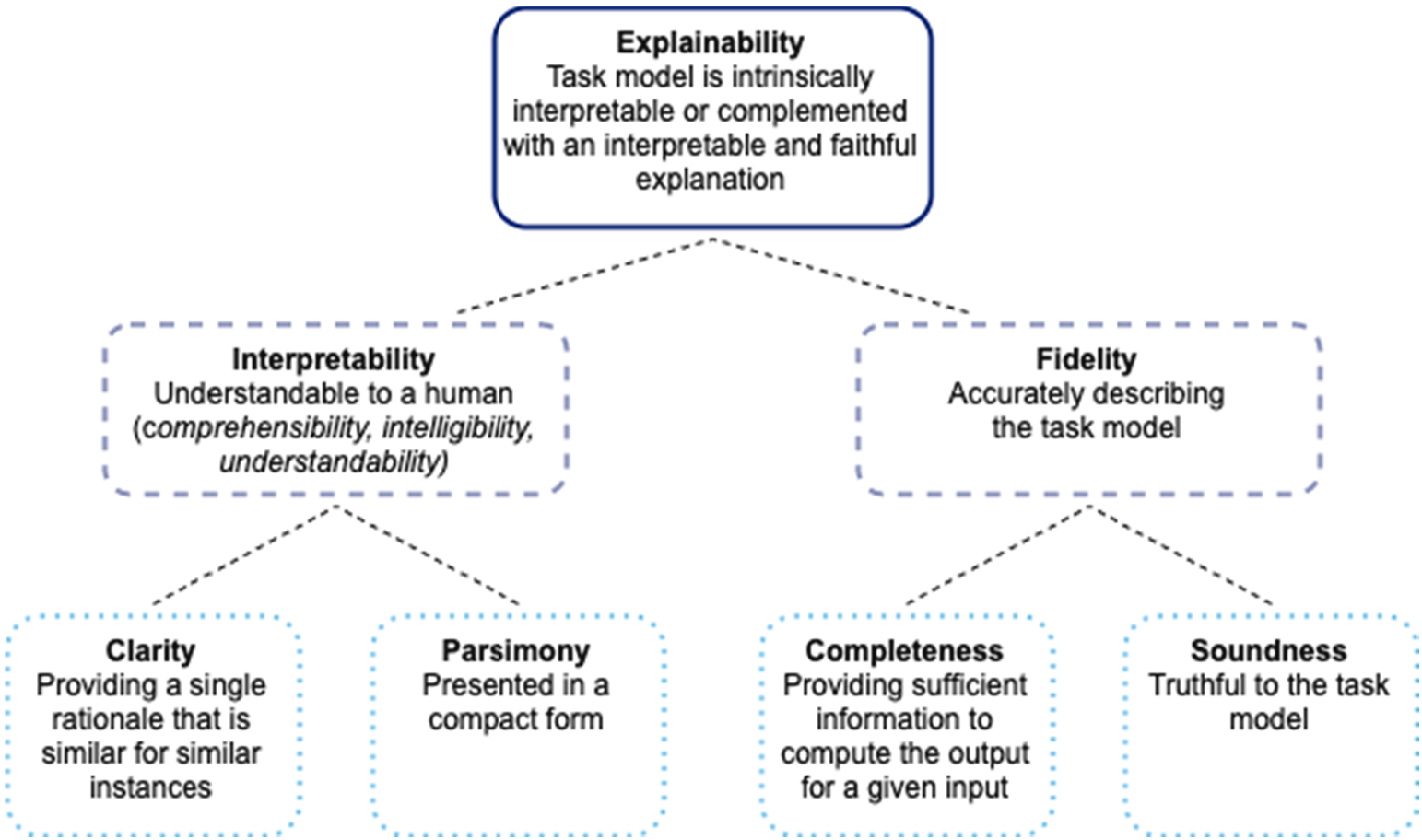
- Interpretability: How understandable is it to a human? (Dimensions: Clarity and Parsimony).
- Fidelity: How accurately does the explanation reflect the actual model? (Dimensions: Completeness and Soundness).
- Explainability: The total package—either an interpretable model by design OR a black box plus a faithful post-hoc explanation.
Methodology: The Strategic Framework
How do you choose a method? The authors propose a 3-step decision tree:
- Performance vs. Explanation: If the cost of a mistake is high (safety-critical), explainability is non-negotiable.
- Model Selection: Can a "White Box" model (like a GAM) match the performance of a "Black Box"? If yes, always choose the White Box.
- The Priority Trade-off:
- If the goal is Verifying Safety/Insights: Prioritize Fidelity. Use Model-based explanations.
- If the goal is Social Interaction/Patient Communication: Prioritize Interpretability. Use Attribution-based (feature weights) or Example-based (patient similarity) methods.
Mapping the XAI Landscape
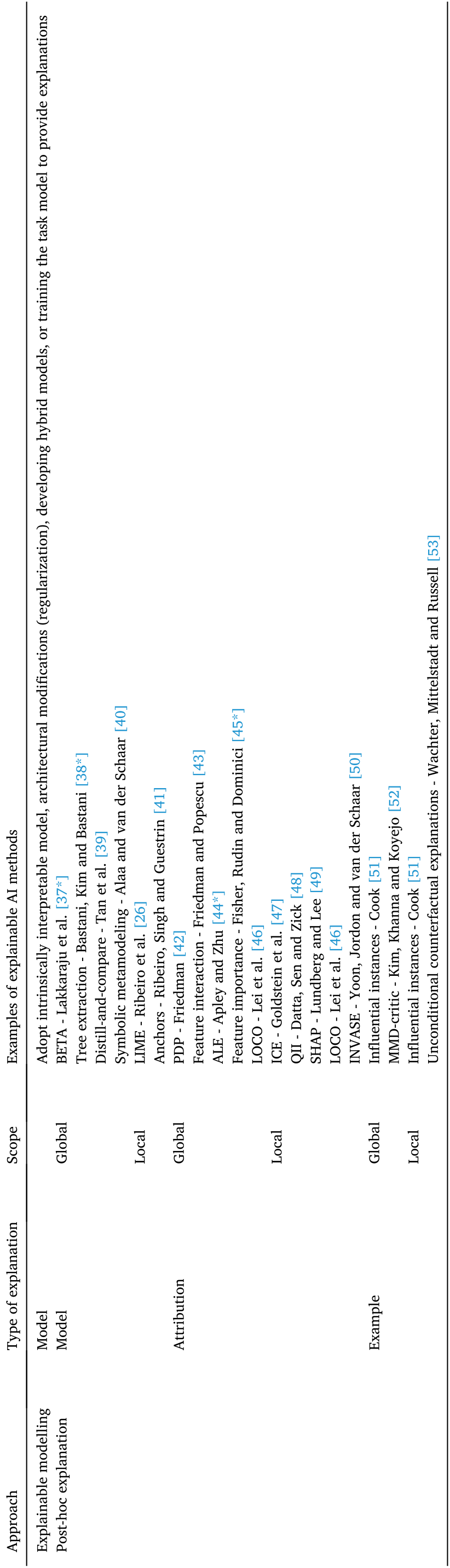
The paper categorizes current SOTA methods into a clear taxonomy:
| Approach | Scope | Type | Notable Examples |
|---|---|---|---|
| Explainable Modeling | Global | Model | GAMs, GA2Ms, Decision Trees |
| Post-hoc | Local | Attribution | LIME, SHAP, QII |
| Post-hoc | Local | Example | Counterfactuals (Wachter et al.) |
Critical Analysis: The Evaluation Crisis
A major contribution of this work is the assessment of how we measure success. The authors find a disturbing "I know it when I see it" attitude in current research.
- Model-based methods have robust metrics for Soundness (predictive agreement).
- Attribution methods rely on axioms (sensitivity, continuity) but often fail to distinguish between a bad model and a bad explanation.
- Example-based methods (like "similar patients") lack quantitative evaluation entirely.

Beyond Explainability: The Holistic View
The authors conclude with a sobering reality check: Explainability is not trust. To achieve a "Trustworthy AI" ecosystem, we must also implement:
- Data Quality Reporting: Understanding biases in Electronic Health Records (EHR).
- External Validation: Testing models on diverse, multi-center datasets (e.g., using the OMOP Common Data Model).
- Licensing: Treating AI developers like licensed clinicians with professional accountability.
Summary & Future Outlook
This survey serves as a fundamental guide for ML engineers and medical researchers. The future of the field lies in Hybrid Modeling—combining the raw power of deep learning with the structural constraints of domain-specific medical knowledge. As we move toward 2026, the focus will shift from "explaining the black box" to "building better glass boxes."