
Explainable Crowdsourcing: Peering into the "Black Box" of Worker Mistakes
Explainable modeling of annotations in crowdsourcing
The paper introduces a joint aggregation and clustering model designed to improve the explainability of crowd worker errors in Named Entity Recognition (NER) tasks. By extending the classical Dawid & Skene (DS) model with instance clustering, it categorizes worker mistakes into interpretable patterns (e.g., missing nationalities or acronyms).
TL;DR
While label aggregation has traditionally focused on the "what" (getting the right label), this paper focuses on the "why" (understanding why workers fail). The authors introduce a joint model that aggregates labels and clusters worker errors simultaneously. By exposing predictable patterns—such as a worker always missing "nationality" entities—the system helps Requesters improve instructions and helps workers learn from systematic errors.
Problem & Motivation: The Transparency Gap
In platforms like Amazon Mechanical Turk, the annotation process is largely opaque. We see the final labels, but we don’t see the logic—or lack thereof—behind them.
Current state-of-the-art (SOTA) methods usually treat worker reliability as a single scalar or a simple confusion matrix. However, a worker might be 90% accurate but fail 100% of the time on a specific sub-type of data (e.g., acronyms in NER). If a Requester can't "see" this pattern, they can't fix it. The authors argue that we need explainable models that summarize these errors into interpretable clusters.
Methodology: Joint Aggregation and Clustering
The core innovation is bridging the gap between human-centered task design and probabilistic machine learning.
The Model Architecture
Instead of clustering errors after the aggregation is finished (the "Naive Baseline"), the authors bake clustering directly into the Dawid & Skene (DS) framework.
- Aggregation: Uses EM to estimate true labels and worker confusion matrices.
- Confusion Categories: Instances are grouped into True Positive (TP), True Negative (TN), False Positive (FP), and False Negative (FN).
- Clustering: Within each category, the model performs clustering based on instance features (like "Is Capitalized" or "Is Noun").
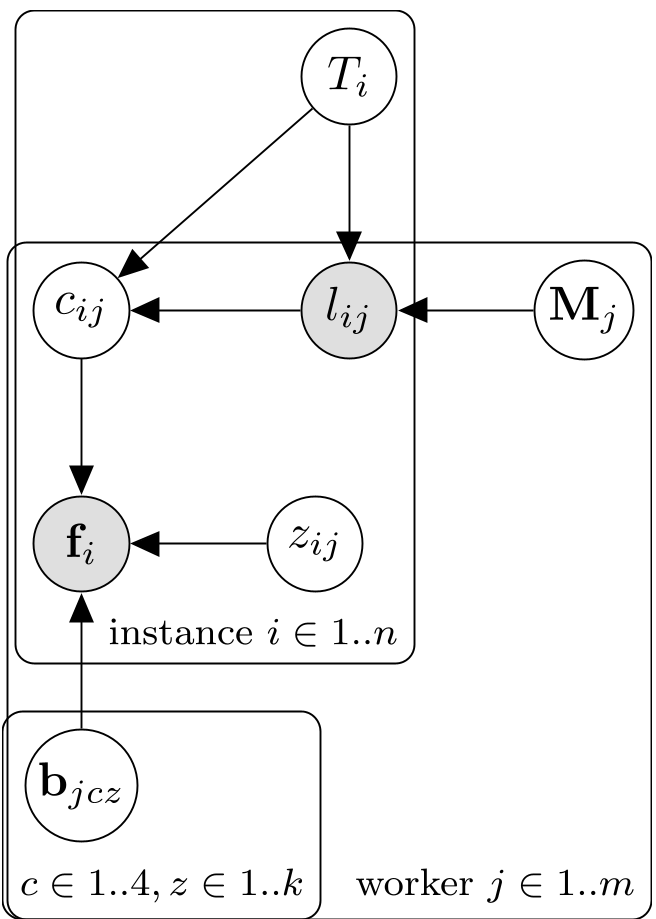
The model uses Gibbs Sampling for inference, which allows it to handle the uncertainty of the true labels. Unlike the baseline, if the model isn't sure about a label, it doesn't "force" it into a cluster with 100% weight, leading to more robust pattern recognition.
Experiments & Results: Does Clustering Help?
1. Statistical Validity
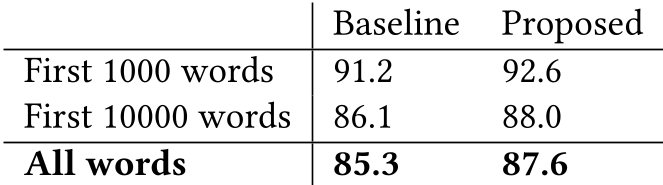
The authors tested if their joint model could recover "real" error patterns compared to a baseline that clusters after aggregation. The results showed that the joint approach was significantly more consistent with ground-truth error patterns, especially as the dataset grew larger.
2. Human Sense-Making
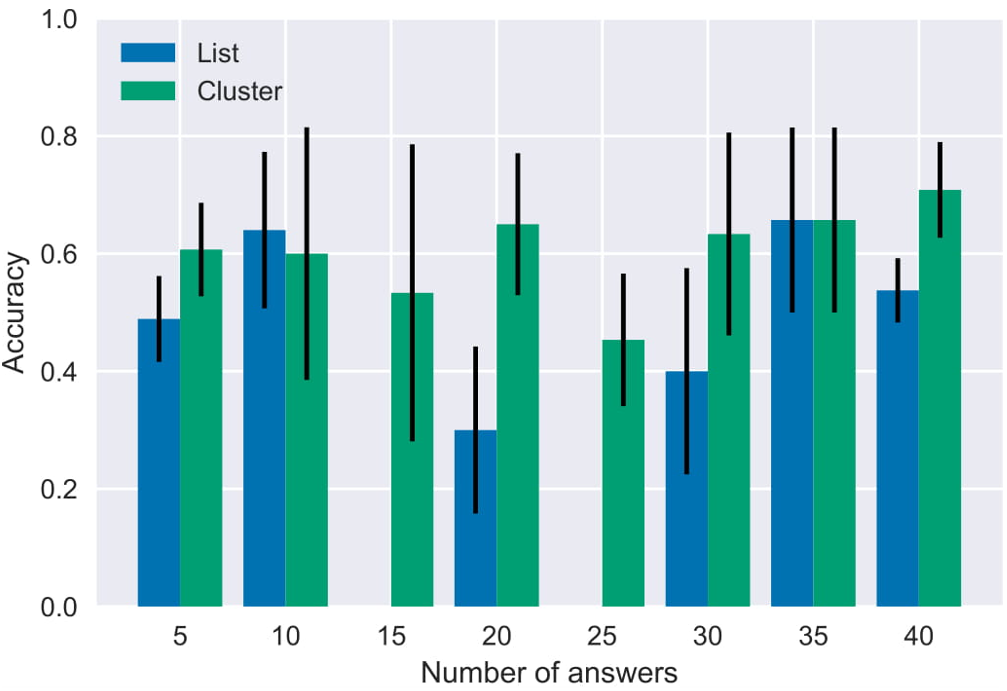
The most compelling evidence came from a "User Study." Humans were asked to look at a worker's past performance and predict where they would fail next.
- Group A (List): Saw a raw list of correct/incorrect labels.
- Group B (Cluster): Saw the model's error clusters (e.g., "This worker misses capitalized nouns").
The Result: Group B outperformed Group A by nearly 10 percentage points in prediction accuracy. This proves that the clusters aren't just mathematically sound—they are human-interpretable and "make sense."
Critical Analysis & Conclusion
Takeaway
This paper shifts the focus of crowdsourcing research from pure accuracy to actionable insights. By identifying that a specific worker struggles with "Nationality" words, a Requester can send a single targeted message that improves that worker's output across the entire remainder of the project.
Limitations
- Feature Dependency: The quality of "explanations" depends entirely on the features (POS tags, capitalization). If the error is due to a nuance not captured by these features, the model remains blind.
- Task Difficulty: The human study showed that even with clusters, predicting worker behavior is hard.
- Categorical Limits: Currently, it simplifies NER into binary classes (entity or not), which might lose nuance in multi-class entity types.
Future Outlook
This approach lays the groundwork for Interactive Crowdsourcing. Imagine a UI that automatically generates a "Training Manual" for a specific worker based on their unique error clusters. As AI moves toward more complex human-in-the-loop systems, these "explainable" bridges will become essential for maintaining data quality in high-stakes domains like medical or legal AI.