
Engagement vs. Satisfaction: The Hidden Cost of Implicit Feedback
14938_Explicit or implicit feedback engagement or satisfaction a field experiment on machine-learning-based recommender systems.
This paper presents a large-scale field experiment on MovieLens, comparing six recommendation algorithms across explicit and implicit feedback paradigms. Utilizing supervised Matrix Factorization, Contextual Bandits, and Q-Learning, the study demonstrates that while implicit feedback models significantly boost user engagement, they also increase negative interactions and browsing effort compared to explicit rating-based models.
TL;DR
In the world of Recommender Systems (RecSys), we've long assumed that more clicks equal a better model. This paper by Zhao et al. (University of Minnesota) challenges that notion through a month-long field experiment with 1,508 MovieLens users. The core finding? optimizing for implicit feedback (actions) drives massive engagement but at the cost of increased user frustration and "browsing fatigue." The solution lies in hybridizing feedback loops using Contextual Bandits.
Problem: The Accuracy-Experience Gap
For years, the industry followed the "Netflix Prize" mantra: lower RMSE (prediction error) equals a better experience. However, a model can be mathematically accurate at predicting a 4-star rating while failing to show the user what they actually want to watch right now. While the industry has shifted toward implicit feedback (clicks/plays), we haven't fully understood how this shift affects the "subjective" user experience—until now.
Methodology: From Matrix Factorization to Q-Learning
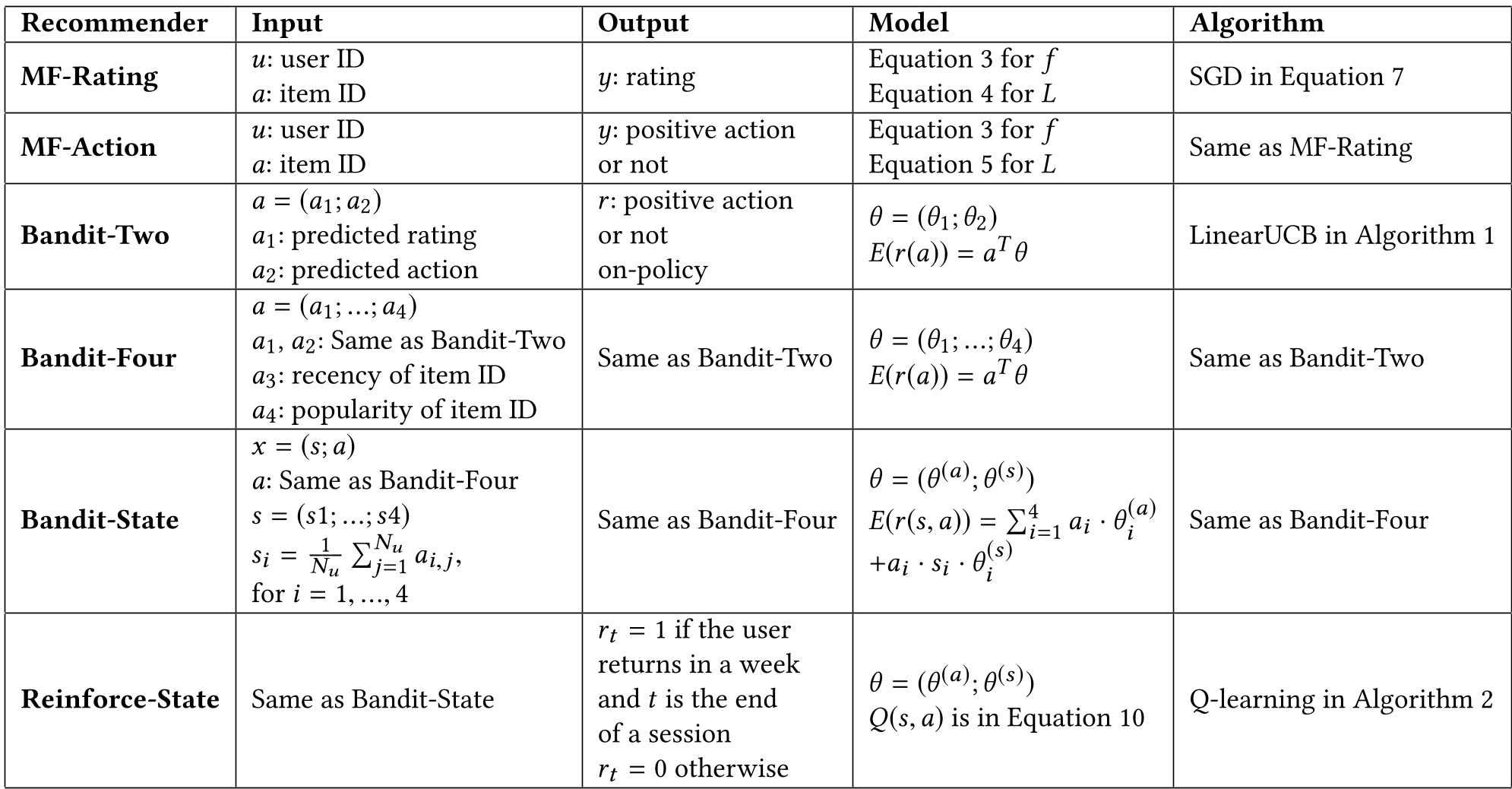
The researchers didn't just test one algorithm; they deployed a spectrum of six models to isolate the effects of feedback types and optimization objectives:
- MF-Rating (Baseline): Classical SVD optimizing for rating prediction.
- MF-Action: Optimizing for the probability of a "positive action" (clicks/wishlist).
- Bandit-Two/Four: Using LinearUCB to online-learn the weights between ratings, actions, recency, and popularity.
- Reinforce-State: A Q-Learning approach attempting to optimize for "User Return" (whether the user comes back in a week), treating the recommendation list as a state transition.
The "Action" Trap: Why Clicks Aren't Everything
The results for RQ1 (Explicit vs. Implicit) were a revelation. The MF-Action model was a powerhouse for engagement—it significantly increased front-page views and positive interactions.
However, there is a catch. The MF-Action model also significantly increased:
- Negative Engagement: Users clicked "Not Interested" or gave low ratings much more frequently.
- Browsing Effort: Users had to dig through more "explore" pages to find what they liked, a behavior negatively correlated with overall satisfaction.
The "Physical Intuition" here is that implicit feedback is noisy. A click might represent curiosity rather than preference. By optimizing for clicks, the model surfaces "clickbaity" or controversial items that the user might dislike after viewing.
Experimental Results: The Bandit Breakthrough
The most successful trade-off came from the Bandit-Two model. By blending both explicit ratings and implicit actions through an online learning algorithm, the system captured the engagement boost of implicit data while keeping "browsing effort" in check.
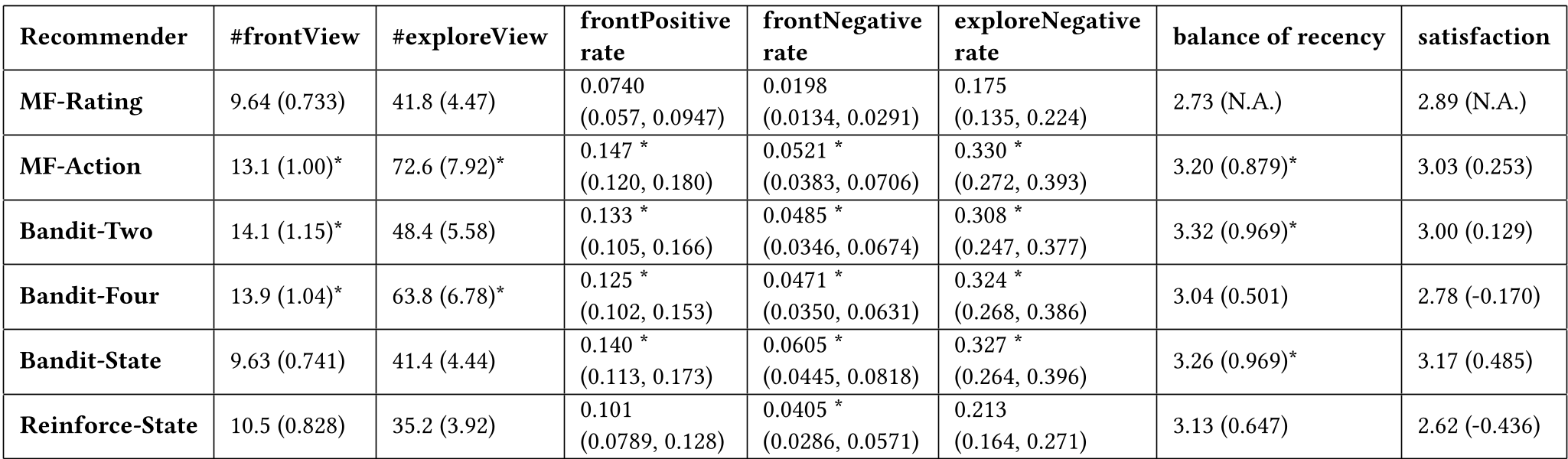
Interestingly, the Reinforce-State model (Q-Learning) struggled. While theoretically sound, optimizing for a sparse, delayed reward like "user return" proved difficult. It actually hurt perceived accuracy and attractiveness, suggesting that our current state-transition models for users are still too simplistic for complex RL.
Critical Insight & Conclusion
This paper proves that Engagement and Satisfaction are not the same thing.
- Engagement is a short-term behavioral metric (clicks, views).
- Satisfaction is a long-term perceptional metric (accuracy, attractiveness).
For practitioners, the takeaway is clear: stop optimizing for a single metric. If you only optimize for clicks, you'll eventually exhaust your users' patience. The future of RecSys lies in Contextual Bandits that can dynamically weight different feedback types—using implicit data to drive "discovery" and explicit data to ensure "trust" and "satisfaction."
Future Work
The authors suggest that linear models for user states are insufficient. The next frontier is combining Recurrent Neural Networks (RNNs) or Transformers with RL to better capture the nuance of "User State" transitions.