
Explicit, Neutral, or Implicit: Navigating the Cultural Nuances of Human-Robot Interaction
Explicit, Neutral, or Implicit: A Cross-cultural Exploration of Communication-style Preferences in Human Robot Interaction
This paper explores the impact of a robot's communication style (Implicit, Explicit, or Neutral) on user preferences across two distinct cultures: India (collectivist) and the USA (individualist). Through a crowdsourced video study involving 299 participants, the authors investigate how cultural norms influence the perceived appropriateness of social robots in various domestic roles, specifically identifying significant cultural effects in the context of elderly care.
TL;DR
As social robots enter our homes, "how" they speak matters as much as "what" they do. This study investigates whether Indian (collectivist) and American (individualist) users prefer robots that mirror their cultural communication styles. The findings reveal a complex picture: while culture significantly influences perception—especially in sensitive tasks like elderly care—a "Neutral" communication style emerges as the surprising cross-cultural favorite.
Context: Why Culture is the Next Frontier for HRI
The acceptance of social robots hinges on their ability to integrate into the delicate fabric of human social norms. A robot that is too direct might be perceived as rude in a collectivist society, whereas a robot that is too vague might be seen as inefficient in an individualist one. The researchers targeted the Indian and American populations as archetypes of these two ends of the cultural spectrum to see if robots need a "cultural UI."
The Experiment: Three Personalities, One Body
The methodology centered on a video-based study where three identical Nao robots held a discussion. The researchers cleverly mapped cultural dimensions (like Hofstede’s Power Distance) into specific linguistic behaviors:
- The Implicit Robot: Used indirect language (e.g., "Aren't they a little loud?") and showed high respect for hierarchy (not questioning a boss).
- The Explicit Robot: Used direct, honest language (e.g., "I don't like them!") and treated everyone as equals ("He is just one of us").
- The Neutral Robot: Acted as a peacemaker and avoided taking strong stances on social hierarchy or personal opinions.
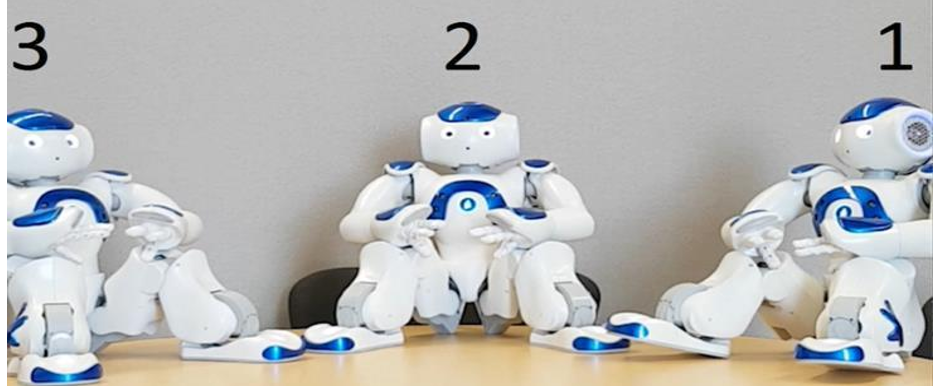 Figure 1: The experimental setup featuring three Nao robots with distinct communication styles.
Critical Insight: The "Neutral" Paradox
The study’s results provided a fascinating contradiction between qualitative feedback and quantitative choices.
Qualitatively, the design worked perfectly:
- Americans praised the Explicit robot for being "logical" and "rational."
- Indians praised the Implicit robot for being "polite," "obedient," and "respectful."
However, when it came to choosing a robot for the actual task of taking care of older adults, both groups trended toward the Neutral robot.
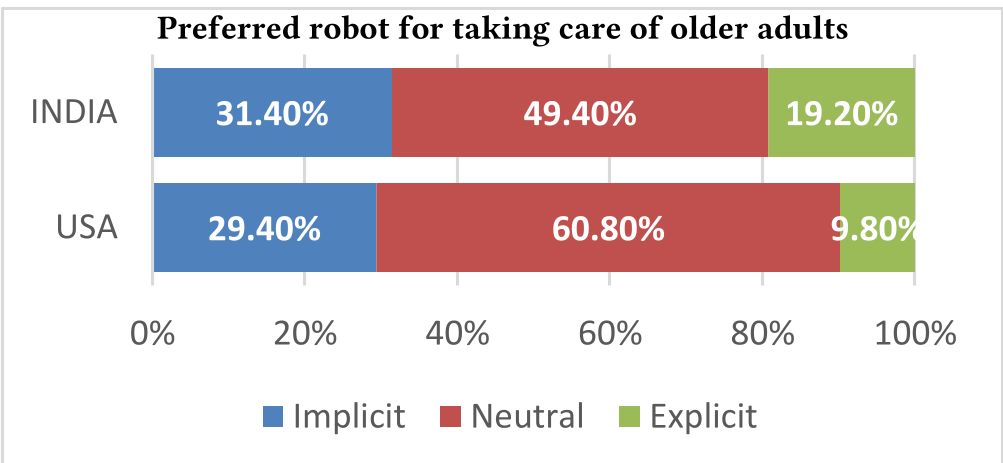 Figure 2: Percentage of preferences for elderly care. Note the dominance of the Neutral robot across both cultures.
Analysis: Why "Neutral" Wins
The dominance of the Neutral robot (as seen in Figure 2) suggests a "Safety-First" social heuristic. In both cultures, users described the neutral robot as "level-headed" or "calm." In high-stakes domestic environments—like caregiving—users may prioritize a robot that avoids conflict and displays emotional stability over one that perfectly mirrors their specific cultural communication style.
Interestingly, Indian participants were more likely to select the Explicit robot for elderly care than Americans were. This counter-intuitive finding suggests that in some collectivist contexts, the clarity and "honesty" of a robot might be valued as a functional tool, even if it contradicts traditional human social etiquette.
Conclusion and Future Outlook
This work challenges the simplistic view that robots should always "mirror" their users. Instead, it suggests a more nuanced design path:
- Baseline Neutrality: For high-trust tasks, start with a calm, balanced persona.
- Context Matters: Cultural preference shifts depending on the task (e.g., chores vs. elderly care).
- Beyond Stereotypes: Users may value specific traits (like "honesty" in an explicit robot) even if those traits aren't the primary norm in their own culture.
As we build the next generation of social AI, understanding this "Cultural Inductive Bias" will be the difference between a robot that is a helpful companion and one that is an invasive stranger.
Limitations: The study relied on video observation rather than live interaction, and the use of Amazon Mechanical Turk may introduce demographic biases within the Indian and American samples. Future research should explore long-term interactions to see if these initial preferences hold over time.