
POST: Mastering Dynamic Sociality for High-Efficiency Mobile Advertising in Vehicular Networks
POST: Exploiting Dynamic Sociality for Mobile Advertising in Vehicular Networks
The paper introduces POST, an innovative mobile advertising scheme for vehicular networks that maximizes advertisement coverage by selecting optimal "seed" vehicles. POST leverages Markov chains to predict the highly dynamic yet temporally correlated social centrality of vehicles based on large-scale real-world traces.
TL;DR
Vehicular networks are the new frontier for mobile advertising, yet their extreme mobility makes picking the right "influencer" vehicles a logistical nightmare. POST (Predicting and Exploiting Dynamic Sociality) is a novel framework that uses Markov chains to predict which vehicles will become "hubs" in the near future. By moving beyond static models, it achieves a 64% improvement in advertising coverage compared to existing methods.
Background: Why Mobile Advertising is a Moving Target
In an urban vehicular network, a few "seed" vehicles (like taxis or buses) are paid to spread digital ads to every car they encounter via V22 (Vehicle-to-Vehicle) communication. The goal is simple: maximize coverage within a limited budget.
However, the execution is remarkably difficult because:
- Topology Volatility: Connections last seconds, and the "most important" vehicle at 8:00 AM might be isolated by 8:30 AM.
- NP-Hardness: Even with perfect future knowledge, selecting the optimal k-seeds is a variation of the Maximum Cover problem, which is computationally expensive.
- Static Logic Failures: Traditional social network analysis assumes stable relationships. In a city, "sociality" is opportunistic and fleeting.
The Insight: Vehicular Sociality has "Memory"
The authors analyzed massive GPS datasets from Shanghai and Shenzhen. They discovered two breakthrough patterns:
- Dynamic Sociality: A vehicle's centrality (how many others it meets) fluctuates wildly, but follows a daily rhythm.
- Temporal Correlations: Knowing a vehicle's contact history significantly reduces the uncertainty of its future contacts. Entropy analysis proved that vehicular sociality is highly predictable using historical patterns.
Methodology: The POST Framework
The POST scheme operates through a three-stage pipeline:
1. Capturing Correlations
The system segments time into slots and builds contact graphs. It specifically tracks Degree Centrality (popularity) and Coreness Centrality (depth in the network).
2. Inferring the Future with Markov Chains
Instead of assuming today is like yesterday, POST uses a kth-order Markov Chain to estimate the expected centrality of each vehicle for the next time slot.
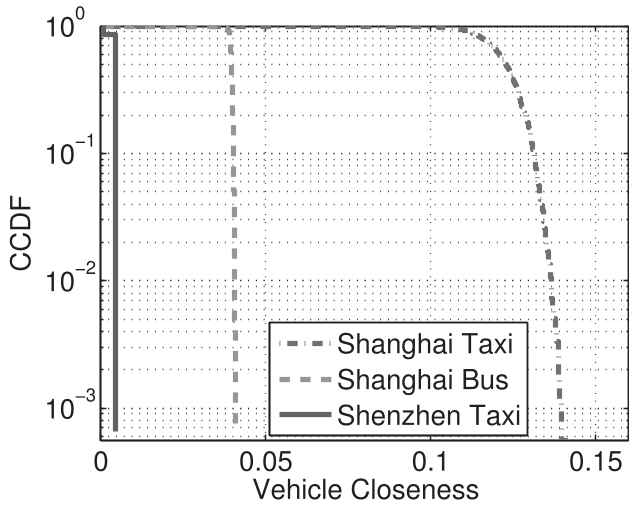 Figure 1: Comparison of different centrality metrics (Degree, Coreness, Closeness) across datasets.
3. Smart Seed Selection
POST provides two strategies for hiring vehicles:
- Straight Strategy: Simply pick the top-ranked vehicles based on predicted centrality. This is great for "Ad Intensity" (making sure the same car sees the ad multiple times).
- Exclusive Strategy: This is the secret sauce. It picks a top vehicle, then removes other candidates that move in similar social circles (using Euclidean distance of contact vectors). This prevents "clustering" and forces the ad to spread to different city sectors.
Experimental Results
The authors tested POST against "Static" heuristics (the current SOTA) and "Random" selection across three real-world datasets.
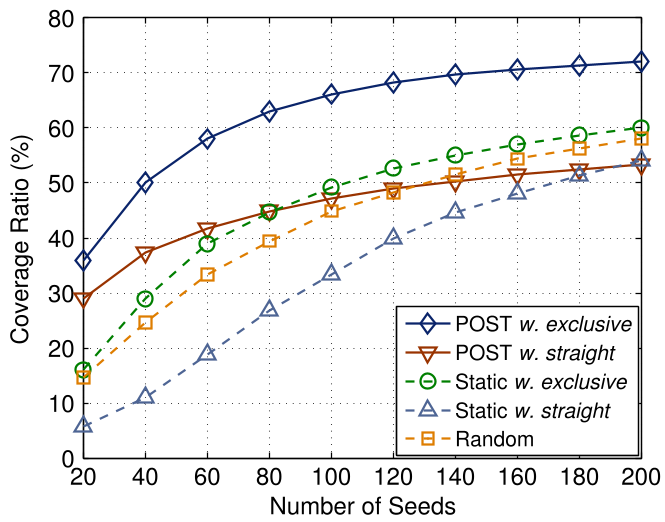 Figure 2: Coverage ratio vs. Number of seeds. POST (Exclusive) consistently dominates the field.
Key Findings:
- Massive Gains: POST averaged a 64% improvement in coverage.
- Seed Efficiency: Recruiting just 20 "POST-selected" seeds achieved 40% network coverage, whereas other methods required nearly double that number for the same result.
- Scalability: While the advantage of POST narrows as the time window grows (since dynamics average out), it remains the superior choice for time-critical announcements (e.g., hazard warnings or flash sales).
Critical Insight: The Intensity vs. Coverage Tradeoff
A fascinating takeaway from the research is the distinction between Coverage and Impact.
- If you want everyone to see the ad once, use the Exclusive heuristic to spread seeds apart.
- If you want a specific group to remember the ad through repetition (high impact), use the Straight heuristic, which allows for natural overlap in high-traffic zones.
Conclusion and Future Outlook
POST proves that the "chaos" of urban traffic is actually a structured series of temporal patterns. By shifting from reactive to predictive seed selection, advertisers can significantly lower costs while increasing reach.
Future research could extend this by incorporating Content-Awareness—matching the ad's subject to the specific communities a vehicle is predicted to visit. As we move toward autonomous fleets, the ability to "program" the sociality of a network for info-dissemination will become a cornerstone of ITS (Intelligent Transportation Systems).